
Gulf Coast CRE Market Update - May 2026
Introduction
Commercial real estate conditions across the Gulf Coast continue to shift as markets move out of the post-pandemic expansion phase. Recent data shows rising vacancy in select office and industrial markets, while rent growth remains positive but has slowed. These changes are being driven primarily by new supply and softer absorption, rather than a broad decline in demand. Market performance is increasingly uneven, with smaller markets remaining constrained and larger markets showing more variability. This edition focuses on five core metrics to provide a clear, comparable view across key Gulf Coast markets.
Vacancy Rate
Commercial real estate vacancy rates across Gulf Coast markets remain relatively stable overall, though conditions vary significantly by city and asset type. Office and industrial vacancy has increased in several larger markets, while retail continues to show tighter fundamentals across most Gulf Coast metros. The chart below compares current office, industrial, and retail vacancy rates across Mobile, Pensacola, Panama City, Tallahassee, Ft. Walton Beach, and Jacksonville as of May 2026.
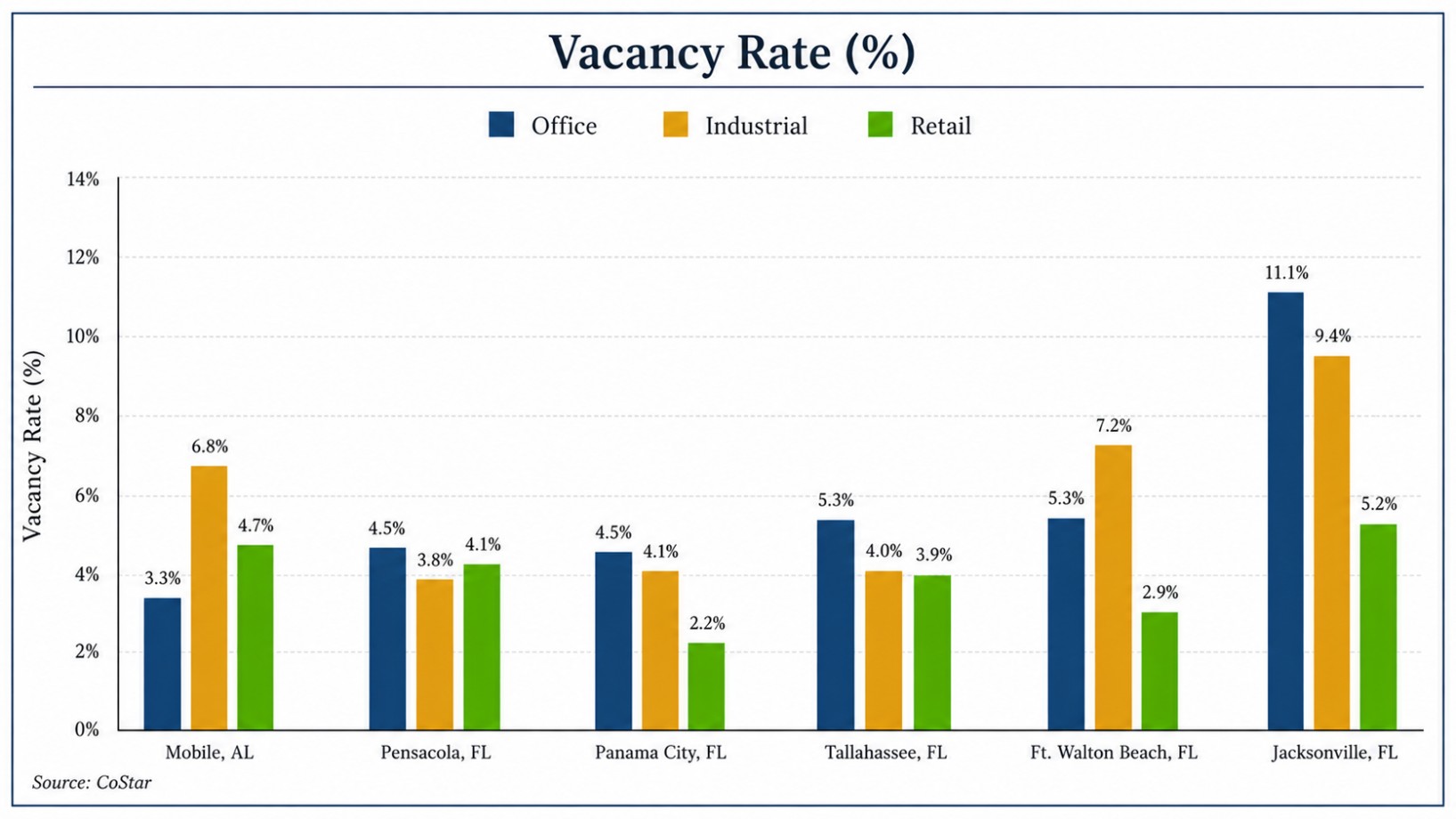
- Vacancy remains low across most smaller Gulf Coast markets, particularly in office and retail
- Jacksonville is the primary outlier, with materially higher vacancy in both office and industrial
- Retail continues to show the tightest conditions across all markets
- Vacancy increases are present but remain moderate outside of larger metros
Net Absorption
Net absorption trends across Gulf Coast commercial real estate markets indicate softer tenant demand in several sectors, particularly office and retail. Industrial performance remains more mixed, with some markets continuing to absorb newly delivered space despite rising vacancy. The data below highlights 12-month net absorption across major Gulf Coast office, industrial, and retail markets to help identify where occupancy demand is strengthening or weakening.
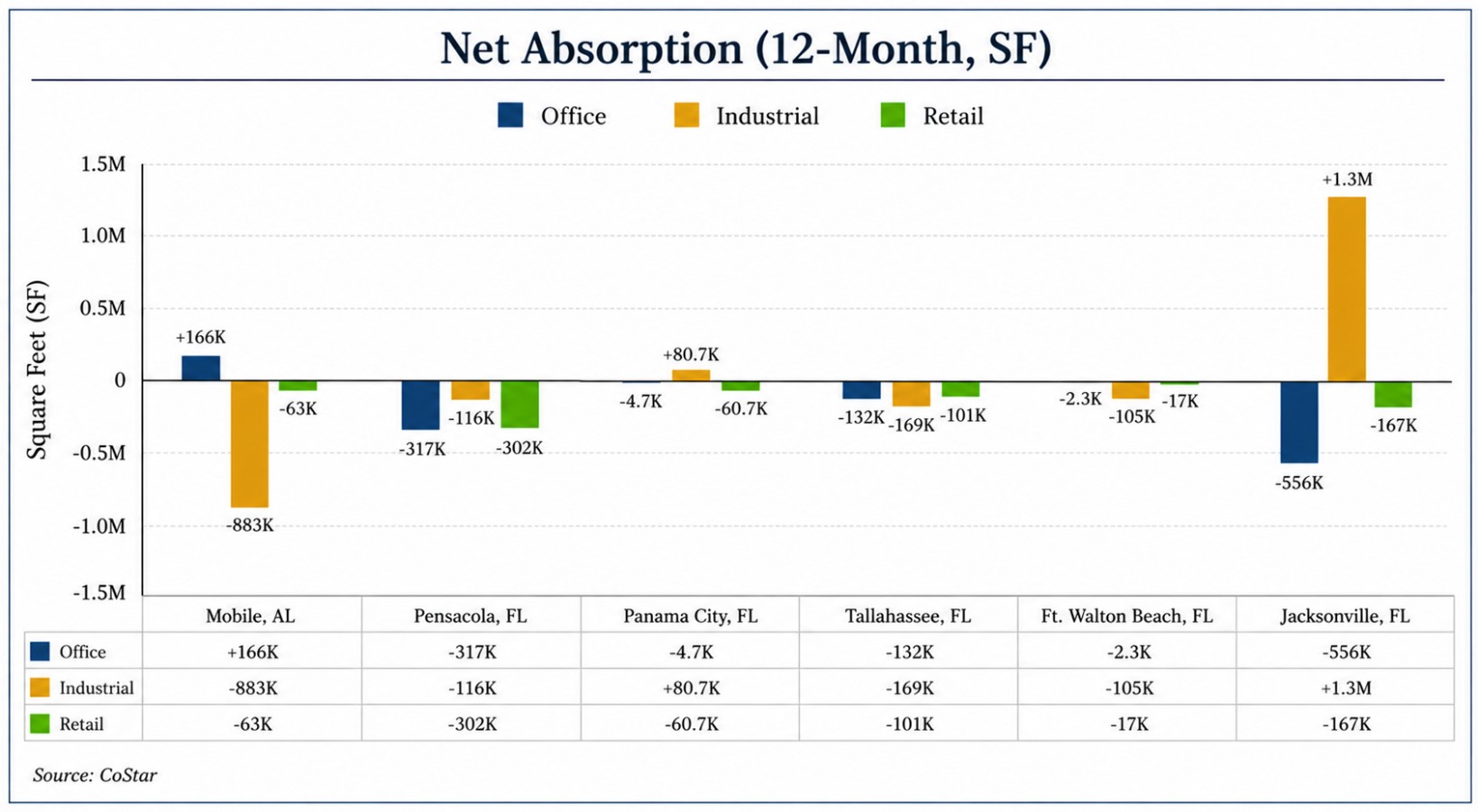
- Office and retail sectors show consistent negative absorption across multiple markets
- Jacksonville office and Pensacola retail are among the largest declines
- Industrial demand is mixed, with Jacksonville showing strong absorption despite rising vacancy
- Absorption trends indicate softening demand in several markets
Market Asking Rent
Commercial real estate asking rents across Gulf Coast markets remain relatively stable, though pricing varies meaningfully by asset class and geography. The chart below compares current market asking rents for office, industrial, and retail properties across Mobile, Pensacola, Panama City, Tallahassee, Fort Walton Beach, and Jacksonville. Office properties continue to command the highest rents in most markets, while industrial rents remain the lowest despite strong long-term demand trends. Retail rents remain competitive, particularly in larger and higher-growth markets where consumer activity and population growth continue to support leasing demand.
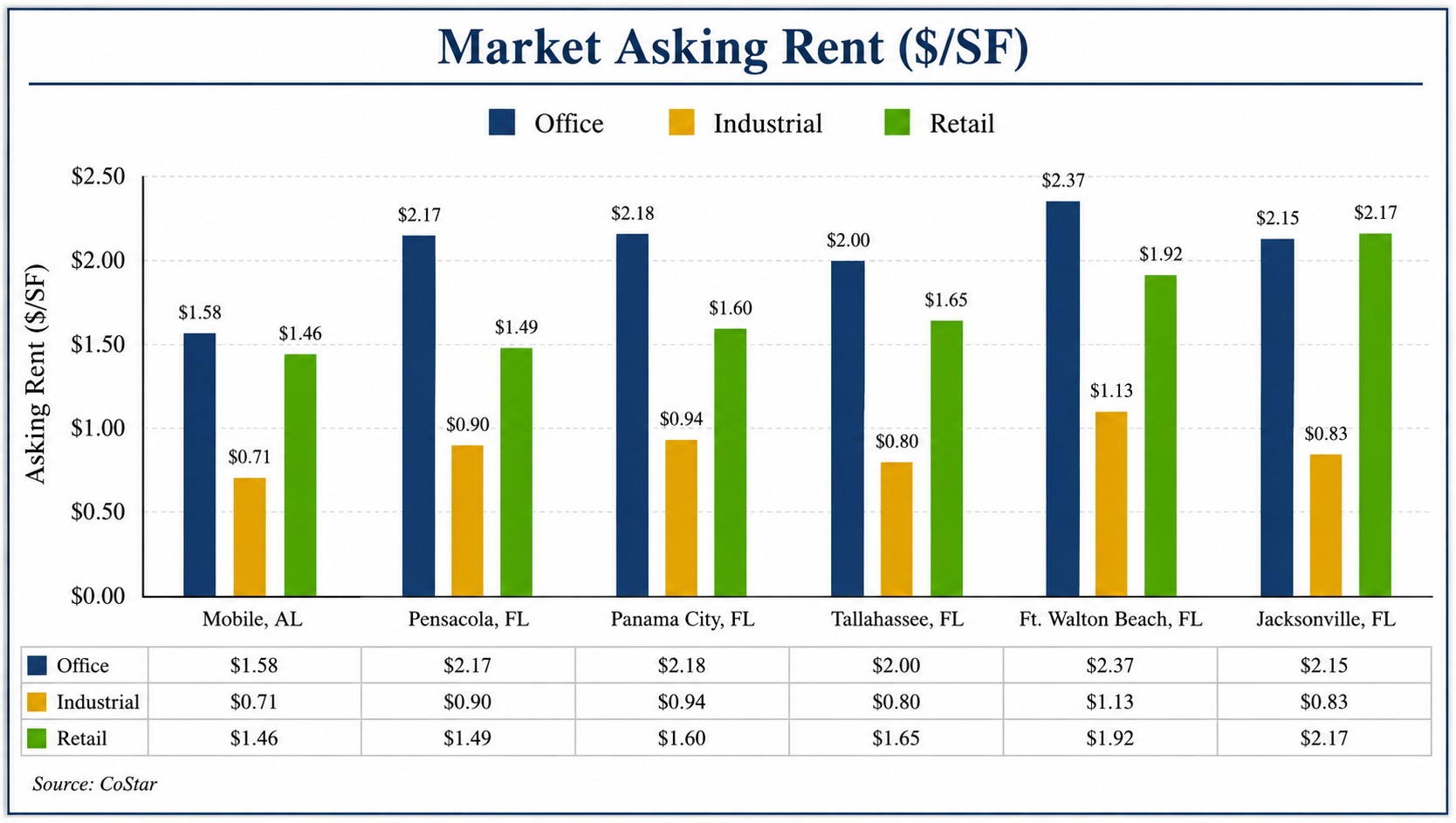
- Office rents remain the highest across all markets, led by Fort Walton Beach at $2.37/SF
- Retail rents are strongest in Jacksonville ($2.17/SF) and Fort Walton Beach ($1.92/SF), reflecting continued tenant demand
- Industrial rents remain the lowest across the region, ranging from $0.71/SF to $1.13/SF
- Rent levels are relatively consistent across Gulf Coast markets, indicating stable pricing conditions despite varying market fundamentals
Estimated Cap Rate
Commercial real estate cap rates across Gulf Coast markets continue to reflect differences in asset quality, market liquidity, lease structure, and local supply-demand conditions. Larger markets typically support lower cap rates for stabilized assets, while smaller markets often trade at higher yields due to lower transaction volume and perceived risk. The chart below outlines estimated cap rate ranges for office, industrial, and retail assets across key Gulf Coast markets based on observed transaction trends and current market conditions.
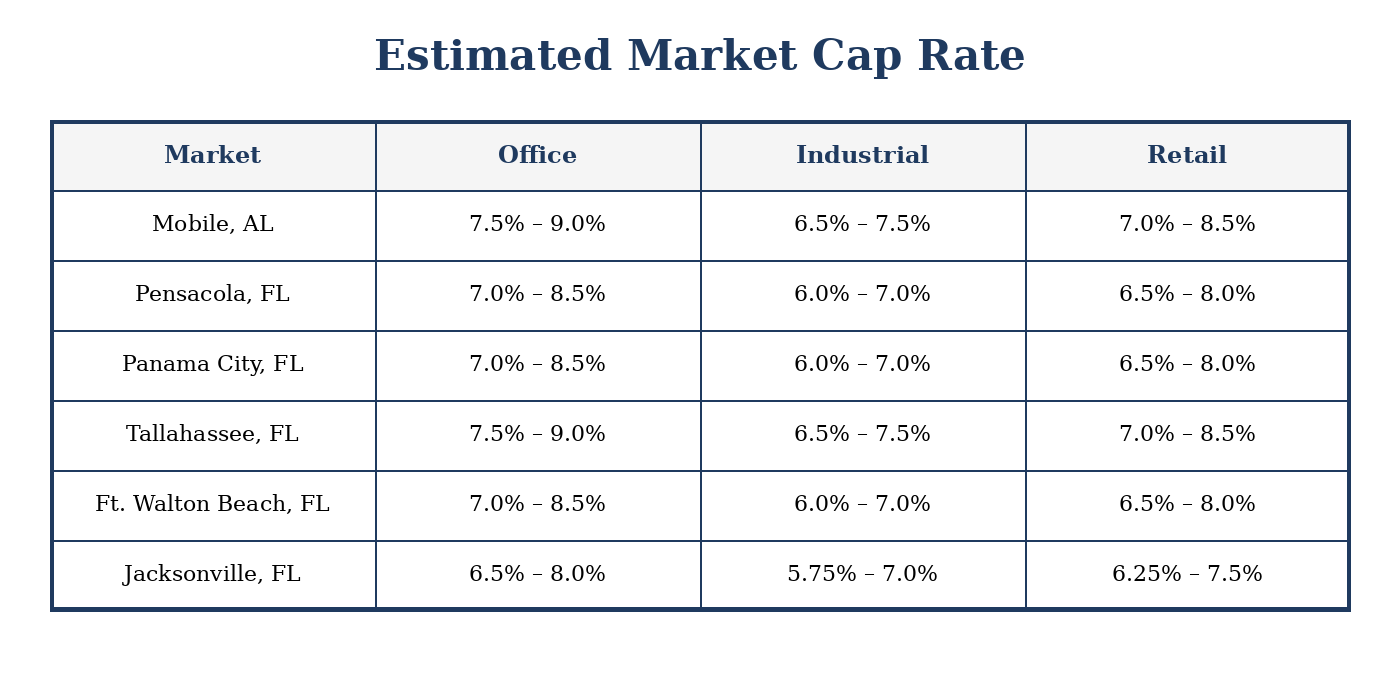
- Cap rates vary significantly by asset quality, lease structure, and submarket
- Larger markets such as Jacksonville generally show lower yields for stabilized assets
- Smaller markets tend to trade at higher cap rates, reflecting lower liquidity
- Pricing pressure may increase in markets with rising vacancy and slowing rent growth
Note: Cap rates are estimated based on transaction trends. Source reports do not provide a single market cap rate.
Contact Gulf Coast Property Group for a no-obligation consultation: (850) 203-5788