CRE Market Update: Multifamily, Retail & Industrial Trends
🍵 Good Morning!
Commercial real estate never stays still for long, and this week is bringing plenty of movement across the market. Apartment rents are showing signs of recovery, retail centers are rethinking their tenant mix, office lenders are looking beyond trophy buildings, and Northwest Florida's industrial sector continues to benefit from tight supply and strong demand.
From shifting consumer habits to evolving financing strategies, the industry is adapting to a new set of market conditions. Whether you're watching multifamily fundamentals, tracking retail trends, or scouting opportunities in industrial real estate, there's plenty to keep on your radar.
Grab your coffee and settle in—we're breaking down the latest developments shaping commercial real estate and the trends worth watching. 🍵
Multifamily Rents: The Apartment Market Is Finally Catching Its Breath
📈 Rent Growth Is Back. Well, Sort Of.
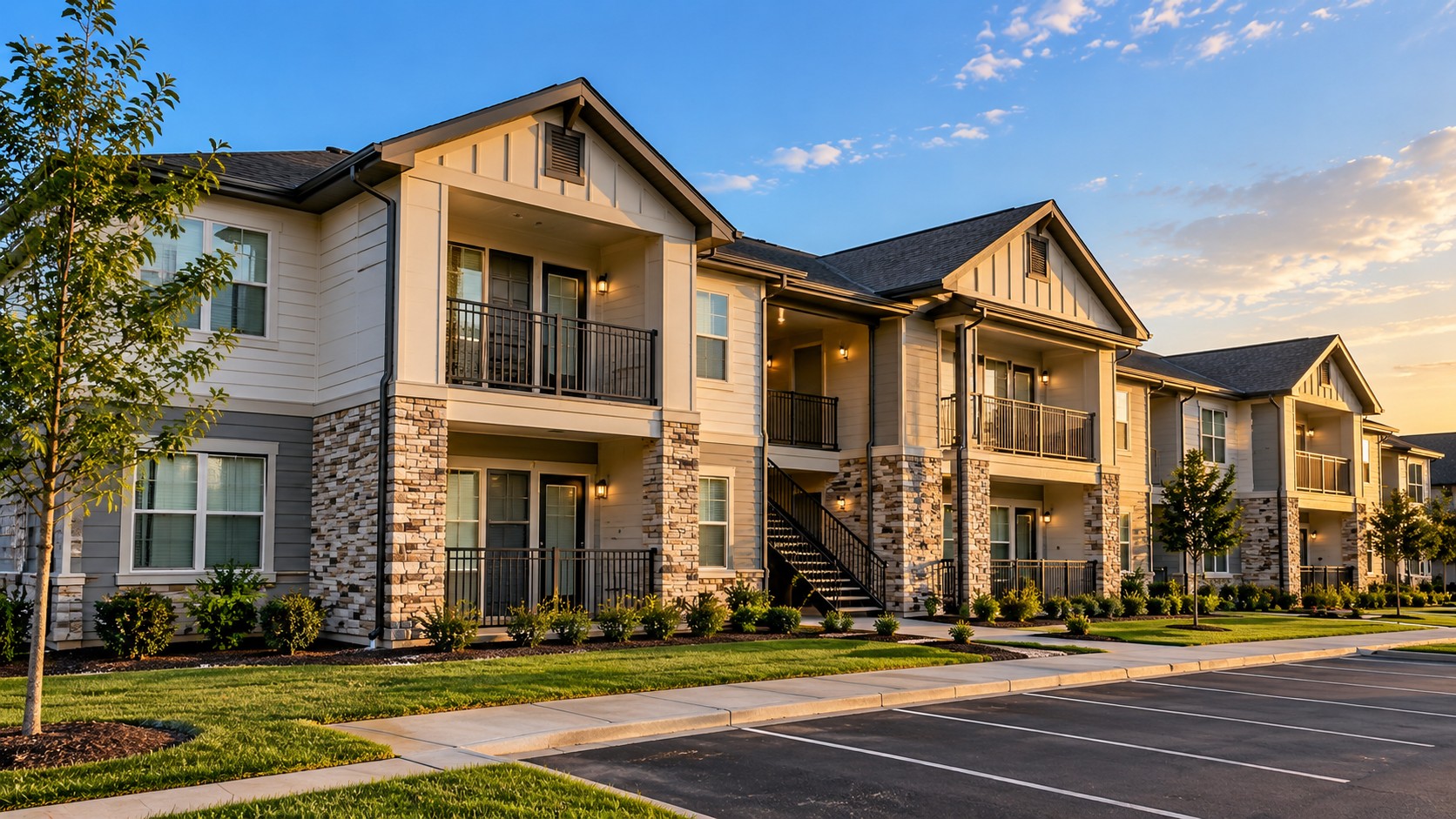
U.S. multifamily rents are showing signs of life—but don't break out the champagne just yet. Advertised rents dipped $1 in September to $1,775, while annual growth ticked up to 0.7%. The bigger headline? Q3 rents rose 0.3%, marking the first third-quarter increase since 2022. After a prolonged supply-driven slog, multifamily may finally be finding its footing.
🏙️ The Market Is Getting Less Divided
The recovery isn't exactly a group project, but more markets are joining in. San Francisco led annual rent growth at 7%, followed by New York City at 3.8% and Chicago at 3.2%. Meanwhile, Austin fell 2.5%, Houston dropped 2%, and Tampa slid 1.4%. Still, the gap between stronger and weaker markets is narrowing—a potential sign that the market is rebalancing.
| City | Annual Rent Growth |
|---|---|
| San Francisco | 7% |
| New York City | 3.8% |
| Chicago | 3.2% |
| Austin | -2.5% |
| Houston | -2% |
| Tampa | -1.4% |
🔑 Renewals Lose Their Superpower
Renewal rent growth has slowed to 1.7%, its lowest level since before the pandemic, as existing leases catch up with advertised rents. On the brighter side, total occupancy has risen 50 basis points since January, suggesting new apartments are gradually getting absorbed.
The Q4 Plot Twist
There's a catch: financing costs remain a heavyweight. With the 10-year Treasury yield above 5%, refinancing gets pricier and transactions face more pressure. Historically, rents have fallen an average of $7 in Q4 over the past four years.
Fort Walton Beach Multifamily: Investors Still Want In—They're Just Not Buying Yet
💰 A $22 Million Market in a $127 Million World
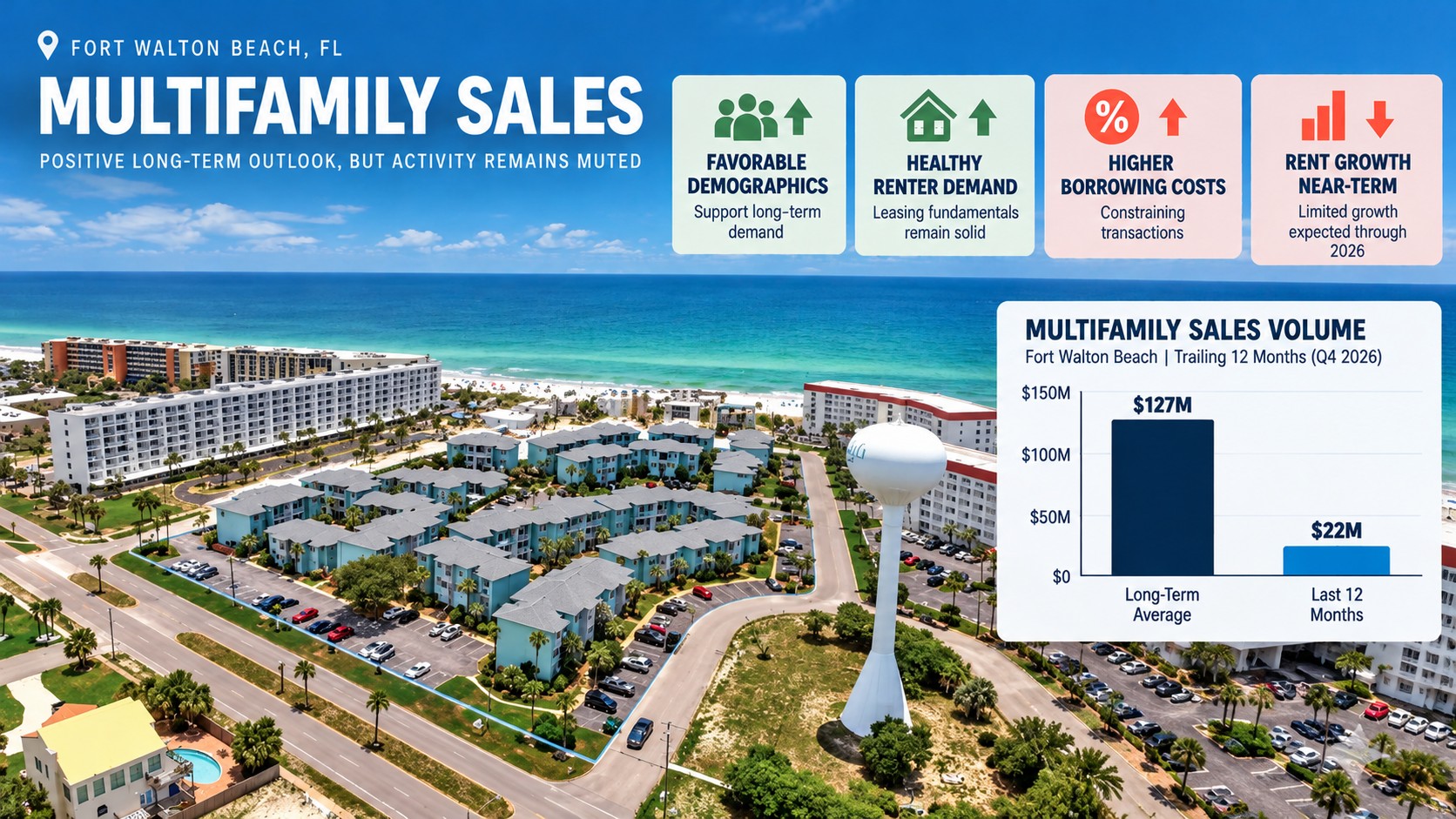
Fort Walton Beach's multifamily market has a classic real estate dilemma: the long-term story looks good, but today's numbers aren't making deals easy. Investor sentiment remains positive, thanks to favorable demographics and healthy renter demand. Yet over the past 12 months, multifamily sales volume totaled just $22 million—well below the market's long-term average of roughly $127 million.
That's a whole lot of dry powder sitting on the sidelines.
🏢 Fundamentals Are Fine. Financing? Not So Much.
Higher borrowing costs and softer rent growth are forcing investors to sharpen their pencils. Instead of betting on rapid appreciation, buyers are prioritizing durable cash flow and taking a harder look at operating expenses, lease-up risk, and capital improvement needs.
Renter demand remains healthy, although it has cooled from the market's earlier growth phase. With limited rent growth expected through 2026, sellers have less pricing power—and fewer properties can deliver the returns buyers currently demand.
🕵️ Private Capital Takes the Wheel
Recent acquisitions have been driven exclusively by private investors and owner-users, reflecting a broader pattern across smaller Florida markets. Institutional-style enthusiasm may be on pause, but selective buyers are still scouting opportunities.
🚀 What Could Unlock the Market?
The next potential catalyst is rent growth. If annual gains return to the 2%–3% range over the next year, stronger income expectations could help rebuild investor confidence and bring more transactions across the finish line.
The bottom line: Fort Walton Beach isn't necessarily a broken market; it's a market waiting for the numbers to cooperate. Until financing becomes more manageable and income growth strengthens, expect buyers to stay selective, underwriting to stay conservative, and deal volume to remain on a short leash.
Retail Centers Get a Makeover: Services In, Apparel Anchors Out
🏢 The Old Retail Playbook Is Officially Out of Style
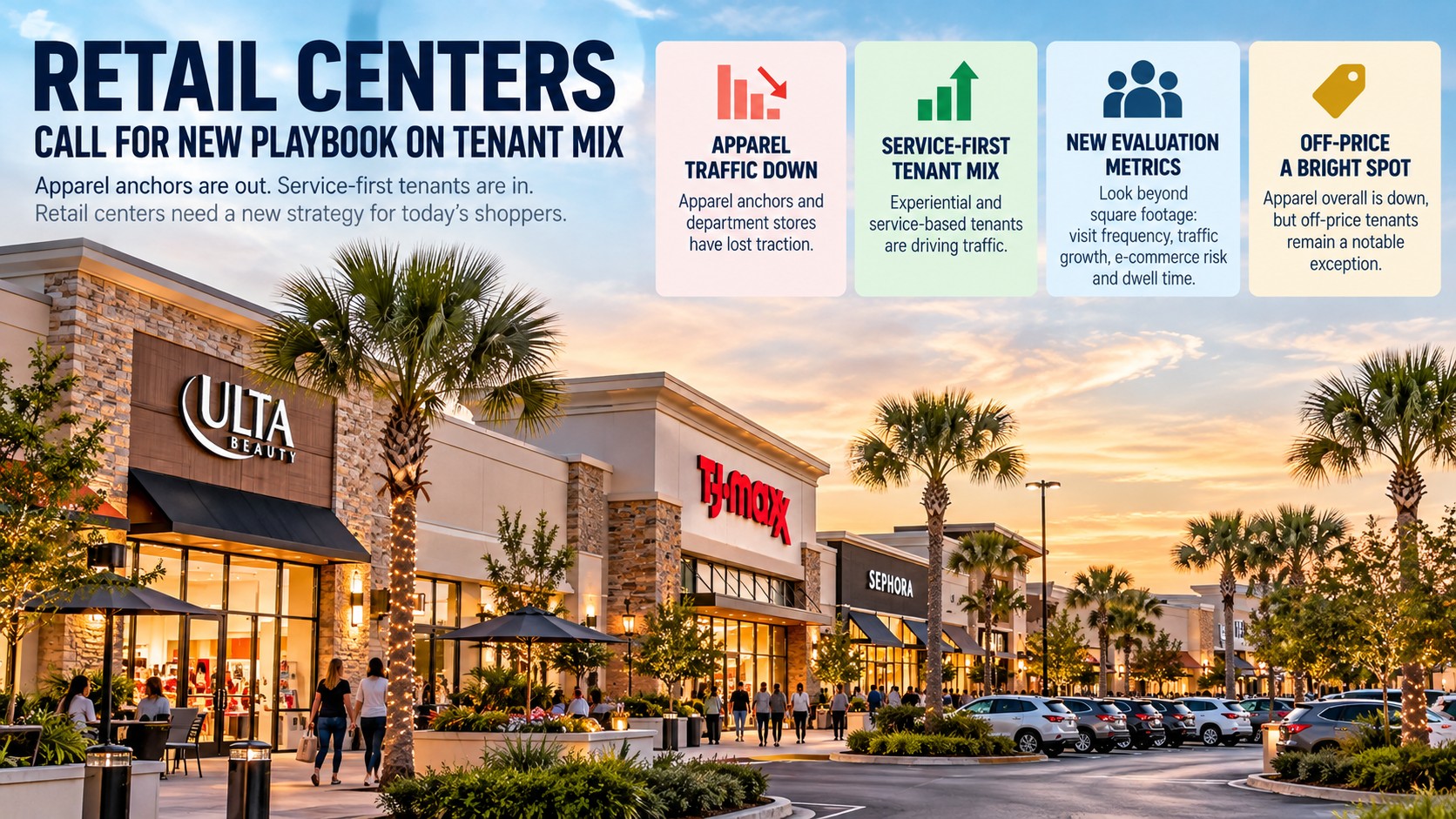
Retail landlords, it's time for a wardrobe change. According to a new white paper from Placer.ai, the tenant mix that worked for neighborhood and lifestyle centers five years ago is losing its edge. Traditional apparel anchors and department stores are giving way to a more service-oriented lineup designed around how people shop—and spend—their time today.
Apparel Loses Its Anchor Status
Clothing retailers have long been the heavy hitters of shopping centers, drawing visitors who might also grab lunch or browse neighboring stores. But that formula is becoming less reliable as shopping habits evolve and e-commerce keeps pressure on traditional retail.
There's one notable exception, though: off-price retailers are holding their ground. Discount-driven stores remain a bright spot in an apparel category that has otherwise struggled to maintain its historic anchor role.
🧹 Services Are the New Storefront Stars
The next generation of successful retail centers will look less like a row of clothing stores and more like an ecosystem of services, experiences, and everyday destinations. Different centers will need different tenant strategies, with lifestyle centers and neighborhood centers each developing their own winning mix.
📊 Forget Square Footage. Follow the Foot Traffic.
Placer.ai says landlords should rethink how they evaluate prospective tenants. Instead of focusing primarily on store size or traditional anchor status, owners should consider four key metrics:
- Visit frequency: How often do customers return?
- Traffic growth: Is the tenant attracting more visitors?
- E-commerce risk: How vulnerable is the business to online competition?
- Dwell time: How long do visitors stick around?
The bottom line: Retail real estate is shifting from a game of filling space to a game of generating visits. Landlords who build the right mix of services, experiences, and resilient value retailers may be better positioned to keep their centers relevant—and their parking lots busy.
Office Lending Is Back—but Lenders Still Want to See the Receipts
💰 CMBS Lenders Expand Their Horizons
Office real estate financing is getting a little less exclusive. Commercial mortgage-backed securities (CMBS) lenders are looking beyond shiny trophy towers to older buildings and suburban office portfolios. But before anyone declares an office-market comeback, there's a catch: lenders are expanding their guest lists, not loosening their belts.
According to Trepp, office properties secured $22 billion of the $103 billion in loans securitized so far in 2026. Yet lenders are keeping leverage in check, with a median loan-to-value ratio (LTV) of 63.2% and a median debt yield of 12.72%.
🏢 A 116-Year-Old Building Makes the Cut
Take 215 Park Ave. South in Manhattan. The 116-year-old building secured a $108 million loan after $3.5 million in upgrades over five years. With nearly 90% occupancy and a $216 million appraisal, the loan represents just 50% of the property's value.
Translation: Old doesn't automatically mean unfinanceable—especially when the income holds up.
🩺 Medical Offices Bring Staying Power
On Long Island, a $280 million loan backed 14 medical and suburban office properties totaling 1.51 million square feet. Medical tenants generate more than 60% of rental income, and the portfolio carries a 5.3-year weighted-average lease term.
Why does that matter? Medical practices can be costly to relocate, potentially supporting tenant retention and more predictable cash flow.
📊 The New Lending Equation
Most office loans in Trepp's analysis had LTVs between 50% and 74.99%. Even deals near the upper end can make sense when income, lease duration, and tenant quality support the risk.
The bottom line: Office financing isn't reserved for trophy buildings anymore. But lenders want convincing cash flow, durable tenants, and enough equity cushion to protect against downside. In today's market, the building's balance sheet matters as much as its bragging rights.
Northwest Florida Industrial: Tight Space, Strong Demand, Selective Opportunity
📦 Industrial Real Estate Is Playing a Different Game
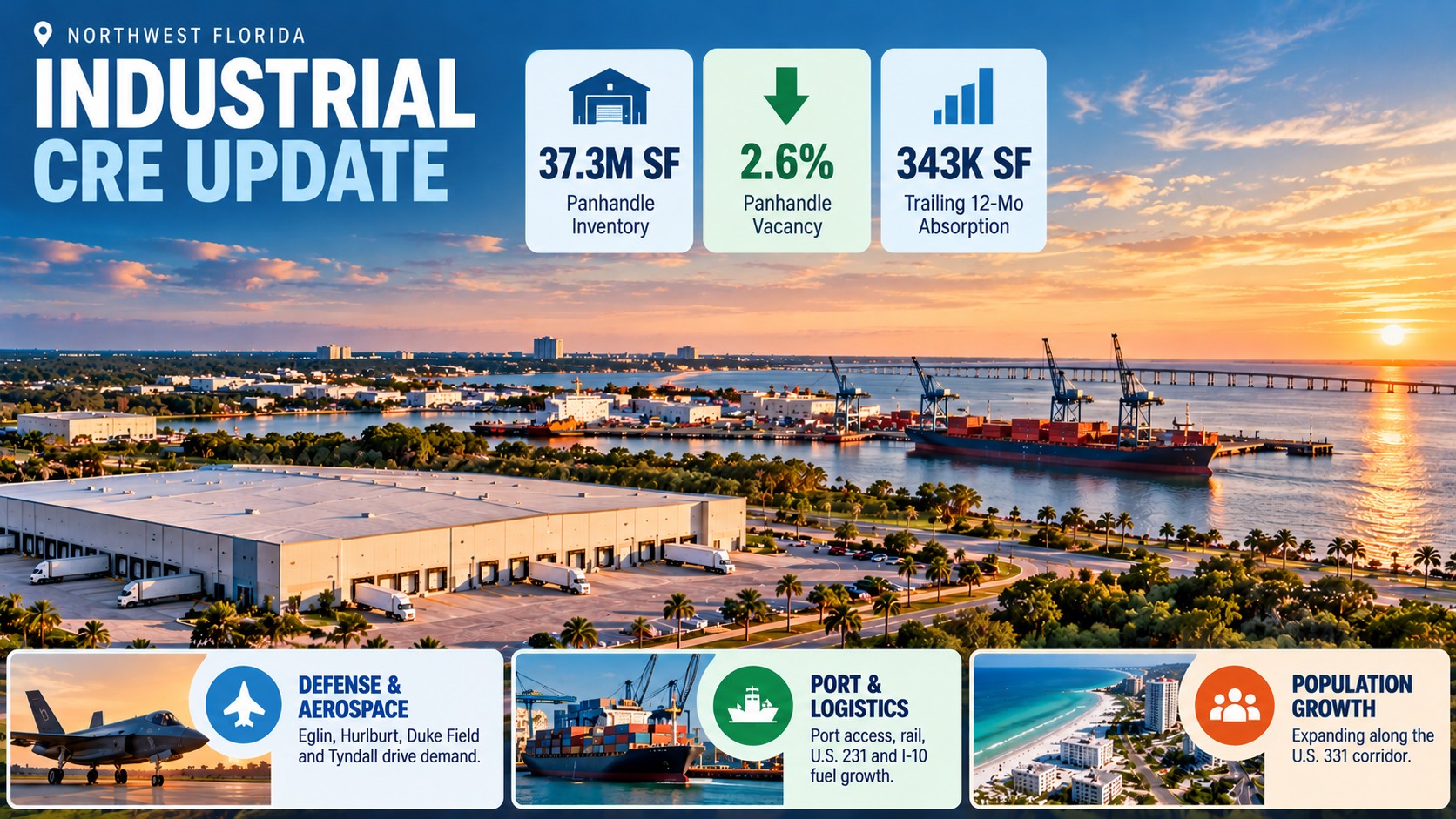
Northwest Florida's industrial market is running short on room—and that's good news for landlords with the right properties. CBRE reports 37.3 million square feet of Panhandle industrial inventory and just 2.6% vacancy, pointing to a market where functional warehouse and distribution space remains in short supply.
The Central Panhandle is even tighter, with vacancy at 1.6%. In other words, finding the right industrial building could be harder than finding a parking spot at a busy beach on a holiday weekend.
🚢 Panama City Is Leading the Charge
Panama City stands out as the region's demand engine. The market recorded 373,375 square feet of trailing 12-month absorption, with vacancy at just 0.9%. Port access, rail connections, highway infrastructure, and defense-related activity help support demand for warehouse, logistics, and distribution space.
Across the broader Central Panhandle, trailing absorption reached 433,397 square feet. Average asking rent was $10.28 per square foot annually on a triple-net (NNN) basis.
✈️ Defense, Logistics, and Growth Keep Demand Moving
The region benefits from several durable demand drivers:
- Defense and aerospace: Eglin, Hurlburt, Duke Field, and Tyndall support military and contractor activity.
- Port and logistics: Port Panama City and connections to rail, U.S. 231, and I-10 support distribution and freight movement.
- Population growth: Growth along the U.S. 331 corridor is creating opportunities for service-oriented industrial users and last-mile distribution.
🏗️ New Supply Has to Earn Its Place
Modern logistics developments, including Emerald Coast Logistics Center in DeFuniak Springs, offer higher-clearance space for users with more demanding distribution needs. But available space at new developments is a reminder that even a supply-constrained market requires careful project-level underwriting.
The bottom line: Northwest Florida offers a compelling industrial story, particularly in Panama City and the Central Panhandle. Small-bay warehouses, functional flex properties, and defense- or port-adjacent assets look well positioned to benefit—but investors still need to evaluate location, building specifications, tenant demand, and competing supply before jumping in.
Overall Takeaway
Real estate rewards those who know where to look. This week's headlines highlight four very different opportunities: apartment rents are finding their footing, retail centers are reinventing themselves, office financing is reaching beyond trophy assets, and Northwest Florida's industrial market is benefiting from scarce space. Each sector has its own challenges, but the bigger story is that opportunity isn't disappearing—it's becoming more specific. For investors and operators, the next win may come from spotting the right property, tenant, or submarket before everyone else catches on.
Which sector do you think holds the biggest opportunity right now—multifamily, retail, office, or industrial? We'd love to hear what you're seeing in your market.
Considering your next commercial real estate move? Gulf Coast Property Group helps owners and investors navigate today's market. Contact us at (850) 203-5788 or learn more about our investment partnerships.
Prepared by Gulf Coast Property Group