CRE Pulse: Multifamily, Office & Retail Market Insights
🥤 Good Morning!
Commercial real estate continues to send mixed signals, but there are opportunities for those paying attention to where the market is heading.
This week, we're looking at four trends shaping the industry: multifamily owners facing refinancing deadlines before rents fully recover, industrial developers navigating growing entitlement challenges, an office market showing signs of improvement, and Walmart finding new ways to turn its physical stores into a competitive advantage.
We're also taking a closer look at Ft. Walton Beach retail, where property sales activity and transaction volume are running ahead of historical averages.
The common thread? The fundamentals are changing, and understanding what's driving those changes matters more than ever. From financing costs and development timelines to tenant demand and how real estate is being used, today's decisions require a closer look at both the opportunities and the risks.
Multifamily Real Estate: The Rent Recovery vs. Refinancing Race
📉 Apartment Owners Are Running Out of Time
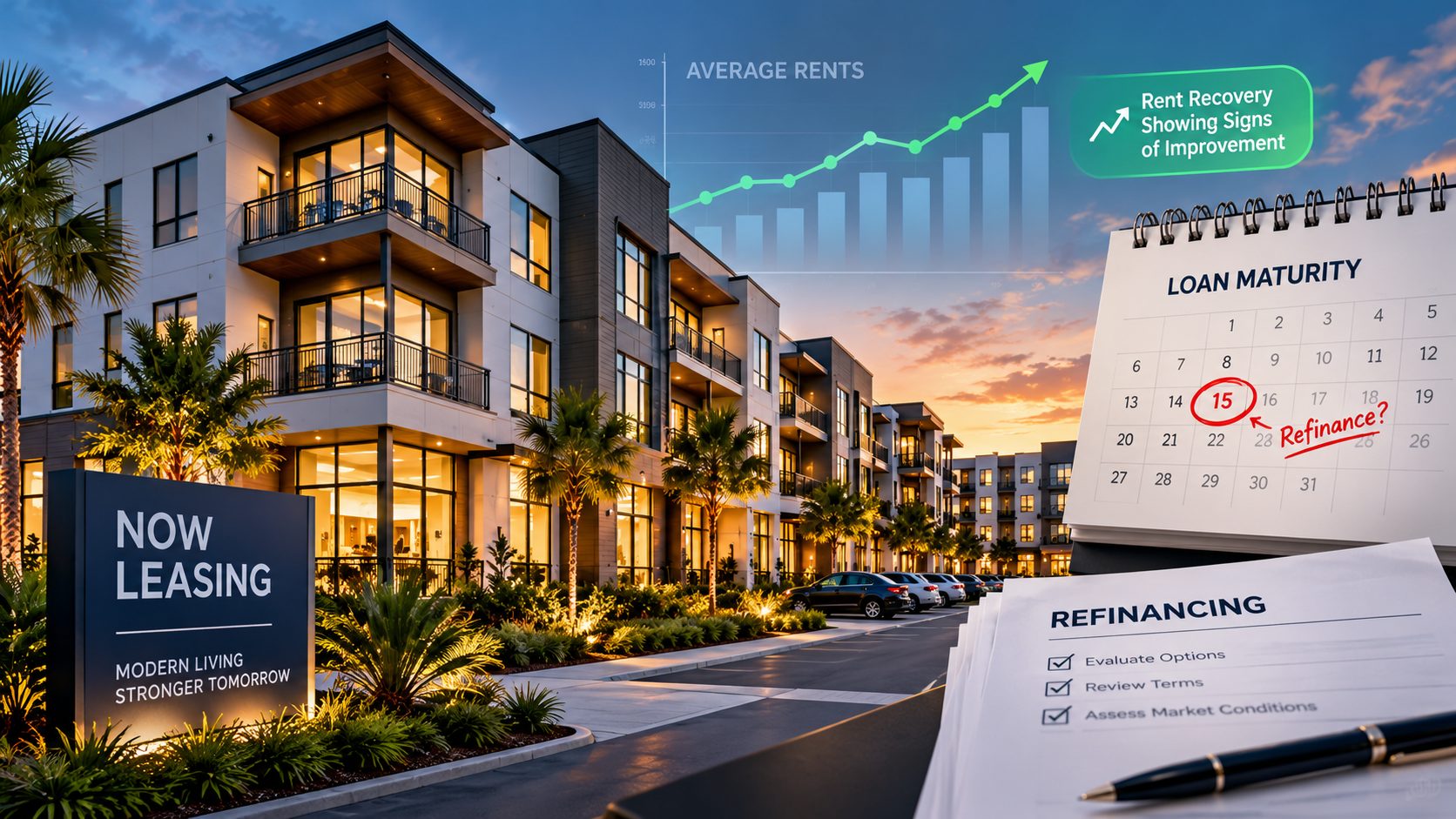
The multifamily market has a classic real estate problem: the rent recovery is taking its sweet time, but the debt clock isn't waiting.
According to Institutional Property Advisors' Q3 market report, apartment owners are facing a growing mismatch between sluggish income growth and looming refinancing deadlines. Translation? Some landlords may need to sell before their properties are financially ready for a comeback — and opportunistic buyers are paying attention.
📊 Values Need an Income Boost
Apartment returns are losing steam. Annualized trailing total returns slipped to 4.6% in Q2, down from 5% in Q1. Meanwhile, apartment appraisal values have climbed just 9% since early 2020.
With the spread between apartment capitalization rates and 10-year Treasury yields compressed for 17 consecutive quarters, owners have little room for financing-cost surprises. If interest rates don't provide much relief, property income needs to do the heavy lifting.
🏠 Rent Growth Isn't a Nationwide Party
There are bright spots: wages are growing faster than rents, and increasingly expensive homeownership is keeping many households in the rental market. But slower household formation and population growth are limiting the upside. Markets such as the Midwest, Northern California, and New York City are recovering, though the broader rebound remains uneven.
⏰ The Debt Deadline Is Real
Nearly $2.1 trillion in commercial real estate debt matures from 2026 through 2028, with apartments representing roughly one-third of the total. Lending is active, but higher borrowing costs mean refinancing isn't automatically a happy ending.
Industrial Real Estate: Getting Approved Is the New Competitive Advantage
🚧 The Biggest Obstacle to a Warehouse? The Neighbors.
Industrial developers used to worry about zoning, truck access, and infrastructure. Now, they also need to win over the people living next door. As communities push back against warehouse traffic, noise, and pollution, entitlement risk is becoming a major line item in industrial development — and it's changing which projects pencil out.
💰 The Cost of Waiting Is Going Up
Longer approval timelines, public hearings, environmental reviews, and potential moratoria can turn a promising land deal into an expensive waiting game. In today's market, an extra year of entitlement work can make or break the economics. As one industry executive put it, when rent growth was running 15% annually, a 12-month delay was an annoyance. At today's rents, it can be the whole deal.
That's helping approved, shovel-ready sites command a premium while unentitled land faces greater uncertainty.
🌳 Good Neighbors, Better Site Plans
Developers are getting proactive: adding landscaping buffers, moving truck courts away from homes, improving roads, upgrading façades, and engaging local officials before formal applications. At Crow Holdings Development's 25 Market St. project in New Jersey, roughly $1 million in architectural enhancements helped create a distinctive building that ultimately attracted MLB Network.
But there's a catch. More buffers can mean less truck-court space, fewer docks, and a smaller pool of potential tenants. Winning community approval can accidentally weaken a project's leasing potential.
🎯 The Bottom Line
The winners won't necessarily be the developers who spend the least or fight every concession. They'll be the ones who price entitlement risk early, build community support, and protect the property's operating economics. In industrial real estate, getting the green light matters — but making the approved project financially viable matters just as much.
Office Real Estate Is Finally Getting Some Good News
The Office Comeback Is Real. But It Has a Dress Code.
After years of vacancy headlines and corporate downsizing drama, the U.S. office market is showing signs of life. According to Cushman & Wakefield's Q3 2026 report, leasing demand remains strong, vacancy is edging lower, and tenants are increasingly voting with their feet for higher-quality buildings.
The headline number? U.S. office net absorption totaled 15.5 million square feet over the past year, marking five consecutive quarters of positive overall absorption. National vacancy slipped 30 basis points year over year to 19.8%.
Class A Is Winning the Office Popularity Contest
Not all office buildings are enjoying the same comeback. Class A properties captured two-thirds of Q3 leasing volume, beating their 10-year average share of 61%. Class A vacancy also fell 60 basis points year over year, as tenants continued to prioritize attractive, functional workplaces.
Markets including Midtown Manhattan, San Francisco, Dallas, and Orange County posted notable demand gains. Meanwhile, sublease availability has declined for 10 straight quarters, falling below 89 million square feet for the first time since 2020.
New Supply Is Scarce — and That's Important
Developers aren't flooding the market with fresh inventory. Office deliveries totaled just 7.1 million square feet through Q3, the lowest three-quarter total in more than 30 years. The construction pipeline has started to tick up, but remains historically lean at 23 million square feet.
The takeaway: Office isn't suddenly cured, but the market is finding its footing. High-quality buildings and improving local fundamentals look best positioned to benefit. For owners of outdated space, though, the recovery may still feel like being invited to the party after everyone else has gone home.
Walmart's Real Estate Superpower: One Store, Many Jobs
It's Not Just a Store Anymore
Walmart has spent decades mastering the art of selling stuff cheaply. Now it's mastering something even bigger: making every square foot of its real estate work harder.
As online retailers invest in physical infrastructure to speed up delivery, Walmart is flipping the script. Its thousands of existing stores are becoming more than shopping destinations — they're pickup hubs, fulfillment centers, delivery launchpads, and digital-commerce engines. The secret sauce? A massive physical footprint that already puts inventory close to customers.
🚚 From Shopping Carts to Fulfillment Hubs
Walmart plans to build or convert more than 150 US stores over five years, while its 2026 modernization push includes remodeling more than 650 Supercenters and Neighborhood Markets. Some smaller-format stores are even redesigning space around digital orders, including refrigerated storage to speed up grocery fulfillment.
The payoff is convenience at scale: Walmart says store-fulfilled fast delivery can reach 95% of US households in less than three hours. That's a lot of last-mile logistics hiding behind a very familiar blue sign.
📱 The Store Is Just One Part of the Ecosystem
Walmart is connecting its physical footprint to Walmart.com, Marketplace, Walmart+, Sam's Club, and Walmart Connect, its retail media business. It's borrowing useful ideas from competitors without abandoning its own identity: everyday low prices, broad assortment, and convenience.
The company is also courting younger shoppers with fashion brands such as Free Assembly, Scoop, and No Boundaries. The opportunity is significant: consumers ages 18–24 already shop at Walmart at high rates, but their average annual spending remains well below that of shoppers ages 35–44.
📊 Scale Is the Starting Point, Not the Finish Line
Walmart operates more than 10,900 stores and clubs across 19 countries and four continents. Its domestic retail sales reached nearly $576 billion in 2025, according to the cited National Retail Federation ranking.
Ft. Walton Beach Retail: Sales Are Picking Up
💰 Retail Real Estate Is Changing Hands — Fast
Ft. Walton Beach's retail market is putting up some serious transaction numbers. Over the past 12 months, 111 retail properties traded, representing 630,000 square feet of inventory turnover — more than three times the market's average annual turnover of 190,000 square feet over both the past five and 10 years.
Total retail sales volume reached $169 million, topping the five-year average of $152 million and the 10-year average of $123 million. In other words, investors have been more active than the market's long-run pace would suggest.
📊 What Are Properties Worth?
Estimated retail pricing sits at $223 per square foot, below the national average of $247. Pricing varies by property type, with general retail averaging $240/SF, power centers $205/SF, malls $200/SF, strip centers $210/SF, and neighborhood centers $179/SF.
🏦 The Yield Story
The market's estimated retail capitalization rate is 7.7%. For investors weighing potential income against acquisition costs, that figure offers a useful starting point — though actual returns will depend on the individual property's rent roll, expenses, tenant quality, and lease terms.
Recent Significant Sales — Ft. Walton Beach Retail
| # | Property | Rating | Yr Built | Bldg SF | Vacancy | Sale Date | Price | Price/SF | Cap Rate |
|---|---|---|---|---|---|---|---|---|---|
| 1 | Tractor Supply Co239 General Rd | 4.5 / 5 | 2025 | 21,930 | 0% | 6/23/2026 | $10,018,400 | $457 | 5.3% |
| 2 | 7700 US Hwy 98 West | 3 / 5 | 1993 | 8,740 | 0% | 9/3/2026 | $7,130,100 | $816 | - |
| 3 | 653 Beal Pky N | 3 / 5 | 2020 | 19,628 | 0% | 12/9/2025 | $6,710,400 | $342 | - |
| 4 | 12200 US Highway 98 W | 3 / 5 | 1999 | 11,032 | 0% | 12/30/2025 | $5,300,000 | $480 | - |
| 5 | Publix251 Miracle Strip Pky SE | 3.5 / 5 | 1992 | 44,271 | 0% | 9/16/2026 | $5,293,766 | $120 | - |
| 6 | 36236 Emerald Coast Pky | 3 / 5 | 2008 | 12,566 | 0% | 1/14/2026 | $5,150,000 | $410 | 7.2% |
| 7 | 65 Miracle Strip Pky SE | 2 / 5 | 1981 | 5,501 | 0% | 4/14/2026 | $4,848,500 | $881 | 8.3% |
| 8 | 36194 Emerald Coast Pky | 3 / 5 | 2006 | 14,932 | 0% | 11/13/2025 | $4,700,000 | $315 | - |
| 9 | 10501 Emerald Coast Pky | 3 / 5 | 1994 | 6,000 | 0% | 6/17/2026 | $4,300,000 | $717 | - |
| 10 | 350 Beal Pky NW | 3 / 5 | 1988 | 18,000 | 0% | 7/2/2026 | $4,050,000 | $225 | - |
| 11 | 65 Miracle Strip Pky SE | 3 / 5 | 1981 | 5,501 | 0% | 3/31/2026 | $3,600,000 | $654 | - |
| 12 | 40 Coy Burgess Loop | 3 / 5 | 1990 | 6,320 | 0% | 4/1/2026 | $3,464,156 | $548 | - |
| 13 | 200 Mack Bayou Rd | 3 / 5 | 2005 | 10,916 | 0% | 3/4/2026 | $3,300,000 | $302 | - |
| 14 | 16234 US Highway 331 S | 3 / 5 | 2001 | 6,706 | 0% | 9/3/2026 | $3,223,900 | $481 | - |
| 15 | 338 Topsl Beach Blvd | 3 / 5 | 1986 | 23,823 | 0% | 10/9/2025 | $3,149,962 | $132 | - |
| 16 | 119 Calhoun Ave | 3 / 5 | 1973 | 2,200 | 0% | 3/4/2026 | $3,000,000 | $1,364 | - |
Source: CoStar
Overall Takeaway
There isn't one story defining today's CRE market. Some sectors are recovering, others are facing new challenges, and some are finding opportunities by adapting to changing conditions.
For investors, owners, and developers, the focus should remain on understanding the fundamentals, evaluating risk, and recognizing where the market is creating opportunities. The strongest positions will come from knowing not just where the market stands today, but what could drive performance going forward.
As always, it's about looking beyond the headlines and understanding what the numbers are telling us.
Considering your next commercial real estate move? Contact Gulf Coast Property Group at (850) 203-5788 or learn more about our investment partnerships.
October 19, 2026 · Prepared by Gulf Coast Property Group