
CRE Pulse: Mixed Market Signals, Office Recovery, Self-Storage Stabilization & CRE Investment Trends
Market signals for commercial real estate are as mixed as they've been all year: some sectors are showing unexpected resilience while others are wobbling under the combined weight of higher rates, cautious consumers, and uneven demand. From stronger-than-expected manufacturing and selective office buying to stretched multifamily loan structures and a cooling self-storage pipeline, the data points don't form a single narrative so much as a set of competing ones. In short: activity is holding up, but it's fragile — and that uncertainty is the story every owner, lender, and investor needs to underwrite.
The Economy Keeps Sending CRE Mixed Signals
Commercial real estate got another week of macroeconomic data — and honestly, it reads like the economy can't decide whether it wants a soft landing or a stress test. From housing to manufacturing to consumer confidence, nearly every report delivered the same message: activity is holding up… but barely.
Let's start with housing. Pending home sales rose 1.4% in April and climbed 3.2% year over year, suggesting buyers haven't completely abandoned the market despite mortgage rates still hanging in the mid-6% range. But before homebuilders start celebrating, single-family housing starts dropped 9% in April as affordability pressures continue sidelining buyers.
Translation: Americans still want homes — they just don't want today's monthly payment. That's quietly good news for multifamily landlords, since high borrowing costs continue extending renter tenure and keeping apartment demand relatively stable.
Meanwhile, manufacturing is suddenly flexing. The May Manufacturing PMI jumped to 55.3 — its highest level in four years — helping industrial real estate avoid a deeper slowdown. But there's a catch: much of that growth appears tied to precautionary inventory stockpiling rather than genuine long-term demand.
The services economy, however, is flashing warning signs. Hiring weakened, business activity slowed, and office/hospitality demand could soften further if service-sector job losses continue piling up. And then there's consumer sentiment… which fell to 44.8, lower than the inflation panic days of 2022. Consumers are increasingly worried about prices, inflation, and personal finances — especially lower-income households feeling squeezed by energy and living costs.
For CRE, that means pressure remains highly uneven. Trophy assets may stay resilient, but Class B/C multifamily, value retail, and discretionary spending categories could face a rougher road ahead.
Why This Matters
The biggest CRE challenge right now isn't collapse — it's uncertainty. Strong manufacturing, weak services, stubborn inflation, cautious consumers, and elevated interest rates are all pulling the market in different directions at once. That's making underwriting, pricing, and forecasting significantly harder across nearly every property type.
And as long as the Fed stays stuck in "higher-for-longer" mode, borrowing costs will continue acting like gravity on transactions, valuations, and new development. The economy may still be moving forward — but it's definitely doing it with the parking brake partially on.
Multifamily Update
Interest-Only Loans Are Becoming Multifamily's "Balloon Payment Problem"
Remember when paying down debt was considered…good? Apparently, the multifamily lending market missed that memo. A new Trepp analysis shows that interest-only (IO) loans have quietly become the dominant structure in Agency multifamily lending — and now the industry may be staring down a refinancing headache as billions in loans mature over the next few years.
Here's the big shift: traditional amortizing loans used to naturally reduce leverage over time because borrowers chipped away at principal every month. That meant by the time refinancing rolled around, owners usually had a healthier debt profile and more breathing room. Now? Many borrowers are reaching maturity with loan balances looking almost identical to Day 1.
That's especially true at Freddie Mac, which leaned heavily into full-term IO loans, while Fannie Mae favored partial IO structures that at least allow some deleveraging later in the loan's life. The result: refinance success increasingly depends on one thing borrowers can't fully control — market conditions. And in today's "higher-for-longer" rate environment? That's a risky bet.
Trepp notes this doesn't necessarily mean a wave of defaults is imminent. Instead, the pressure will likely show up through extensions, recapitalizations, sponsor equity injections, and creative refinancing gymnastics before outright losses occur. Think less "crash landing," more "turbulence with the seatbelt sign permanently on."
The bigger issue is timing. Massive IO-heavy loan vintages are scheduled to mature between 2026 and 2028, meaning lenders and borrowers alike are about to find out whether rising NOI can outrun elevated rates. Spoiler alert: the math gets harder when your principal balance never shrinks.
Why This Matters
For years, IO loans helped fuel transaction volume and maximize leverage during the cheap-money era. But as rates stay elevated, the lack of built-in deleveraging is turning refinance risk into commercial real estate's newest stress test.
Self-Storage Is Finally Catching Its Breath
After years of developers building storage facilities like Americans were preparing for a nationwide garage sale, the self-storage market may finally be entering its "less is more" era. According to new data from Yardi Matrix, national advertised self-storage rents climbed 1% month over month in April to $16.22 per square foot — and nearly every major metro joined the party.
The surprising part? Annual rent growth is still technically negative in most markets. That contradiction tells the story of today's storage sector: operators are regaining short-term pricing power as new construction slows, but they're still digesting a massive wave of pandemic-era supply. Translation: the storage hangover hasn't fully worn off… but the headache is fading.
The construction pipeline is now down to 46.2M rentable square feet nationally, representing just 2.2% of existing inventory. Developers are pulling back as higher interest rates, tighter financing, and softer rent growth make speculative projects harder to justify.
Some markets are still overloaded. Phoenix and Sarasota–Cape Coral continue to lead the nation in new supply concentration, with construction equal to 6.5% of existing inventory. Meanwhile, Portland has practically stopped building altogether. And yes, there's a lesson here: turns out "if you build it" only works for baseball movies.
The broader takeaway is that self-storage fundamentals remain relatively healthy compared to other CRE sectors, but operators are now shifting from growth mode to stabilization mode. The focus has become occupancy, pricing discipline, and surviving the oversupply wave without slashing rents into oblivion.
Why This Matters
The slowdown in construction could mark a turning point for self-storage operators who've spent the last two years competing against an avalanche of new facilities. If supply keeps cooling and demand holds steady through the busy summer leasing season, pricing power may finally swing back toward owners heading into 2027. For developers, though? The era of "just add another storage facility" may officially be running out of boxes.
Office Isn't Dead — Wall Street Just Put Money Behind That Bet

After spending years treating office buildings like radioactive assets, institutional investors are suddenly back at the closing table. And not just nibbling. According to Avison Young, US office investment sales jumped to $20.5B in Q1 2026 — a 38.6% increase from the same period last year. Institutional investors alone poured $7.1B into office acquisitions through mid-May, nearly matching their entire 2023 buying volume in less than five months.
Apparently, "office apocalypse" has officially been downgraded to "selective optimism."
The comeback is being fueled by improving leasing activity, stronger return-to-office momentum, and growing confidence that premium office assets — especially trophy towers in gateway cities — still have real pricing power. Translation: investors don't want all offices back. They want the shiny ones with fancy lobbies, prime locations, and tenants willing to pay top dollar to lure employees away from their home espresso machines.
REITs are moving aggressively too. Office REIT acquisition volume already hit $3.3B this year, blowing past all of 2023 and rapidly approaching 2025 levels. Meanwhile, developers like BXP are pushing forward with massive new office projects in Washington, DC and Manhattan — including a 930K-square- foot tower above Grand Central Terminal. That's not exactly the behavior of an industry planning a funeral.
The bigger story here is confidence. Institutional buyers largely abandoned office after the pandemic scrambled occupancy trends and made underwriting feel more like guesswork. Now, rising trophy rents, AI-driven tenant demand, and clearer differentiation between "good office" and "obsolete office" are helping capital return to the sector.
Why This Matters
When institutional capital re-enters a market, liquidity follows. That matters because office has spent the last several years stuck in pricing limbo, with buyers and sellers unable to agree on values. Large investors and REITs help reset benchmarks, support refinancing activity, and create transaction momentum that smaller players often follow. The office market may still be fragmented, but one message is getting louder: prime office isn't disappearing — it's becoming more exclusive.
Regional Insights — Pensacola: A Promising CRE Investment Hotspot
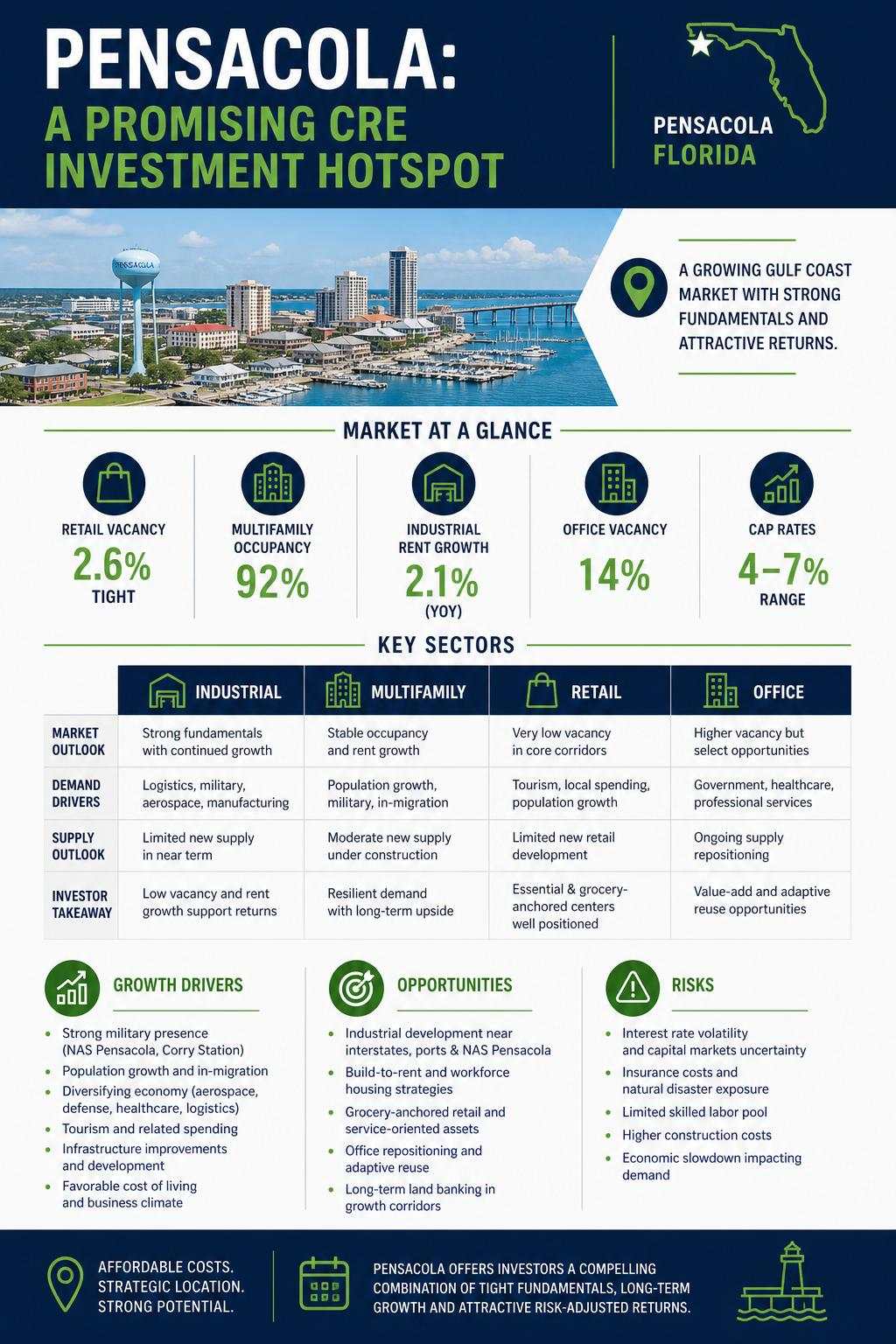
Pensacola has become a market that commercial real estate investors are watching more closely, not because it is a breakout story, but because it offers a combination of relative affordability, steady demand drivers, and a more disciplined supply environment than some larger Florida metros. That mix has made the market appealing to buyers looking for value-add opportunities without paying top-tier pricing.
A few fundamentals help explain the attention. Retail vacancy has remained low in recent reporting, multifamily occupancy has been relatively stable, and industrial rents have continued to show modest growth, even as higher interest rates and insurance costs continue to affect underwriting. Office conditions are softer, with higher vacancy than the stronger sectors, but that has also created selective opportunities for repositioning and adaptive reuse rather than broad-based new development.
Pensacola also benefits from several durable demand anchors. Baptist Health Care opened a new $650 million hospital campus in Pensacola, which reflects long-term investment in healthcare infrastructure and supports nearby real estate activity. The region's military presence, including Naval Air Station Pensacola, and its tourism base also help diversify the local economy.
The investment case is not without risks. Rising insurance costs, rate sensitivity, and the possibility of oversupply in certain industrial and office submarkets can affect returns if assumptions are too aggressive. For that reason, Pensacola appears best suited for investors who are underwriting conservatively and focusing on well-located assets with clear demand support.
Why This Matters
As institutional investors search for yield outside gateway markets, secondary metros with stable demand drivers and lower acquisition costs are becoming increasingly attractive. Pensacola checks a lot of those boxes: military stability, healthcare expansion, tourism demand, and relatively healthy property fundamentals. The result? A market that may not dominate headlines — but could quietly outperform louder Sun Belt cities over the next several years.
Overall Takeaway
Commercial real estate is becoming increasingly selective. While property fundamentals are stabilizing across many sectors, refinancing pressure, elevated borrowing costs, and tighter underwriting standards continue to separate winners from losers. Investors are gravitating toward markets with strong demographics, constrained supply, and durable demand, while lenders remain focused on sponsorship quality, leverage, and cash flow stability.
In today's market, success depends less on chasing growth and more on disciplined underwriting, operational execution, and the ability to capitalize on opportunities created by market dislocation. The market is still moving forward — but it is rewarding preparation over optimism.
Have a Loan Maturity Approaching or Considering a Sale, Refinance, or Acquisition?
Let's discuss your options. Call (850) 203-5788 or visit www.gulfcoastpg.com to schedule a free consultation and property review.