
The Deals, Debt & Distress Shaping Commercial Real Estate
☕ Good Morning!
The market isn't frozen—it's selective.
Some investors are racing to close deals before tax benefits fade. Others are hunting for owners under pressure, while lenders are bracing for a wave of maturing debt. Meanwhile, strong regional economies are attracting attention as high construction costs keep developers cautious.
Different stories, same lesson: In today's CRE market, opportunity rarely comes without a catch.
Here's what's moving the market this week. 👇
CRE Buyers Are Racing the Tax Clock
Bonus depreciation is turning Q4 into a closing sprint. ⏰💰
Commercial real estate investors have found a new reason to move fast: tax savings.
Bonus depreciation is pushing sponsors to accelerate acquisitions before year-end, with qualifying property potentially eligible for up to 80% bonus depreciation in 2026. Pair that with cost segregation, and investors can pull deductions forward, unlock cash sooner, and potentially juice their after-tax returns.
Translation? Deals that might have waited until 2027 are suddenly getting a big "close me now" sticker.

🔍 The Catch: Lenders Aren't Impressed by Tax Magic
Sponsors may be underwriting deals twice these days—once on traditional property fundamentals and again through the after-tax lens.
But lenders are sticking to the classics: NOI, debt-service coverage, asset quality, and borrower strength.
Because here's the inconvenient truth: depreciation can improve an investor's tax bill, but it doesn't magically increase rent, fix deferred maintenance, or improve a property's operating performance.
Why This Matters
Tax policy is becoming a real deal-making variable in CRE.
The 2026 bonus depreciation deadline is pushing investors to pull acquisitions forward, capture deductions, and free up cash for their next move.
But here's the catch: tax savings don't fix bad fundamentals. They don't boost NOI, improve tenant quality, or strengthen debt-service coverage. Understanding metrics like debt service coverage ratio remains central to underwriting.
The result? CRE underwriting is becoming a two-part equation: property performance + after-tax returns.
Bottom line: The tax code may influence when investors buy. Cash flow still determines whether they should.
Multifamily Investors Are Hunting for Sellers Under Pressure
The multifamily market is still working through a pricing reset, and investors are getting more selective about where they put capital.
At the GlobeSt.com Multifamily Owners Summit, panelists said they're increasingly targeting "forced sellers"—owners facing liquidity constraints rather than simply testing the market.
The Big Shift
For buyers, distress can create an opening to acquire assets at more attractive pricing. REITs and other owners dealing with capital pressures are already surfacing as potential sellers across markets including New Orleans, Hoboken, Washington, D.C., and Birmingham.
But getting a discount isn't the whole strategy.
Investors are also looking for properties with a clear operational playbook—where better management, execution, or asset-level improvements can drive returns without relying on a broad recovery in rents.
Why This Matters
The multifamily playbook is shifting from "buy and wait for the market to improve" to "buy where you can create the improvement."
That puts liquidity, operational expertise, and execution at the center of the investment thesis.
Bottom line: The best opportunity may not be the owner who wants to sell. It may be the one who needs to.
The CMBS Maturity Wall Is Putting Office Under Pressure
August brings a $5.49B refinancing test—and office is in the hot seat
Commercial real estate borrowers are facing another problem: the clock.
Private-label CMBS loans totaling $5.49 billion hit hard maturity in August, more than double July's $2.55 billion. Office accounts for $1.81 billion, or nearly one-third of the total.
And the bigger concern? Many loans may be performing today but could struggle when it's time to refinance.
The Debt-Yield Problem
About $3.04 billion, or 55% of August's maturity pool, carries debt yields below 8%. Nearly $1 billion sits below 6%—levels that can make refinancing difficult under current underwriting standards.
Borrowers may need to bring in more equity, restructure their debt, accept lower valuations, or sell. For more context, see our breakdown of the commercial real estate maturity wall.
Meanwhile, Trepp expects $76.6 billion in CMBS maturities throughout 2026, with 39% arriving in Q4.
Office Is Still the Weak Link
Every non-performing loan in August's cohort is tied to office. The sector also represents $986.5 million in special servicing, making it the biggest source of stress.
Even loans that remain current aren't necessarily safe. Nearly $962 million of severely impaired loans could default when they reach maturity.
Why This Matters
This is becoming more than a maturity issue—it's a refinancing and valuation test.
As loans mature, properties have to meet today's lending standards, not yesterday's. That could mean more restructurings, principal paydowns, discounted payoffs, and distressed sales.
Bottom line: The maturity wall is getting closer, and office borrowers may be the first to feel the impact. For investors, that could also mean more distressed opportunities hitting the market.
Retail Construction Costs Are Cooling—But Developers Aren't Celebrating
Fit-out inflation is slowing. Unfortunately, the math still isn't working. 💰
Retail fit-out costs are finally showing signs of moderation, with national costs for in-line retail space averaging $157 per square foot in 2026, up just 1.4% year over year.
But developers aren't exactly rushing back to the construction site.
The active shopping-center pipeline totaled just 13.3 million square feet in Q2, roughly 33% below its long-term average. Years of rising labor and material costs, combined with elevated borrowing costs, continue to make new projects difficult to justify.
The Regional Divide
Where you build matters—a lot.
Northern California leads the country at $217/SF, followed by the Pacific Northwest at $202 and New York City at $181.
At the other end, the Midwest averages just $120/SF, while the Southeast comes in at $126.
Some markets are even seeing costs fall as thinner construction pipelines create more competition among contractors. Fit-out costs dropped about 7% in the Mountain region, excluding Denver, and roughly 5% in both the Southwest and Midwest.
Why This Matters
Lower inflation doesn't necessarily mean cheaper development.
Construction costs have risen faster than achievable rents for years, while expensive financing has further squeezed project economics. Skilled-labor shortages and renewed increases in materials like copper and aluminum are keeping pressure on budgets.
That's pushing developers toward projects with pre-leased tenants, build-to-suit commitments, or exceptionally strong demographics.
Bottom line: Retail fundamentals may be healthy, but developers still need the numbers to work. Until rents catch up with construction and financing costs, the retail pipeline is likely to stay selective.
Fort Walton Beach Industrial – 10 Sale Snapshot
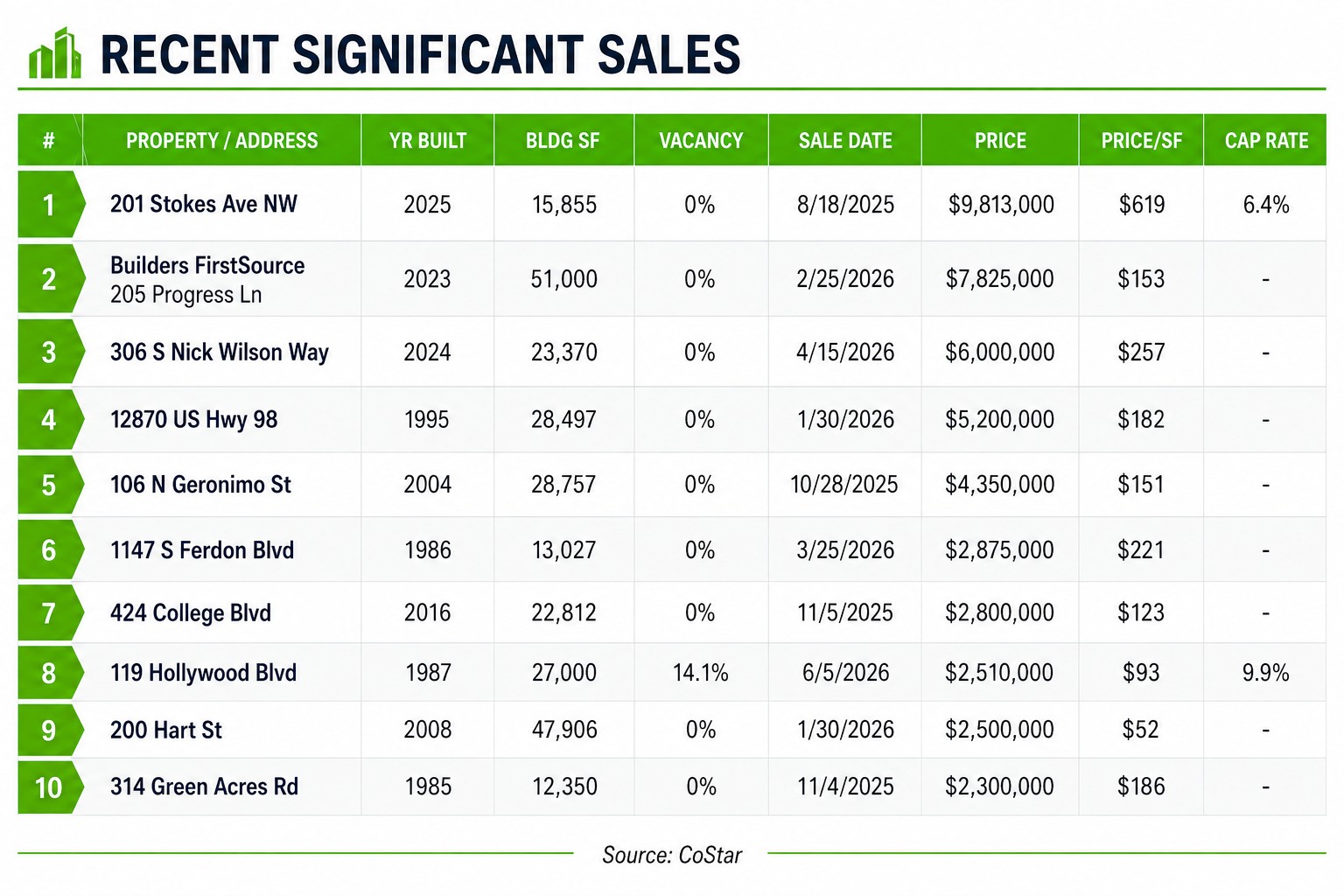
Over the past year, ten significant industrial sales in the Ft. Walton Beach area show a market that's both active and tightly occupied. Nine of the ten properties traded at 0% reported vacancy, and even the one partially vacant deal—a 27,000-SF building on Hollywood Boulevard with 14.1% vacancy—sold at about $93/SF and a 9.9% cap rate, indicating investors are still comfortable with some lease-up risk.
Pricing now ranges from roughly $52/SF for larger, bulk product up to more than $600/SF for smaller, premium assets, with most trades clustering in the $90–$225/SF band. The pattern is clear: bigger, more utilitarian buildings get discounted on a per-foot basis, while smaller, well-located and more modern assets can command notable premiums.
For owners, the message is straightforward—full, functional industrial space remains highly sought after, and targeted improvements that keep a building competitive can materially impact value. For investors, the spread between a roughly 6.4% cap on stabilized product and close to 10% on a partially vacant asset suggests there is still room to capture yield by taking on measured leasing or repositioning risk in a fundamentally strong market.
Crestview–Ft. Walton Beach–Destin Metro Area Economy
Military strength, tourism, and a growing workforce are giving the Crestview–Ft. Walton Beach–Destin market a solid economic foundation.
The region's economy grew 3.1% in 2025, and Oxford Economics expects average annual growth of 2.3% from 2026 through 2030. Employment is also projected to increase about 1% annually, with professional services and hospitality leading the gains.
✈️ Military Is the Economic Anchor
One of the market's biggest advantages is Eglin Air Force Base, the largest installation in the U.S. Air Force.
Eglin generates more than $9 billion in annual economic impact and supports over 74,000 jobs, while its military and aerospace operations attract a deep network of defense contractors and specialized employers.
The workforce pipeline is another plus. Roughly 1,400 service members transition out of the military locally each year, and many stay in the region—bringing valuable skills into the civilian economy.
A Diversified Employment Base
The area isn't dependent on a single industry. Government, finance, real estate, healthcare, education, retail, aerospace, and hospitality all contribute to the economy.
Major employers include Lockheed Martin, Boeing, Walmart, Publix, HCA Florida Fort Walton-Destin Hospital, and the Okaloosa County School District.
Strong schools and higher-education institutions also help support the region's long-term workforce growth.
Why It Matters
For CRE investors, the appeal is economic diversification plus stability.
The military provides a dependable base of employment, while tourism, aerospace, healthcare, education, and professional services create additional demand. Three airports, proximity to Interstate 10, and access to the Intracoastal Waterway further strengthen connectivity.
Bottom line: Destin may sell the beach lifestyle, but its investment story is increasingly about what happens beyond the shoreline. A growing economy, skilled workforce, and powerful military presence could provide a durable foundation for CRE demand through 2030.
Overall Takeaway
This week's stories show a market where opportunity and pressure are increasingly coming from the same place: the numbers.
Tax incentives are accelerating deals. Liquidity challenges are creating motivated sellers. Maturing debt is exposing properties that may struggle to refinance. At the same time, economically diverse markets continue to attract capital, while high construction and financing costs are keeping developers disciplined.
The message for investors is pretty simple:
Don't chase the market. Find the situations where the fundamentals, pricing, and execution actually line up.
In this environment, the best opportunities may not be the most obvious ones—they may be the assets, sellers, and markets where other investors aren't willing or able to move.
Interested in Joining Our Investor Network?
Connect with us to receive updates on off-market opportunities, market insights, and emerging investment trends. Call (850) 203-5788 or visit our Investment Partnerships page to start the conversation.