CRE Pulse: Gulf Coast Office, Industrial, Retail & Multifamily Update
Commercial real estate conditions across Gulf Coast markets continue to show a mixed picture as tenant demand, new supply, and rent growth vary by sector and location. Recent market data highlights rising vacancy in select multifamily and commercial sectors, while industrial properties continue to demonstrate resilience in several markets. Development activity remains concentrated in larger metros, particularly Jacksonville, where both completed projects and construction pipelines significantly exceed those of neighboring markets. This edition of CRE Pulse examines key indicators across office, industrial, retail, and multifamily sectors to provide a clear view of current market conditions and emerging trends across the Gulf Coast region.
Vacancy Rate
The chart below compares office, industrial, and retail vacancy rates across six Gulf Coast markets, highlighting where tenant demand remains strongest and where space availability is increasing. Vacancy levels remain relatively low across most smaller Gulf Coast markets, though industrial and office sectors are beginning to show signs of softening in select areas. Monitoring vacancy trends helps investors, owners, and tenants better understand market conditions, pricing power, and potential leasing opportunities.
Vacancy Rate (%)
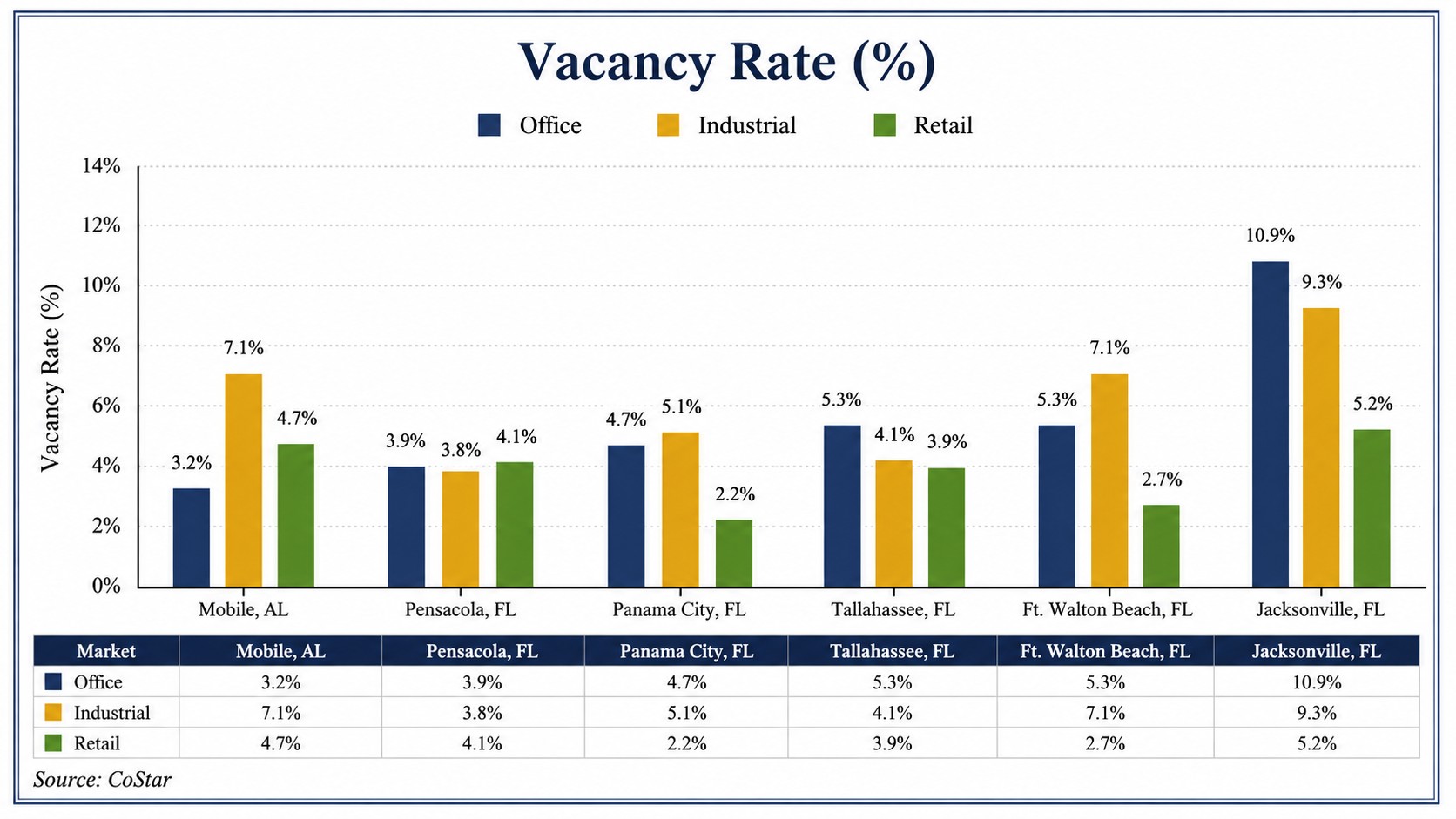
- Retail remains the tightest commercial asset class, with vacancy ranging from 2.2% in Panama City to 5.2% in Jacksonville.
- Office markets remain relatively healthy across most Gulf Coast cities, with Jacksonville standing out as the only market above 10% vacancy.
- Industrial vacancy has increased in larger markets as recent deliveries continue to be absorbed.
- Smaller Gulf Coast markets continue to maintain relatively balanced supply and demand conditions.
Net Absorption
Net absorption measures the amount of space occupied versus vacated over the past 12 months and serves as a key indicator of tenant demand. Positive absorption signals that tenants are leasing more space than they are giving back, while negative absorption suggests weakening occupancy trends. The chart below compares office, industrial, and retail net absorption across major Gulf Coast markets, highlighting where demand remains strongest and where leasing activity has softened.
12-Month Net Absorption (SF)
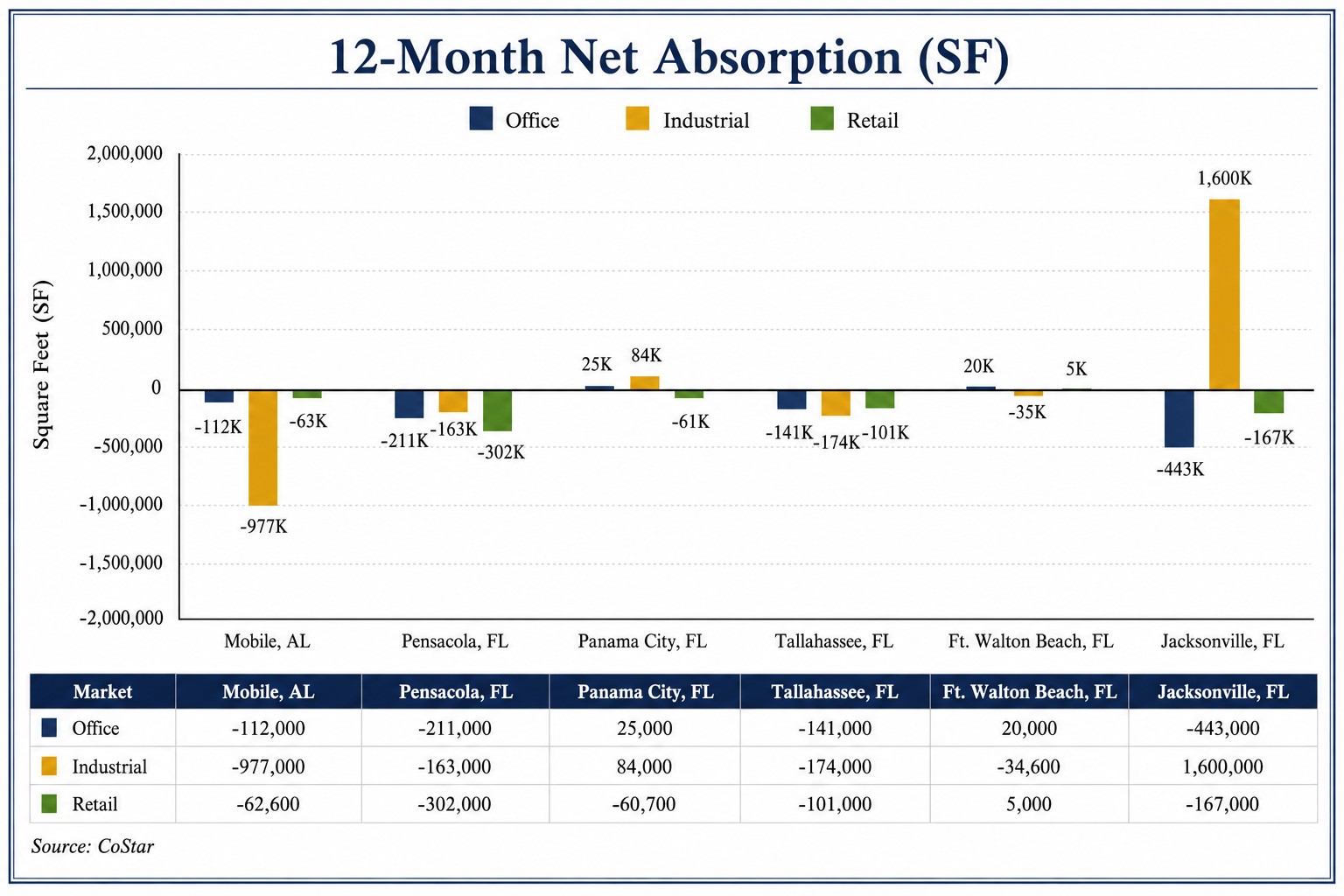
- Industrial performance is mixed, with Jacksonville posting the strongest positive absorption while several smaller markets recorded negative absorption.
- Office absorption remains uneven, with Pensacola, Mobile, Tallahassee, and Jacksonville reporting net move-outs over the past 12 months.
- Retail absorption softened across many markets, reflecting slower leasing activity.
- Panama City remains one of the strongest-performing markets, posting positive absorption across multiple sectors.
Market Asking Rent
Market asking rents provide insight into revenue potential, tenant demand, and overall pricing power across commercial real estate sectors. The chart below compares current office, industrial, and retail asking rents across six Gulf Coast markets, highlighting differences in pricing by asset class and location. While office properties continue to command the highest rents in most markets, retail rents remain competitive in several areas, particularly in larger population centers.
Market Asking Rent ($/SF)
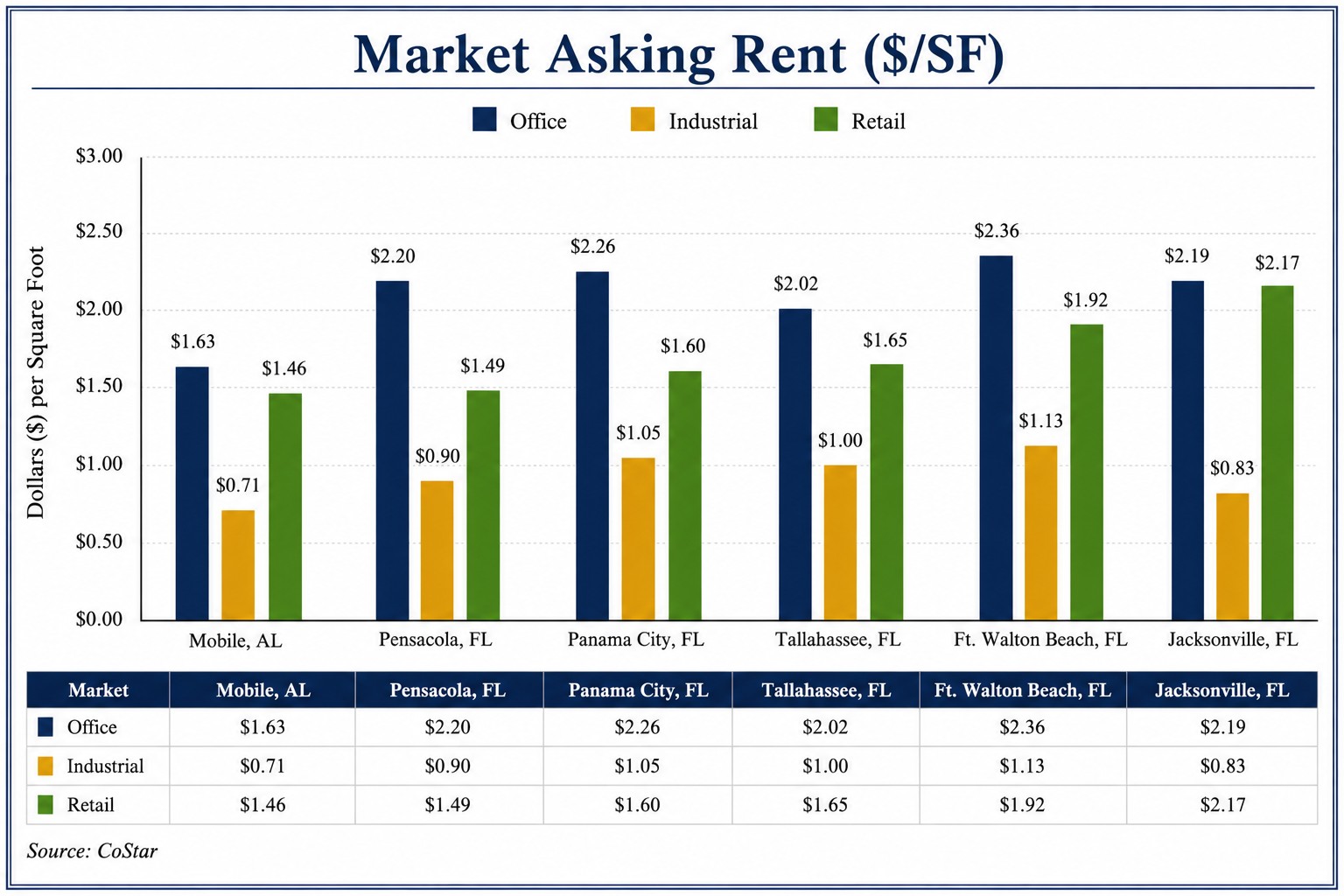
- Office rents remain the highest across all markets, led by Ft. Walton Beach ($2.36/SF) and Panama City ($2.26/SF).
- Jacksonville and Ft. Walton Beach report the strongest retail rents at $2.17/SF and $1.92/SF, respectively.
- Industrial rents remain the lowest among the three asset classes, ranging from $0.71/SF in Mobile to $1.13/SF in Ft. Walton Beach.
- Rent levels remain relatively stable across Gulf Coast markets, with only modest variation between cities.
Deliveries
New deliveries measure the amount of commercial space completed and added to the market over the past 12 months. Tracking deliveries helps identify where developers are actively expanding inventory and where new supply may influence future vacancy, rent growth, and leasing activity.
12-Month Deliveries (SF)
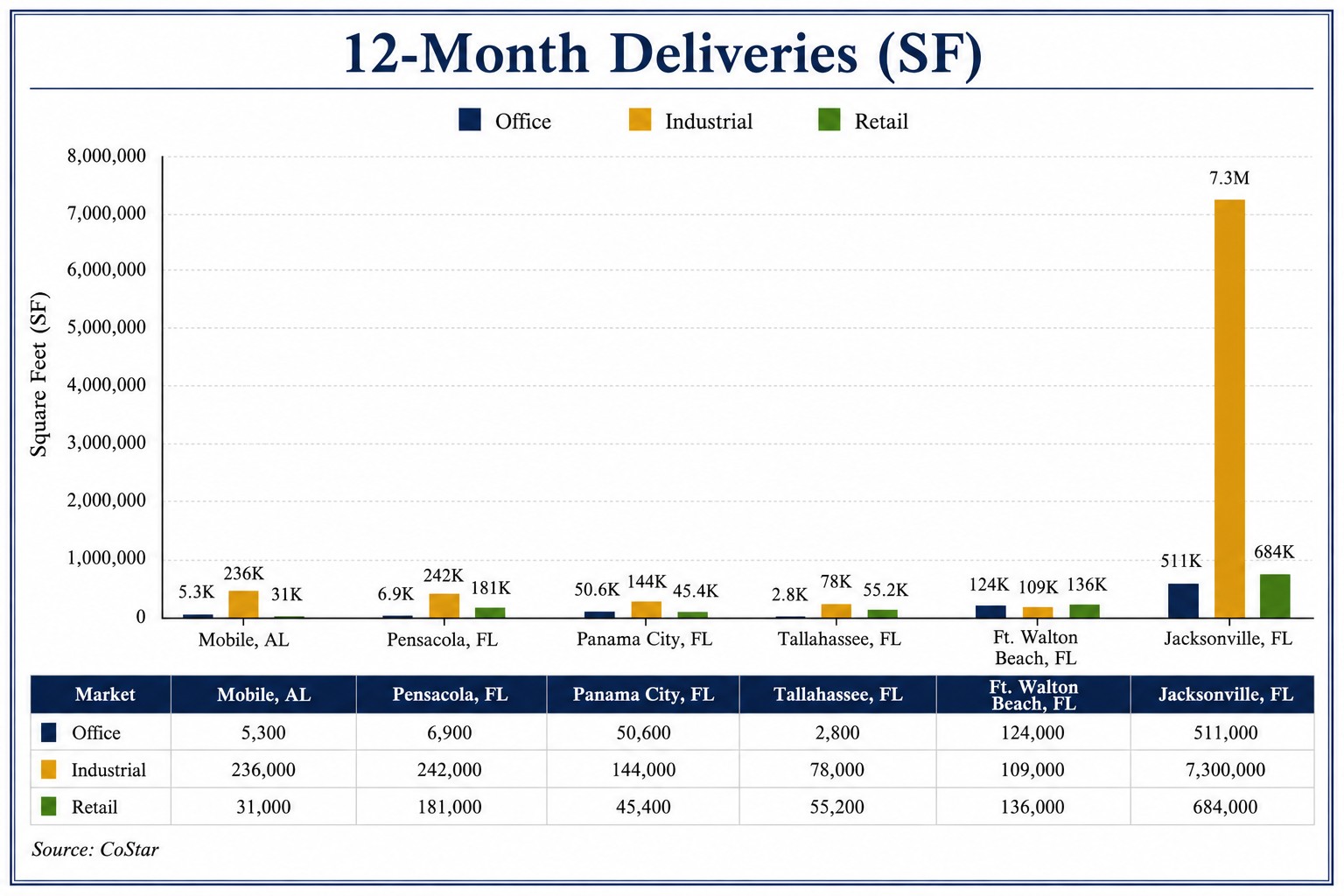
- Jacksonville accounts for the largest volume of new development, led by approximately 7.3 million SF of industrial deliveries.
- Industrial properties represent the majority of new commercial supply across most Gulf Coast markets.
- Office deliveries remain relatively limited outside of Jacksonville and Ft. Walton Beach.
- Retail development activity is modest in most markets, though Jacksonville and Pensacola recorded the highest retail deliveries.
Under Construction
Properties currently under construction provide an early indicator of future supply that has not yet been delivered to the market. Tracking construction pipelines helps investors, owners, and tenants anticipate potential changes in vacancy rates, rent growth, and competitive dynamics.
Under Construction (SF)
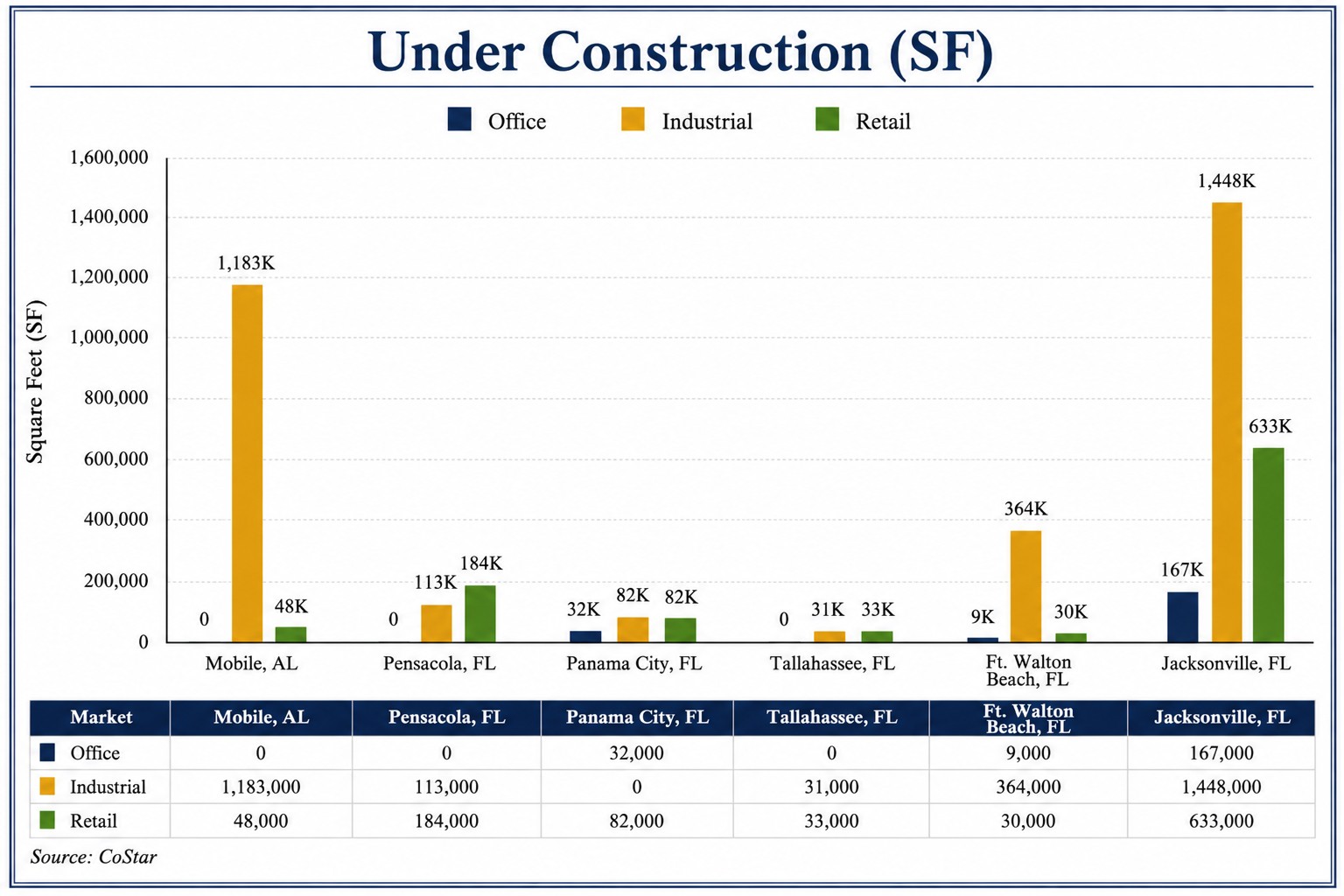
- Jacksonville maintains the largest active development pipeline in the region.
- Industrial properties account for the majority of space currently under construction.
- Office construction remains limited across most Gulf Coast markets.
- Retail development remains relatively restrained and focused on targeted growth corridors.
Multifamily Market Watch
Multifamily Vacancy Rate (%)
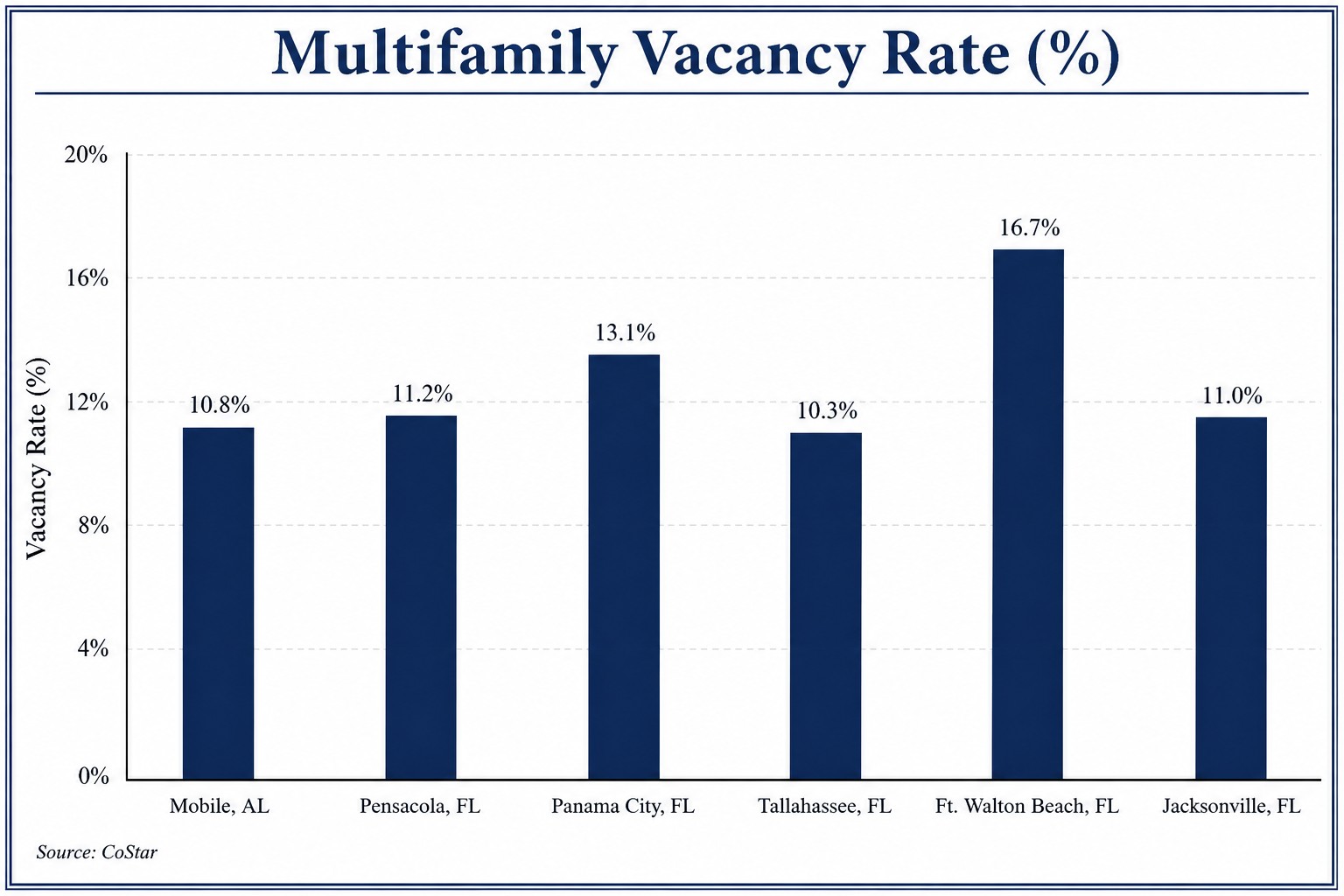
- Multifamily vacancy exceeds 10% in every market reviewed.
- Ft. Walton Beach and Panama City continue to experience the highest vacancy rates.
- Elevated vacancy is largely the result of recent apartment deliveries rather than a collapse in renter demand.
- Most markets remain in an absorption phase as newly delivered units are leased.
Multifamily Asking Rent ($/Unit/Month)
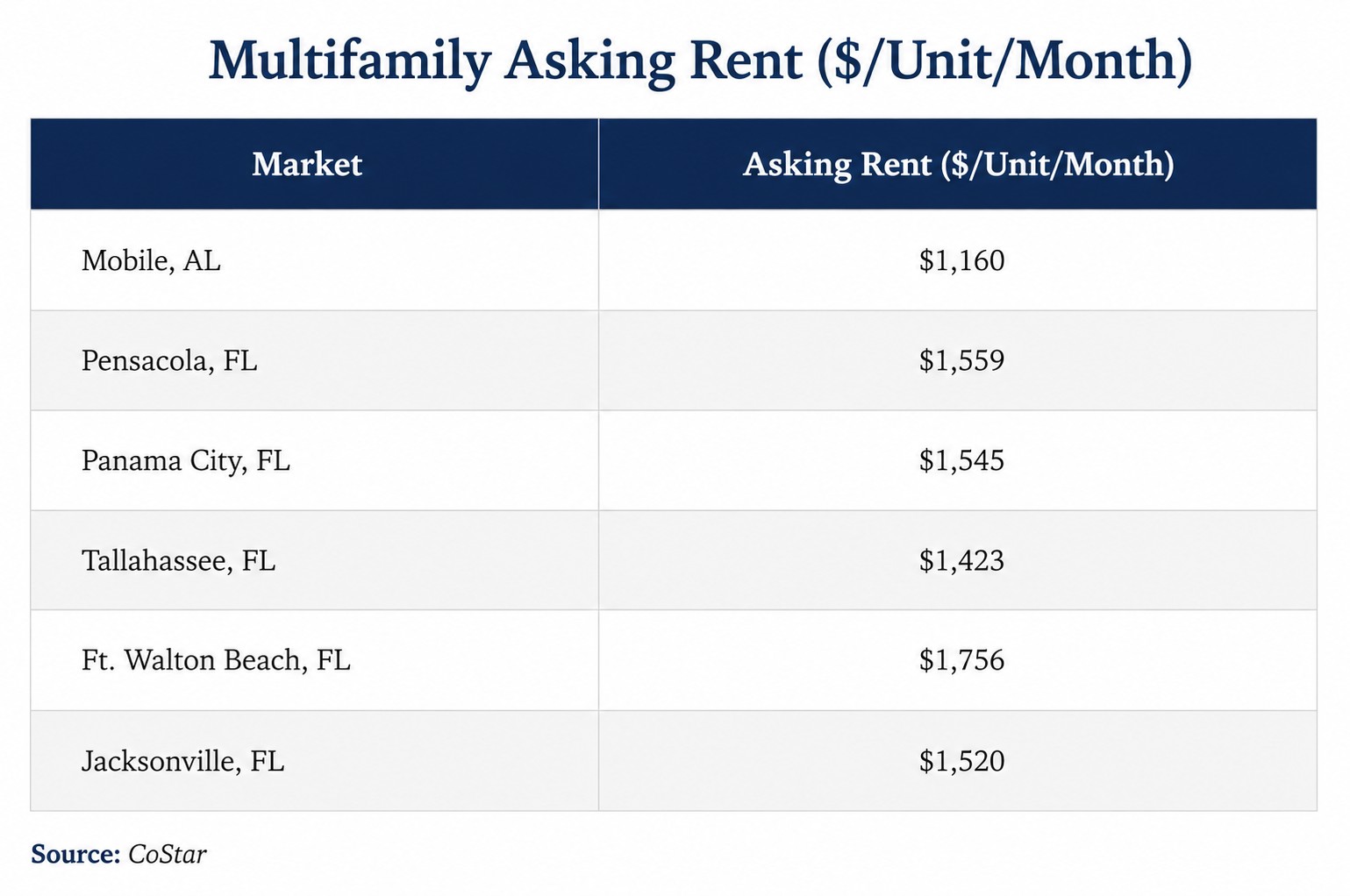
- Asking rents remain highest in Ft. Walton Beach and Pensacola.
- Jacksonville continues to benefit from scale and tenant demand despite recent rent pressure.
- Mobile and Tallahassee remain the most affordable apartment markets in the region.
- Rent levels remain well above pre-pandemic averages across all markets.
12-Month Asking Rent Growth (%)
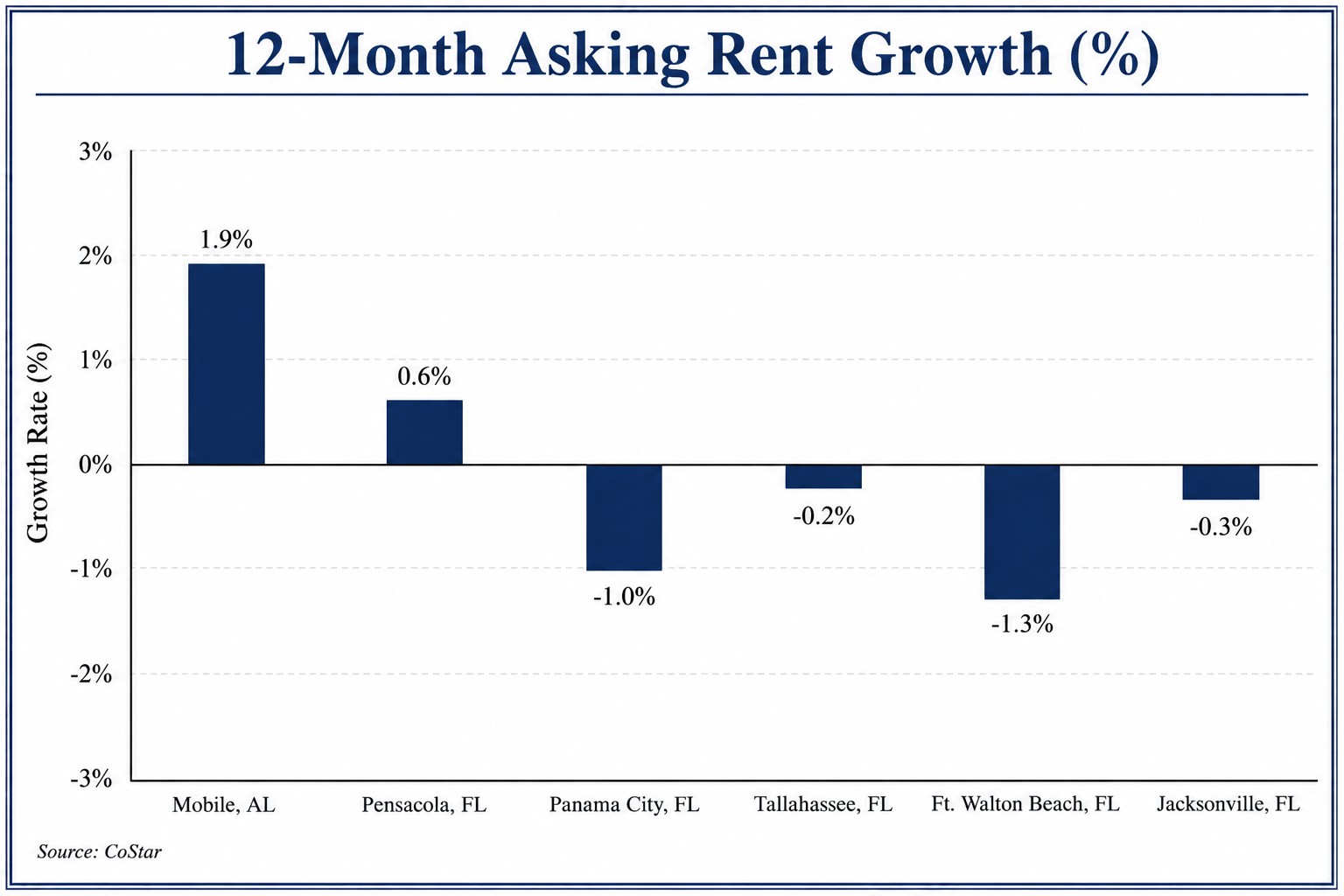
- Rent growth has slowed significantly throughout the region.
- Mobile remains the strongest performer with positive annual rent growth.
- Several markets are now experiencing modest year-over-year rent declines.
- Northwest Florida markets continue to work through supply-driven rent pressure.
12-Month Delivered Units
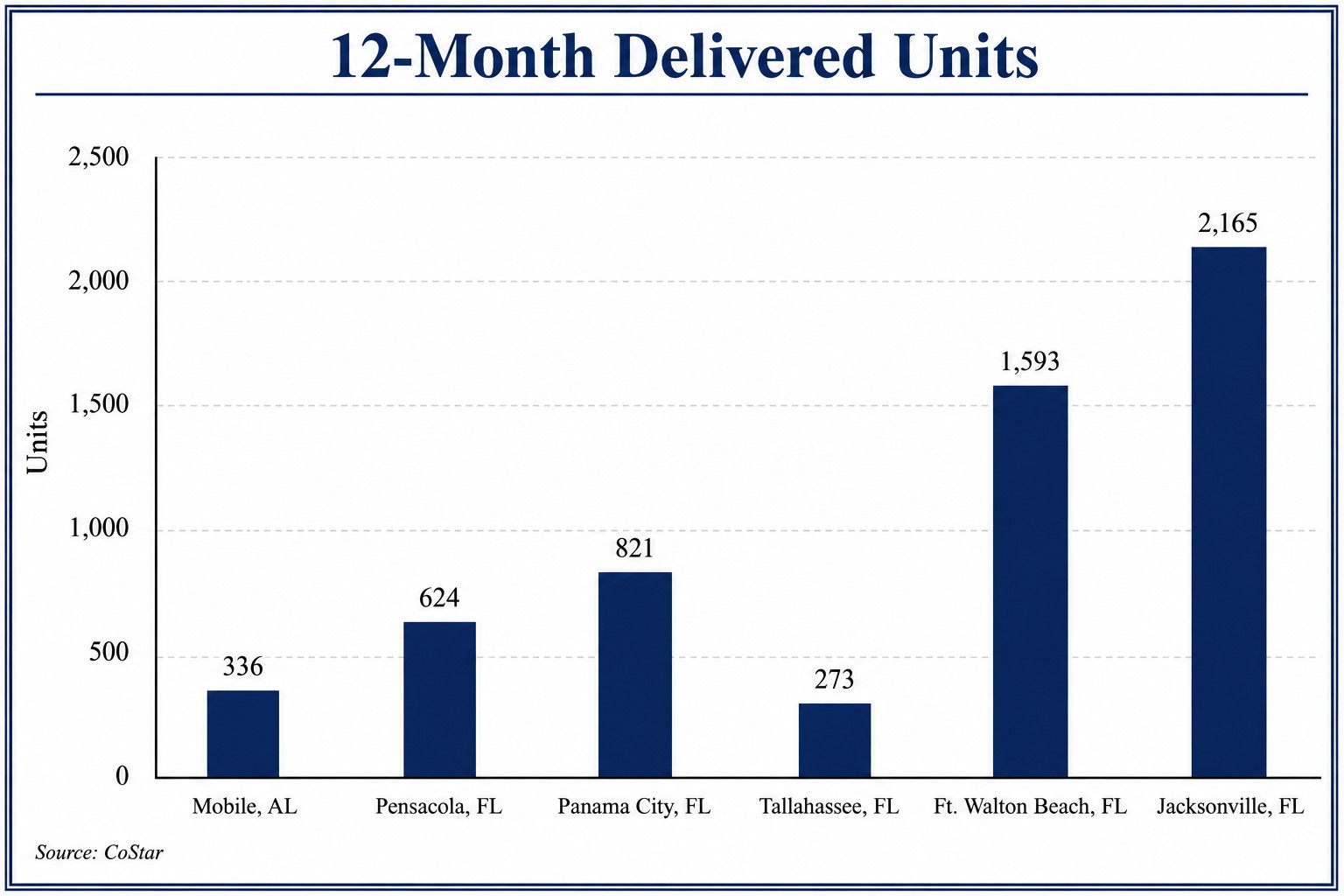
- Ft. Walton Beach, Jacksonville, and Panama City recorded the largest delivery volumes.
- Deliveries remain the primary driver behind elevated multifamily vacancy.
- Several markets continue to absorb inventory delivered during the recent development cycle.
- New construction activity appears to be moderating across much of the region.
12-Month Absorption Units
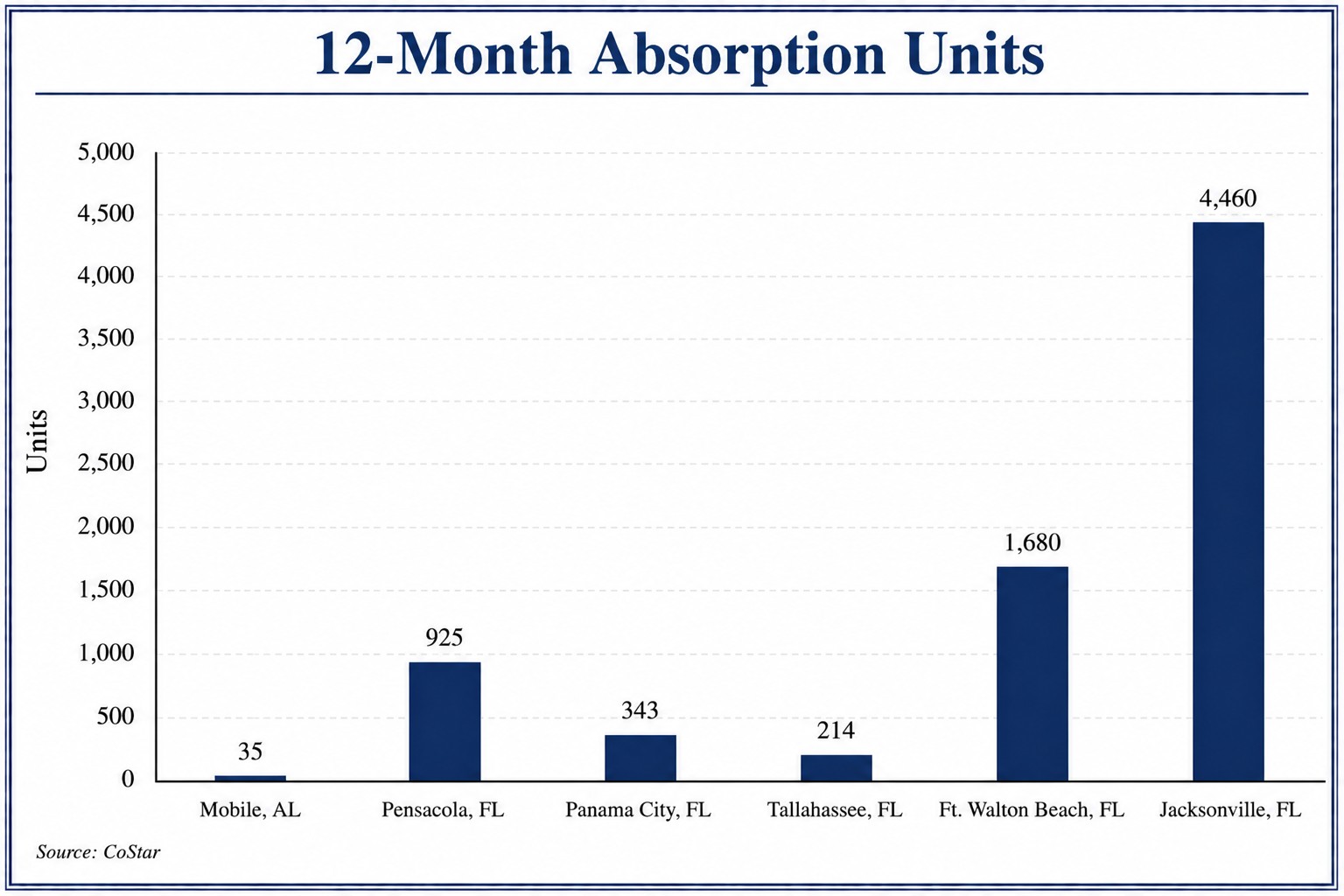
- Jacksonville recorded the strongest apartment demand among the markets reviewed.
- Ft. Walton Beach also posted substantial absorption despite elevated vacancy.
- Positive absorption is occurring across all markets, though not always fast enough to offset recent deliveries.
- Demand remains present throughout the region despite slower rent growth.
Overall Takeaway
The latest data suggests Gulf Coast commercial real estate remains fundamentally stable, though market performance is becoming increasingly segmented by asset class and geography. Industrial properties continue to benefit from stronger demand and development activity, while office and retail sectors are experiencing softer absorption in several markets. Multifamily vacancy remains elevated across the region as recently delivered units continue to be absorbed. Overall, markets with the largest construction pipelines and recent deliveries are showing the greatest supply pressure, making local market fundamentals increasingly important when evaluating investment and leasing opportunities.
Looking for commercial real estate opportunities across the Gulf Coast? Connect with Gulf Coast Property Group to discuss current market trends, active opportunities, and potential investment partnerships. Learn more about our investment partnerships.