Northwest Florida CRE Market Update – August 2026
The commercial real estate market continues to move through a period of adjustment, with performance increasingly varying by property type and location. Across the Florida Panhandle and comparable regional markets, the latest data shows a mix of improving demand, uneven rent growth, changing vacancy levels, and significant differences in development pipelines.
This market update examines the latest occupancy, absorption, rental growth, construction, transaction volume, and cap rate data across industrial, office, retail, and multifamily markets. The goal is to identify where fundamentals are strengthening, where supply or pricing pressures are building, and where the current market may be creating opportunities for property owners, investors, and developers.
Vacancy Rate (%)
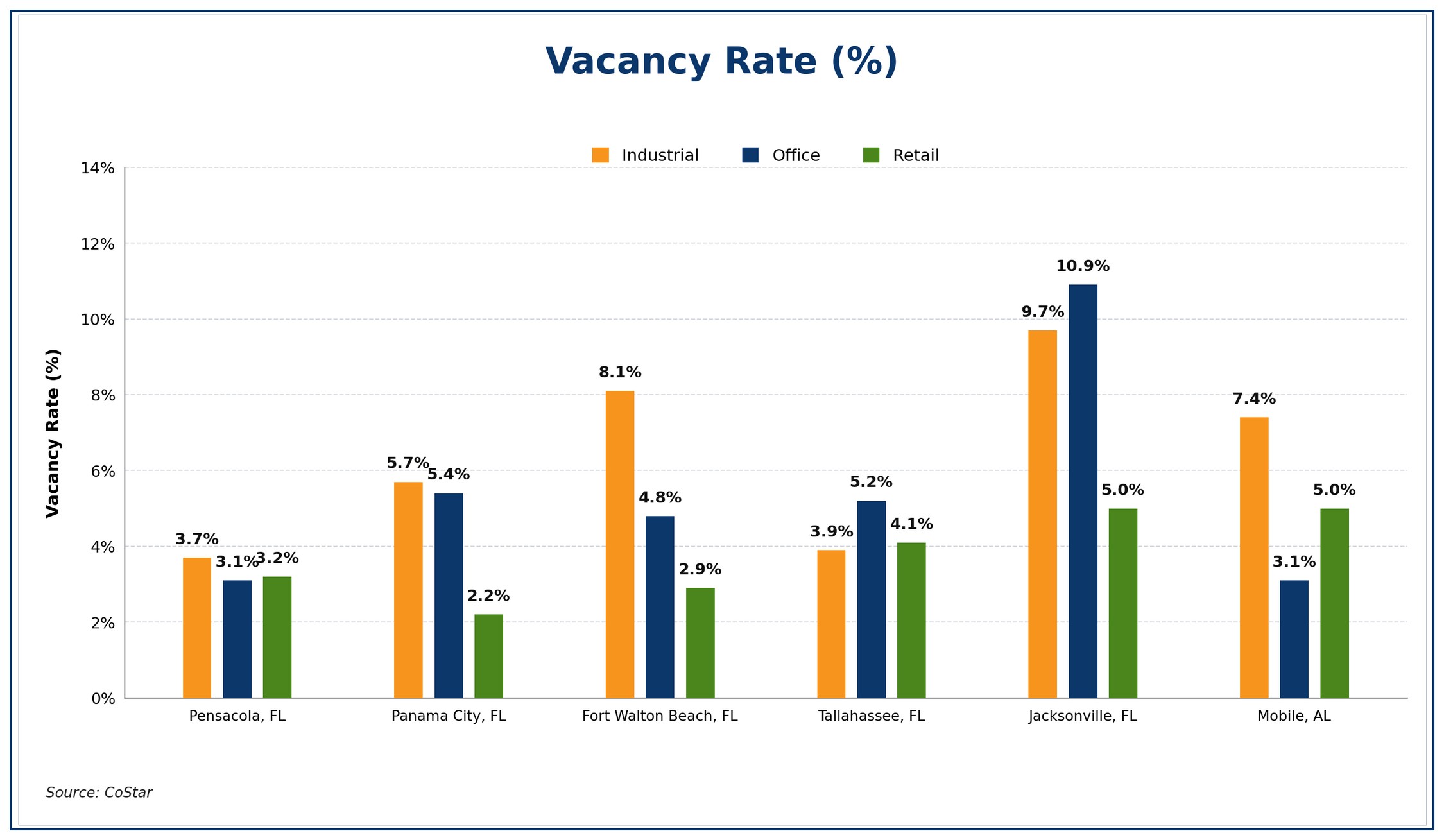
- Pensacola stands out for tight vacancy, with industrial, office and retail all below 4%, signaling strong tenant demand and limited available space.
- Jacksonville has the most leasing pressure, particularly in office (10.9%) and industrial (9.7%), creating more negotiating leverage for tenants and potential acquisition opportunities.
- Industrial vacancy varies significantly, from just 3.7% in Pensacola to 9.7% in Jacksonville, highlighting meaningful differences in supply-demand conditions.
- Retail remains the most consistently stable sector, with vacancy at or below 5% across all six markets, supporting continued demand for well-located retail assets.
Market Asking Rent
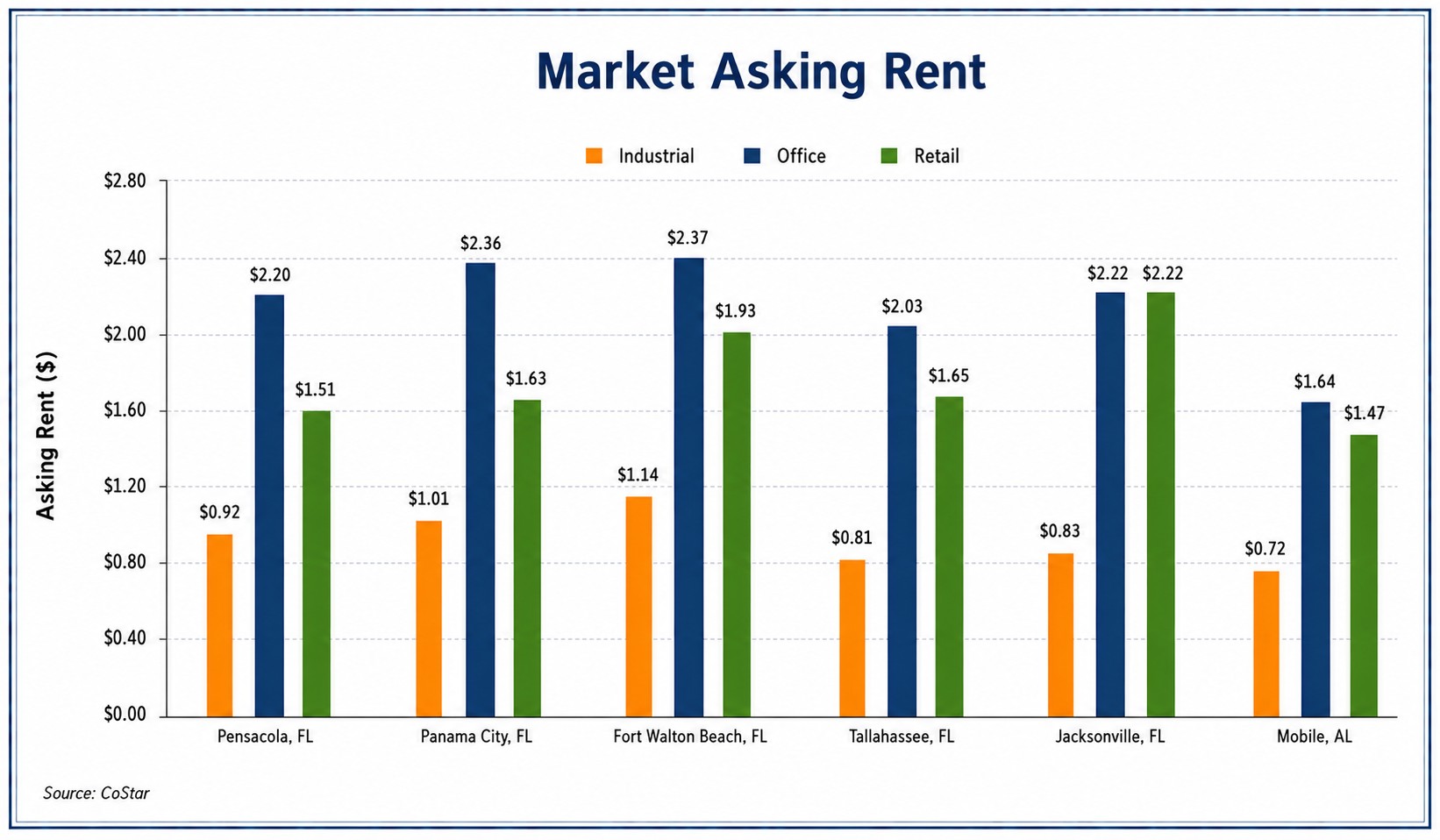
- Fort Walton Beach leads the market in asking rents, with office at $2.37/SF and retail at $1.93/SF, reflecting strong pricing levels in the market.
- Office commands the highest asking rents across every market, ranging from $1.64/SF in Mobile to $2.37/SF in Fort Walton Beach.
- Jacksonville retail stands out at $2.22/SF, the highest retail asking rent in the comparison and equal to its office asking rent.
- Pensacola offers a balanced pricing profile, with industrial at $0.92/SF, office at $2.20/SF, and retail at $1.51/SF.
- The data suggests higher rents do not necessarily translate to stronger investment fundamentals. Markets such as Fort Walton Beach and Jacksonville command premium rents, but investors should weigh those rates against vacancy, absorption, and new supply before assuming higher rents indicate greater opportunity.
Availability Rate (%)
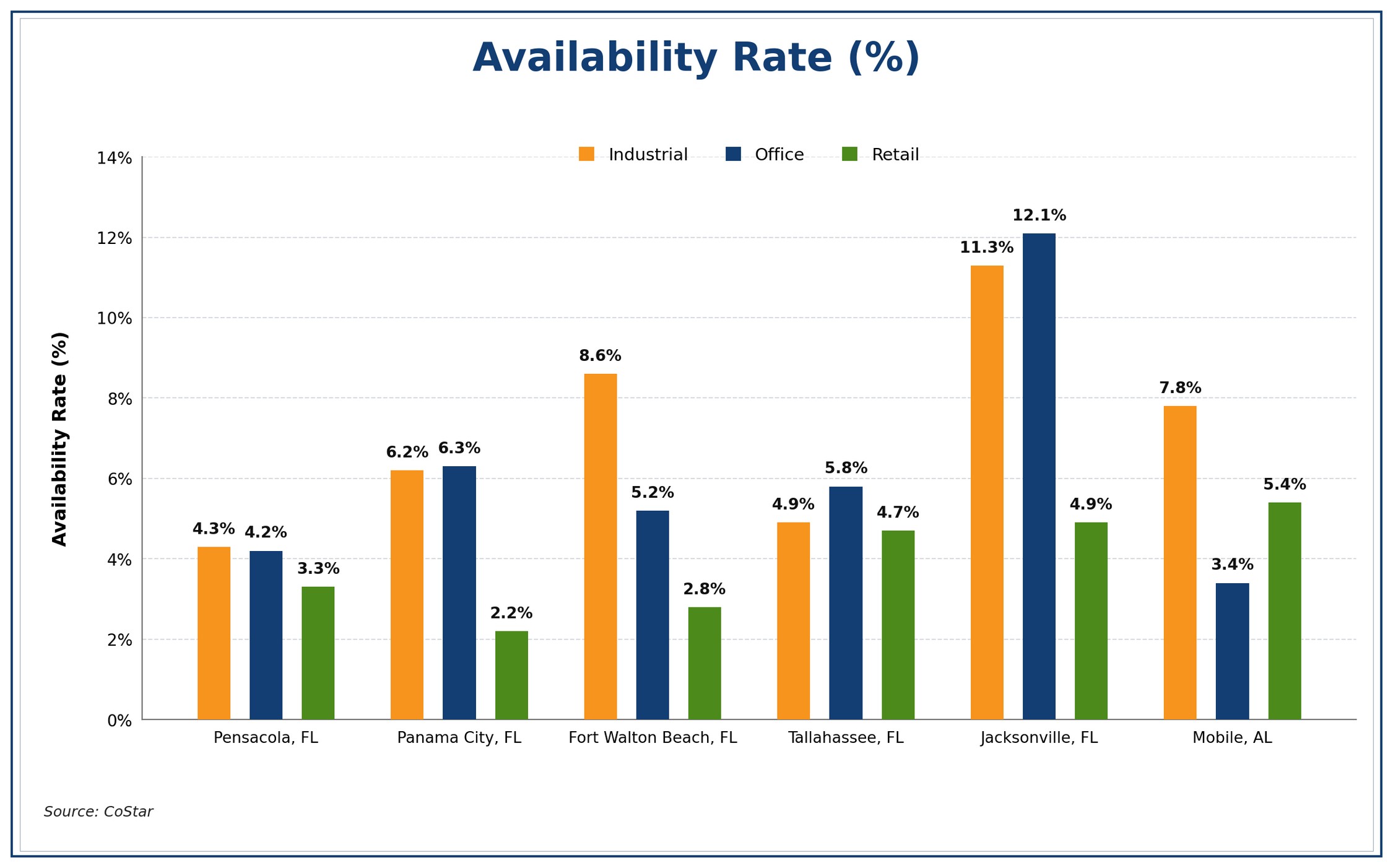
- Pensacola has the tightest overall availability, with industrial at 4.3%, office at 4.2%, and retail at 3.3%, indicating limited space across all three sectors.
- Jacksonville shows the most available space, particularly office at 12.1% and industrial at 11.3%, giving tenants more negotiating leverage but potentially creating acquisition opportunities.
- Fort Walton Beach industrial availability is elevated at 8.6%, suggesting more space is available for tenants despite the market's relatively high asking rents.
- Retail remains the tightest sector across the region, with availability below 5% in every market except Mobile (5.4%), pointing to continued demand for quality retail space.
- The data suggests investors should prioritize markets where availability is constrained relative to demand. Pensacola stands out for defensive positioning, while higher-availability markets such as Jacksonville and Fort Walton Beach may offer opportunities to acquire assets at more favorable pricing if leasing fundamentals improve.
Net Absorption (SF)
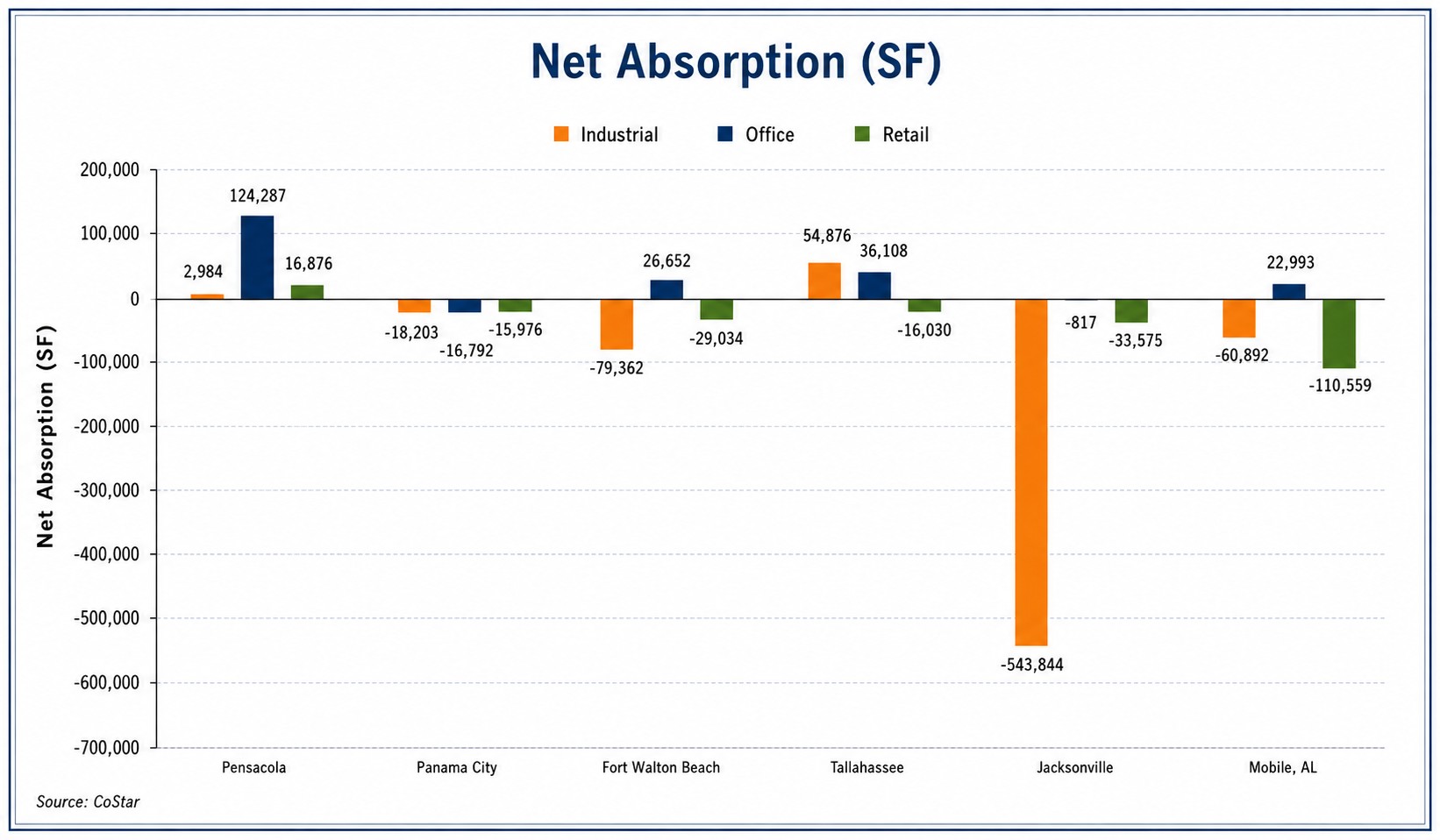
- Pensacola shows the strongest overall demand, with positive absorption across all three sectors. Office leads at 124,287 SF, while retail adds 16,876 SF and industrial 2,984 SF.
- Tallahassee is also performing well, led by 54,876 SF of industrial and 36,108 SF of office absorption, although retail posted negative absorption of 16,030 SF.
- Jacksonville is the clearest weak spot, with industrial absorption plunging to -543,844 SF and retail at -33,575 SF, suggesting meaningful tenant contraction or excess space.
- Mobile is mixed, with positive office absorption of 22,993 SF, but negative industrial (-60,892 SF) and retail (-110,559 SF).
- What we can infer: Demand is increasingly concentrated in select markets and property types. For investors, markets such as Pensacola and Tallahassee appear better positioned for near-term occupancy stability, while negative absorption in Jacksonville and Mobile could create opportunities to acquire assets at a discount — but only where the underlying tenant demand remains defensible.
Deliveries (SF)
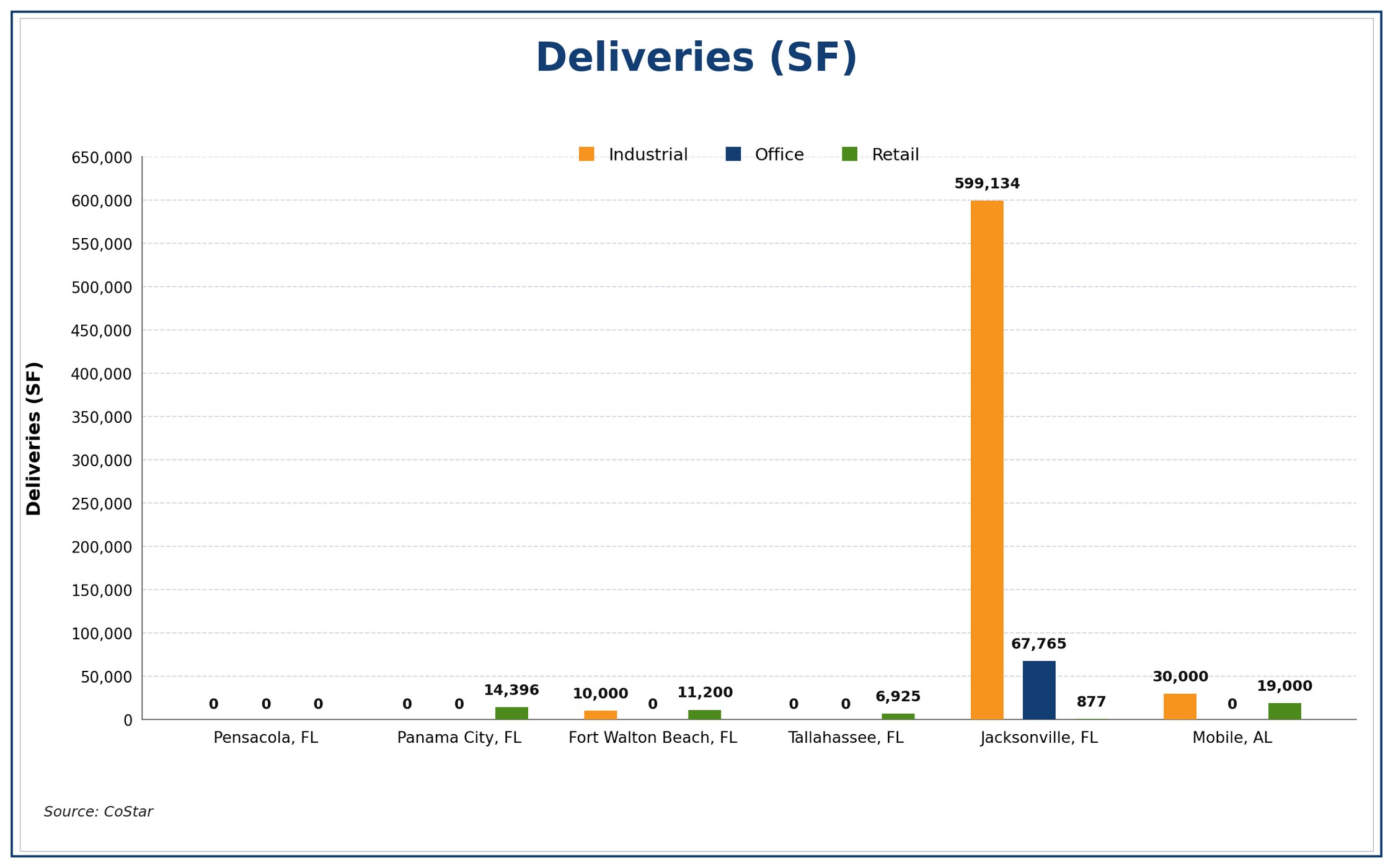
- Jacksonville dominates new supply, with 599,134 SF of industrial delivered over the period, plus 67,765 SF of office. This is significantly higher than the other markets shown.
- Panhandle markets remain supply-constrained, with no new deliveries in Pensacola and only limited additions in Panama City, Fort Walton Beach, and Tallahassee.
- Mobile shows moderate industrial development, with 30,000 SF delivered, while retail added 19,000 SF.
- The key takeaway: Limited new supply in Pensacola and parts of the Panhandle could support existing property owners and help protect occupancy, while Jacksonville's substantial industrial deliveries may create greater competition among landlords.
- What we can infer: For investors, markets with strong demand but limited new construction may offer a more favorable supply-demand balance. Jacksonville warrants more selective underwriting, particularly for industrial assets competing with newly delivered space.
Under Construction (SF)
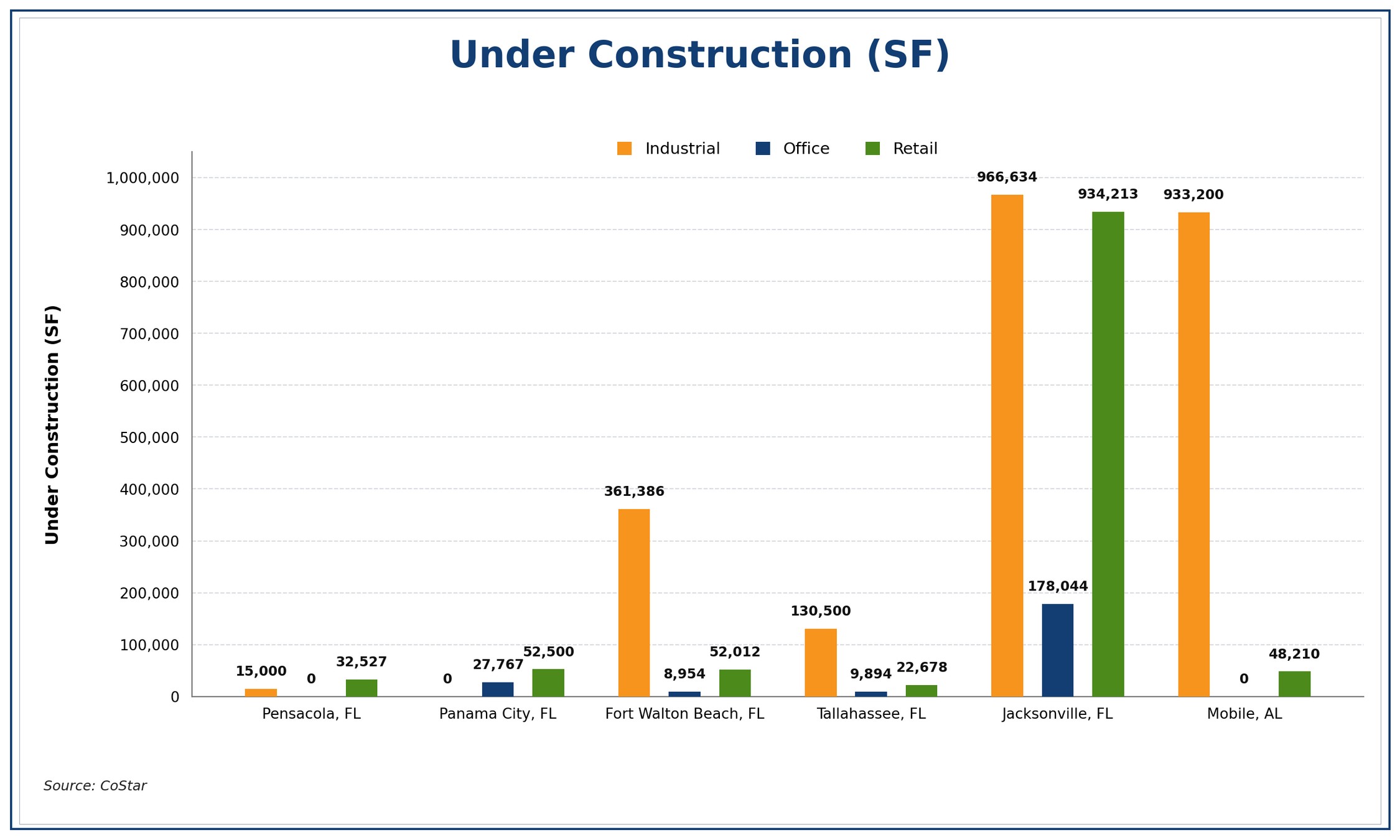
- Jacksonville has by far the largest development pipeline, with nearly 967,000 SF of industrial and 934,000 SF of retail under construction, creating significant future supply risk.
- Fort Walton Beach stands out among Panhandle markets, with 361,386 SF of industrial space under construction — the largest Panhandle pipeline and one worth monitoring closely.
- Pensacola remains relatively supply-constrained, with just 15,000 SF of industrial and 32,527 SF of retail under construction.
- Mobile also has substantial industrial supply coming, with approximately 933,200 SF under construction, potentially increasing competition for existing industrial properties.
- What we can infer: Investors should favor markets where demand can absorb new supply. Pensacola currently offers the strongest supply constraint, while Fort Walton Beach requires closer monitoring as its industrial pipeline comes online.
12 Month Vacancy (YOY)
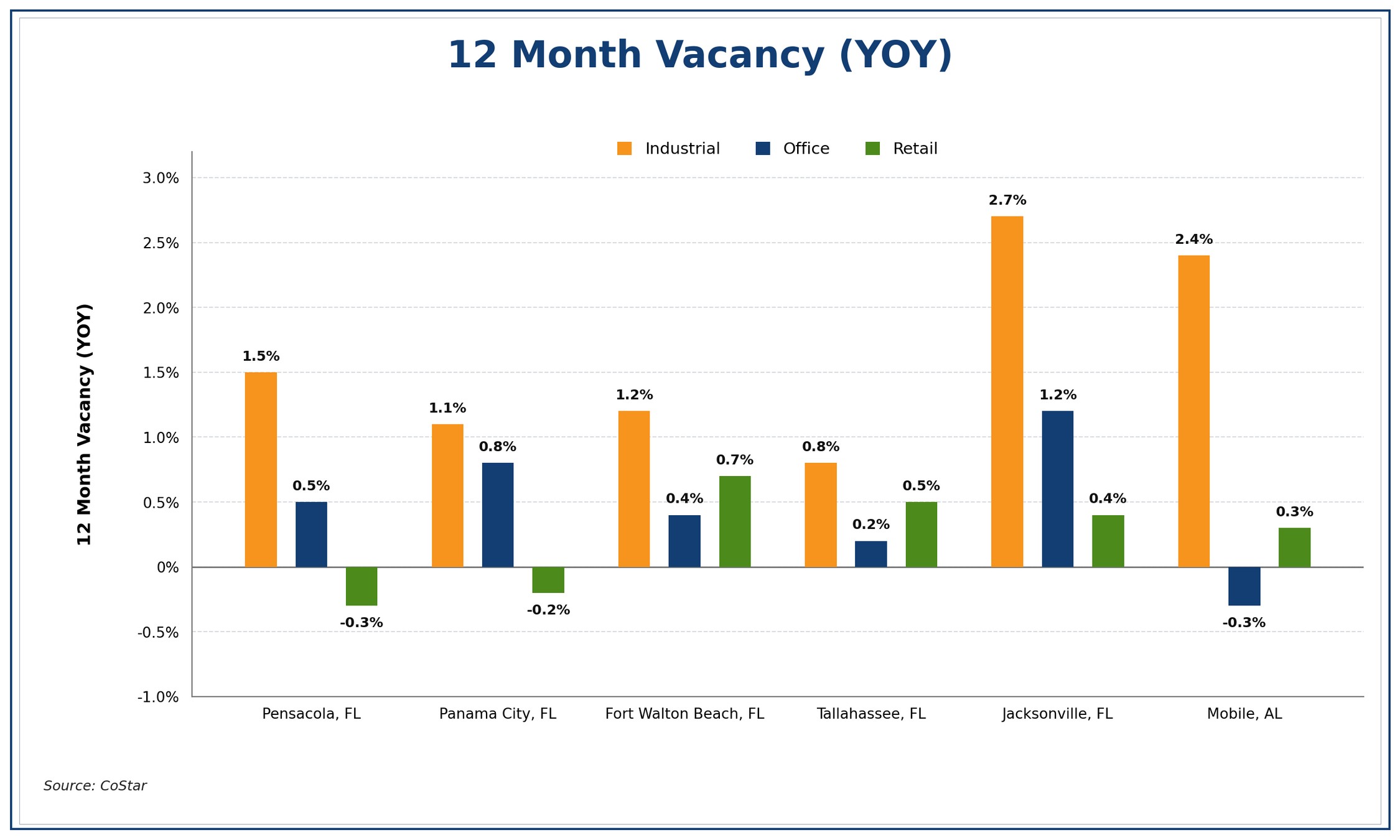
- Industrial vacancy increased across all markets, led by Jacksonville (+2.7%) and Mobile (+2.4%), signaling growing supply pressure and increased competition among landlords.
- Office conditions remain relatively stable, particularly across the Panhandle, while retail vacancy was flat to improving in Pensacola and Panama City.
- Investor takeaway: The Panhandle currently shows a more balanced vacancy environment, while rising industrial vacancy in Jacksonville and Mobile could create acquisition opportunities if pricing adjusts.
12 Month Net Absorption (SF)
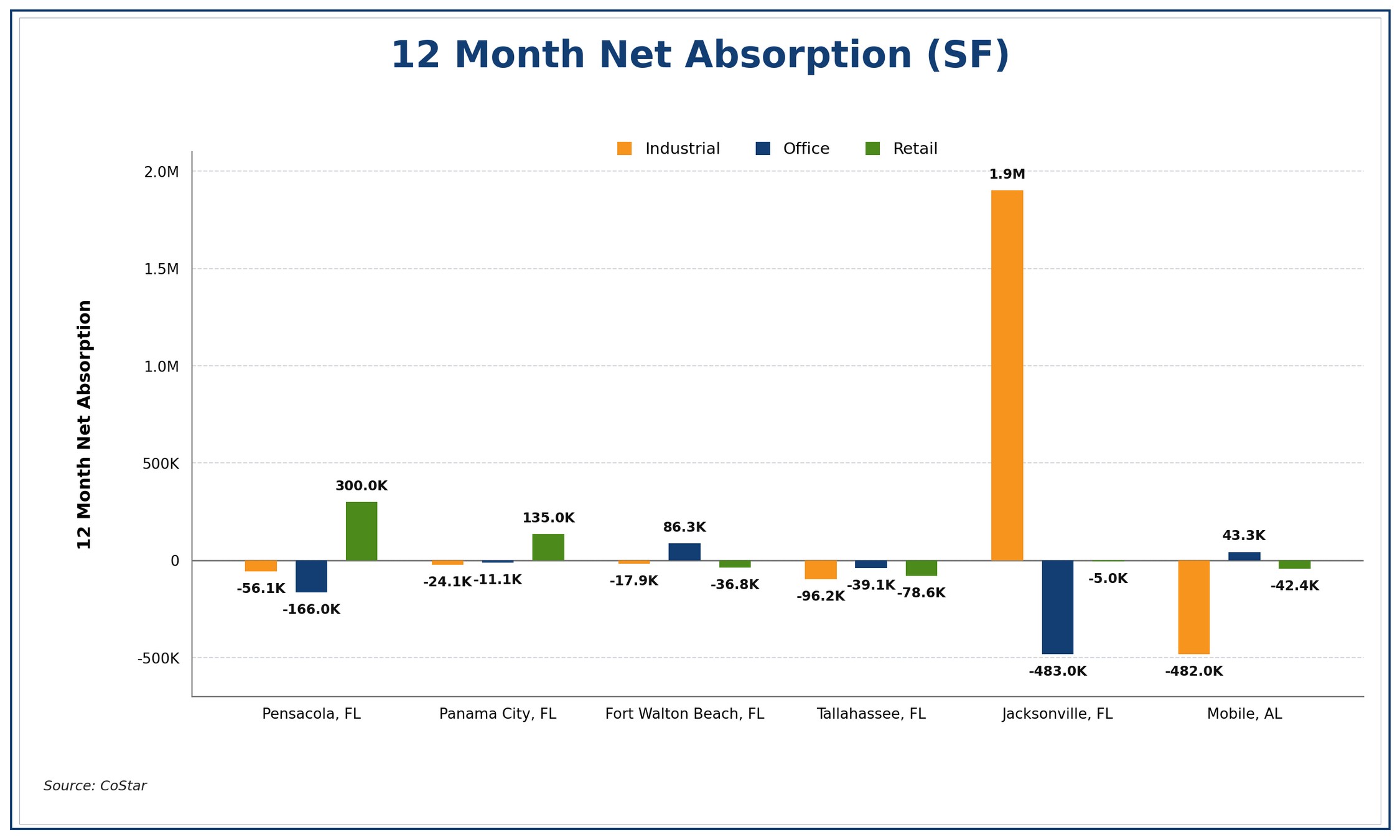
- Pensacola stands out on the retail side, with 300,000 SF of positive absorption, while office and industrial posted negative absorption.
- Jacksonville and Mobile show the most significant weakness in office and industrial respectively, with -483,000 SF and -482,000 SF of absorption.
- Investor takeaway: Demand is strongest in select Panhandle sectors, while negative absorption in Jacksonville and Mobile could create opportunities for investors able to acquire and reposition assets at more attractive pricing.
12 Month Deliveries (SF)
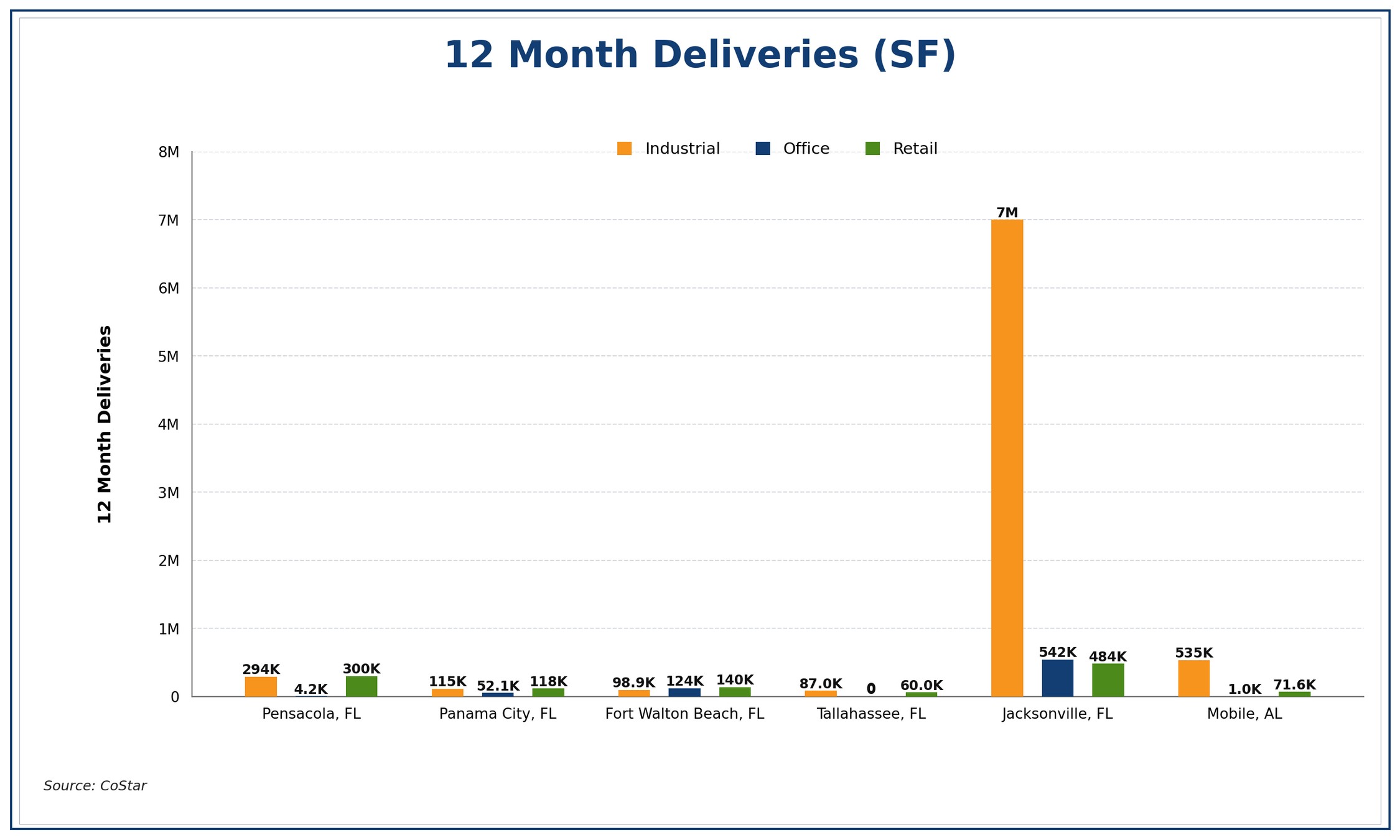
- Jacksonville dominates new supply, with roughly 7.0M SF of industrial deliveries over the past 12 months, far exceeding the other markets.
- Panhandle deliveries remain relatively modest, with Pensacola adding 294K SF industrial and 300K SF retail, while Fort Walton Beach delivered 140K SF of retail.
- Investor takeaway: The limited new supply across much of the Panhandle may support existing properties, while Jacksonville's substantial industrial deliveries increase the need for careful underwriting around vacancy, rents and tenant competition.
12 Month Market Asking Rent Growth
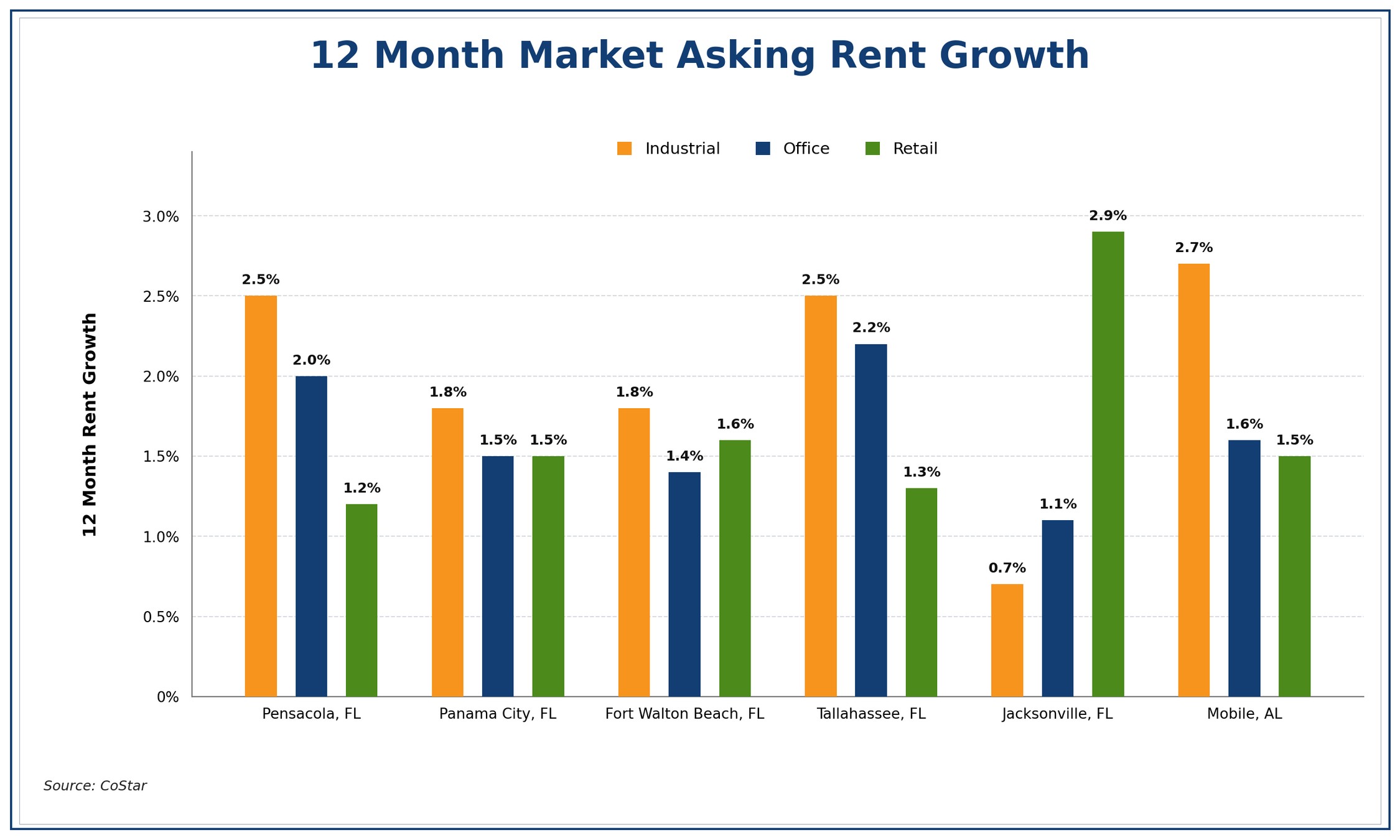
- Industrial remains the strongest rent-growth sector across most markets, led by Pensacola and Tallahassee at 2.5% and Mobile at 2.7%.
- Jacksonville stands out for retail, with 2.9% growth, the highest retail figure in the group, despite slower industrial growth at just 0.7%.
- Investor takeaway: The Panhandle continues to show healthy, broad-based rent growth, particularly in industrial, supporting the case for well-located assets where supply remains limited and tenant demand is durable.
12 Month Sales Volume
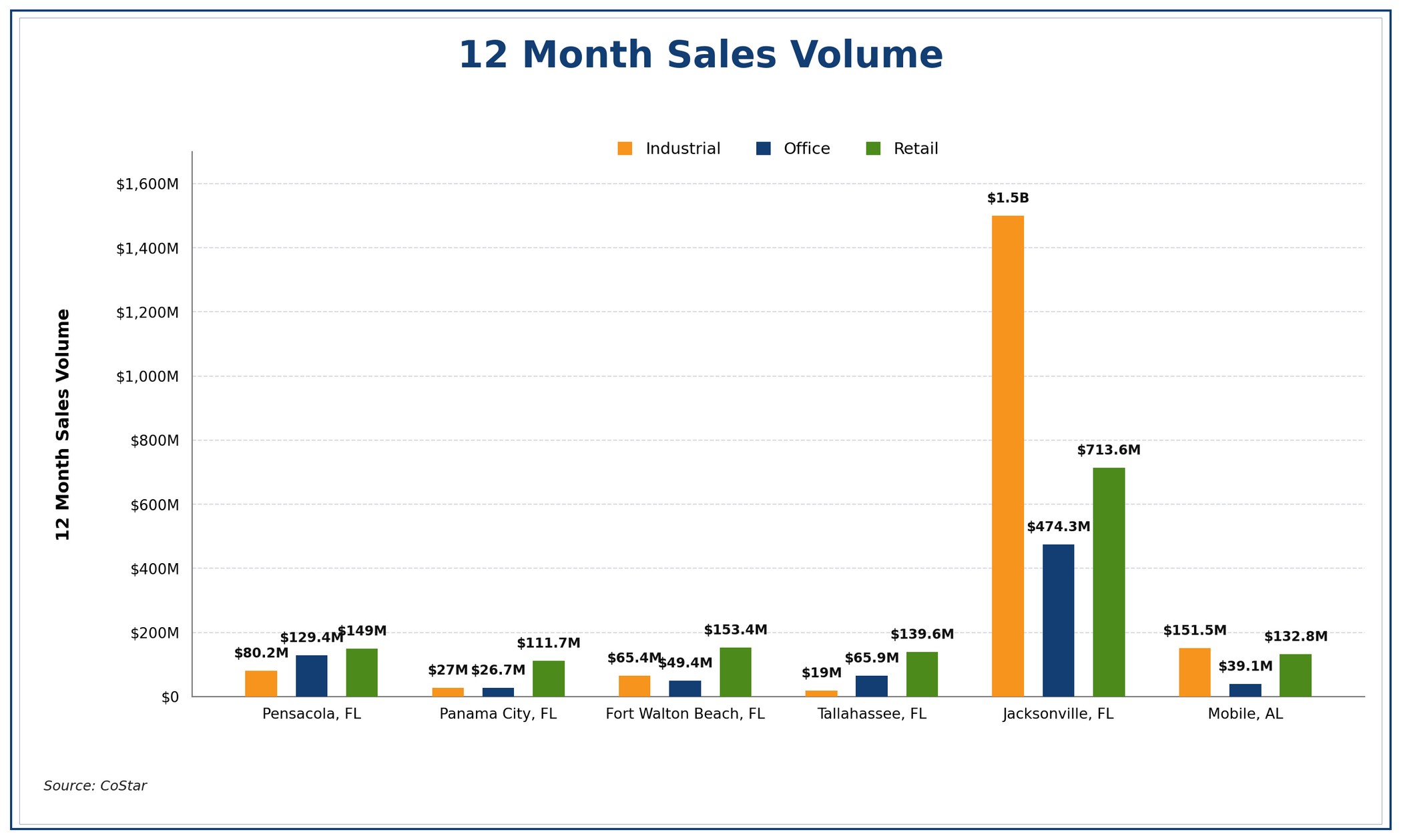
- Retail leads transaction activity across the Panhandle, with Pensacola at $149M, Fort Walton Beach at $153.4M, and Tallahassee at $139.6M in 12-month sales volume.
- Jacksonville remains the most active market by scale, led by $1.5B in industrial and $713.6M in retail sales volume.
- Investor takeaway: The Panhandle shows meaningful liquidity across retail and office, while Jacksonville offers greater transaction depth. For investors, strong sales activity combined with positive rent growth and limited new supply is the more compelling signal than volume alone.
Estimated Market Cap Rate
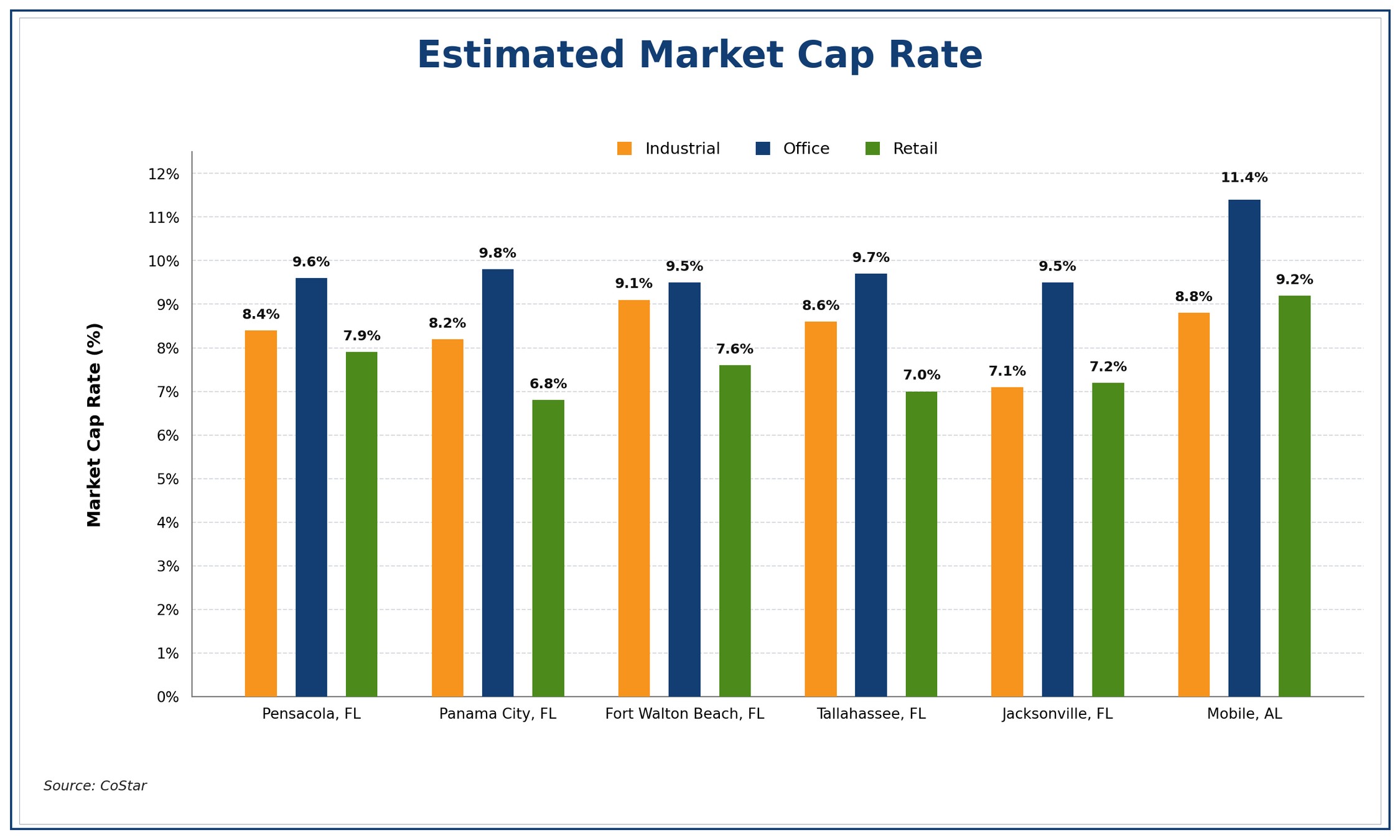
- Industrial cap rates range from 7.1% to 9.1%, with Fort Walton Beach at the high end and Jacksonville at the low end. The higher yields in smaller Panhandle markets may offer stronger going-in returns, but typically come with less transaction liquidity.
- Office carries the highest cap rates across every market, ranging from 9.5% in Fort Walton Beach to 11.4% in Mobile, reflecting the greater perceived risk associated with office assets. Higher yields may create opportunities for investors willing to underwrite tenant rollover, capital expenditures and longer lease-up periods.
- Retail presents a more balanced risk-return profile, with cap rates ranging from 6.8% in Panama City to 9.2% in Mobile. Panama City and Fort Walton Beach stand out for relatively lower retail cap rates, suggesting stronger investor demand for retail assets in those markets.
- Investor takeaway: The data suggests a clear trade-off between yield and perceived risk. For investors seeking higher current returns, industrial in Fort Walton Beach and office in the smaller markets offer wider entry yields; however, retail in markets such as Panama City may offer a more balanced combination of income, demand and risk.
Multifamily
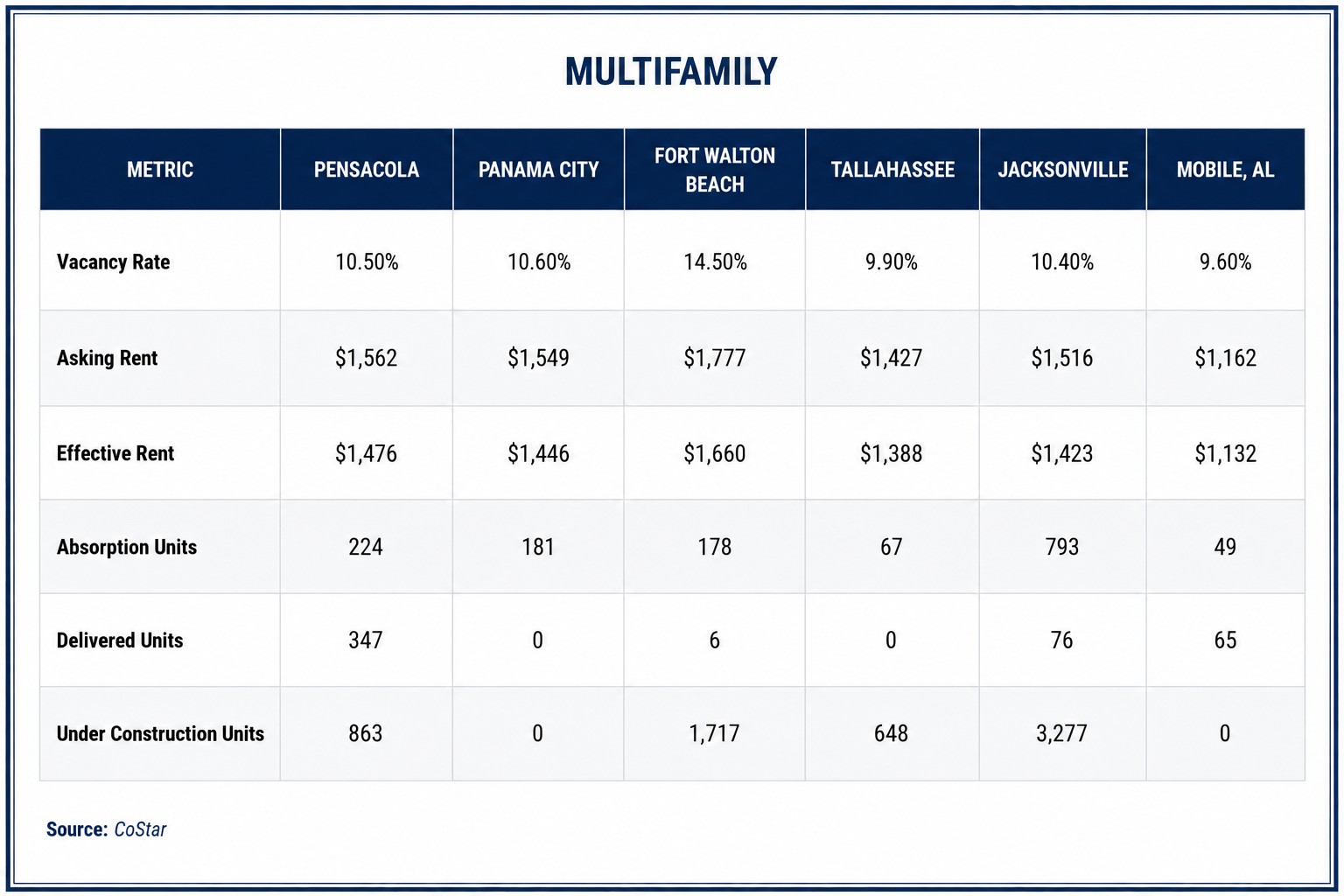
- Fort Walton Beach has the highest vacancy at 14.5%, with 1,717 units under construction — making new supply the market's biggest near-term risk.
- Jacksonville has the strongest absorption at 793 units, but its 3,277-unit pipeline could create future pressure on occupancy and rents.
- Pensacola appears more balanced, combining positive absorption (224 units) with a more moderate 863-unit pipeline.
- Panama City has positive absorption with no units currently under construction, suggesting relatively limited near-term supply risk.
- Investor takeaway: Based on these metrics, Pensacola and Panama City appear to offer the most balanced multifamily fundamentals, while Fort Walton Beach warrants greater caution.
Multifamily Annual Trends
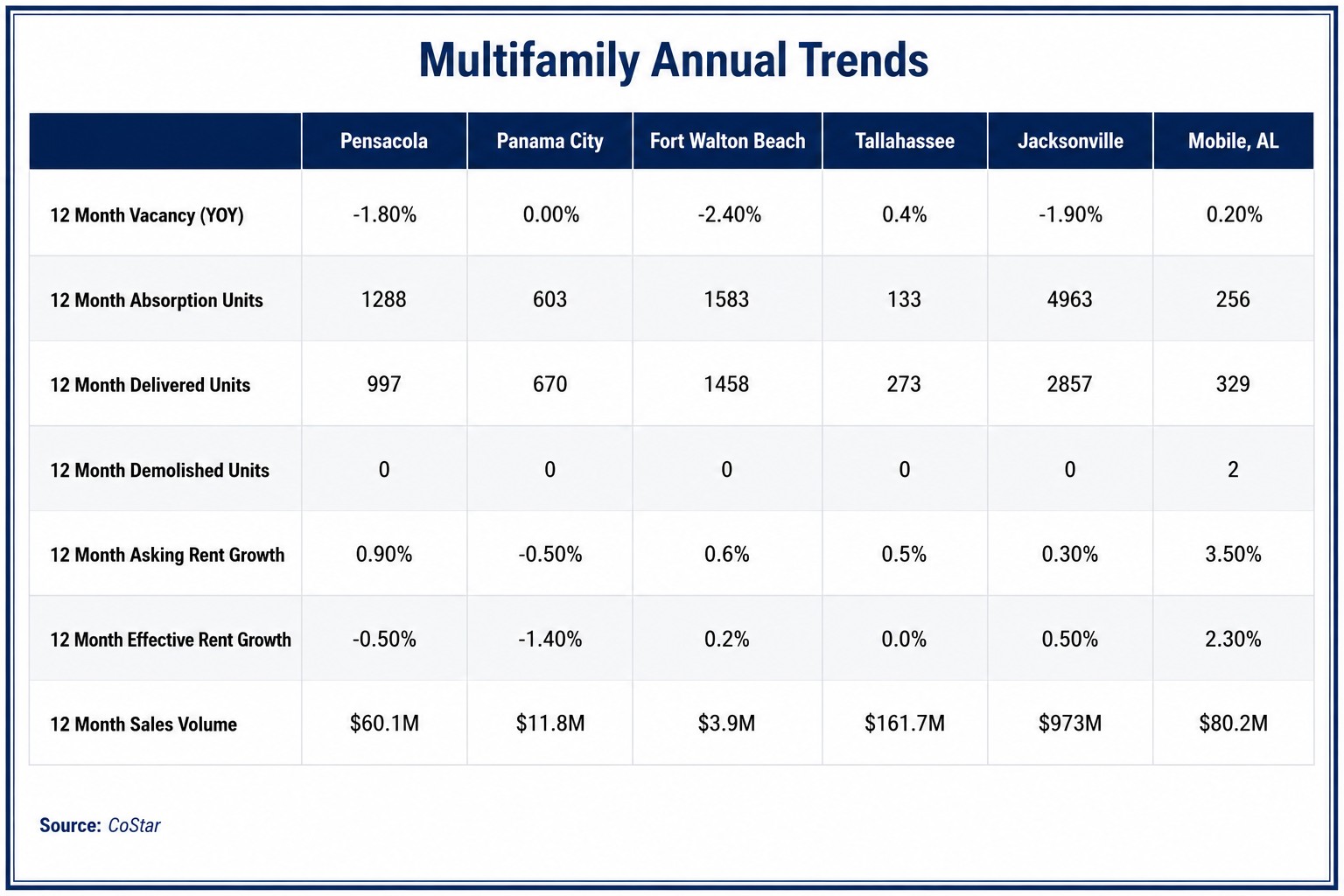
- Fort Walton Beach shows the strongest operating improvement, with vacancy down 2.4% YoY and 1,583 units absorbed, exceeding deliveries of 1,458 units.
- Pensacola also has solid fundamentals, with vacancy down 1.8% and absorption of 1,288 units versus 997 deliveries. However, effective rents declined 0.5%, indicating some pricing pressure.
- Mobile stands out on rent performance, with 3.5% asking rent growth and 2.3% effective rent growth, despite more modest absorption of 256 units.
- Panama City shows the most pressure, with effective rents down 1.4% and asking rents down 0.5%, suggesting softer pricing conditions.
- Investor takeaway: The data points to Fort Walton Beach and Pensacola as the strongest demand stories, while Mobile offers the strongest rent-growth story.
Multifamily Estimated Market Cap Rate
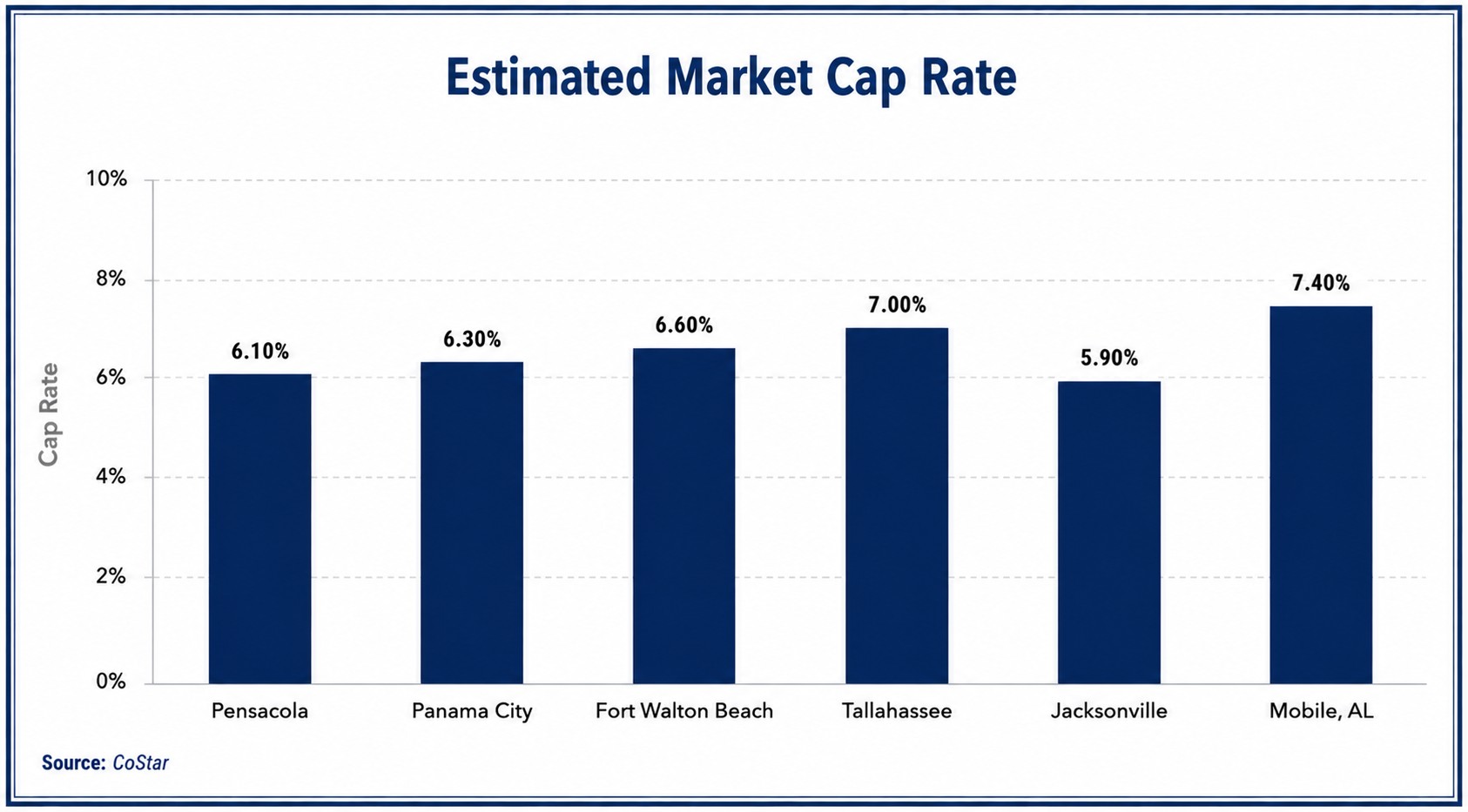
- Multifamily cap rates range from 5.9% in Jacksonville to 7.4% in Mobile, reflecting meaningful differences in pricing and perceived market risk.
- Fort Walton Beach (6.6%) and Panama City (6.3%) offer higher going-in yields than Pensacola (6.1%), but investors should weigh those yields against their respective supply and vacancy conditions.
- Jacksonville's 5.9% cap rate reflects stronger investor demand, consistent with its high absorption, but the market also carries a substantial development pipeline.
- Mobile offers the highest cap rate at 7.4%, providing greater potential current yield, while its strong rent growth makes it particularly noteworthy despite lower absorption.
Overall Takeaway
The market is becoming increasingly selective as we enter the second half of 2026. Across the markets reviewed, Pensacola and Fort Walton Beach are showing some of the strongest demand fundamentals, while Panama City benefits from limited near-term multifamily supply. Mobile stands out for rent growth, particularly in multifamily and retail, while Jacksonville continues to demonstrate strong demand but carries substantially more incoming supply.
From a property-type perspective, industrial and retail appear better positioned than office, with office continuing to face elevated vacancy and weaker absorption in several markets. Multifamily remains attractive where demand is keeping pace with deliveries, but markets with large construction pipelines — particularly Fort Walton Beach and Jacksonville — require more careful underwriting.
Looking ahead 3–6 months, the biggest opportunities may come from assets where fundamentals are improving but pricing has not fully adjusted. Owners should focus on maintaining occupancy and protecting cash flow where new competition is emerging, while investors may find opportunities in well-located assets with durable demand, limited new supply, and attractive entry cap rates.
Bottom line: The data does not point to a broad "buy everything" market. It points to a market-selection and asset-selection environment, where understanding local supply, demand and pricing differences will be increasingly important to investment performance.
If you're looking to acquire commercial real estate or explore investment opportunities along the Gulf Coast, contact Gulf Coast Property Group at (850) 203-5788 or visit Investment Partnerships to learn more about partnering with us.