Northwest Florida CRE Market Update – July 31, 2026
The commercial real estate market across Northwest Florida continues to be shaped by resilient economic growth, disciplined development activity, and evolving capital market conditions.
While elevated interest rates and higher borrowing costs have slowed transaction activity nationally, local markets have remained relatively stable, supported by steady population growth, healthy tenant demand, and limited speculative development. This market update provides a comparative look at key performance indicators across Pensacola, Panama City, Fort Walton Beach, Tallahassee, Jacksonville, and Mobile, offering insight into how industrial, office, retail, and multifamily sectors are performing and where opportunities and challenges are emerging.
Vacancy Rate by Market and Sector
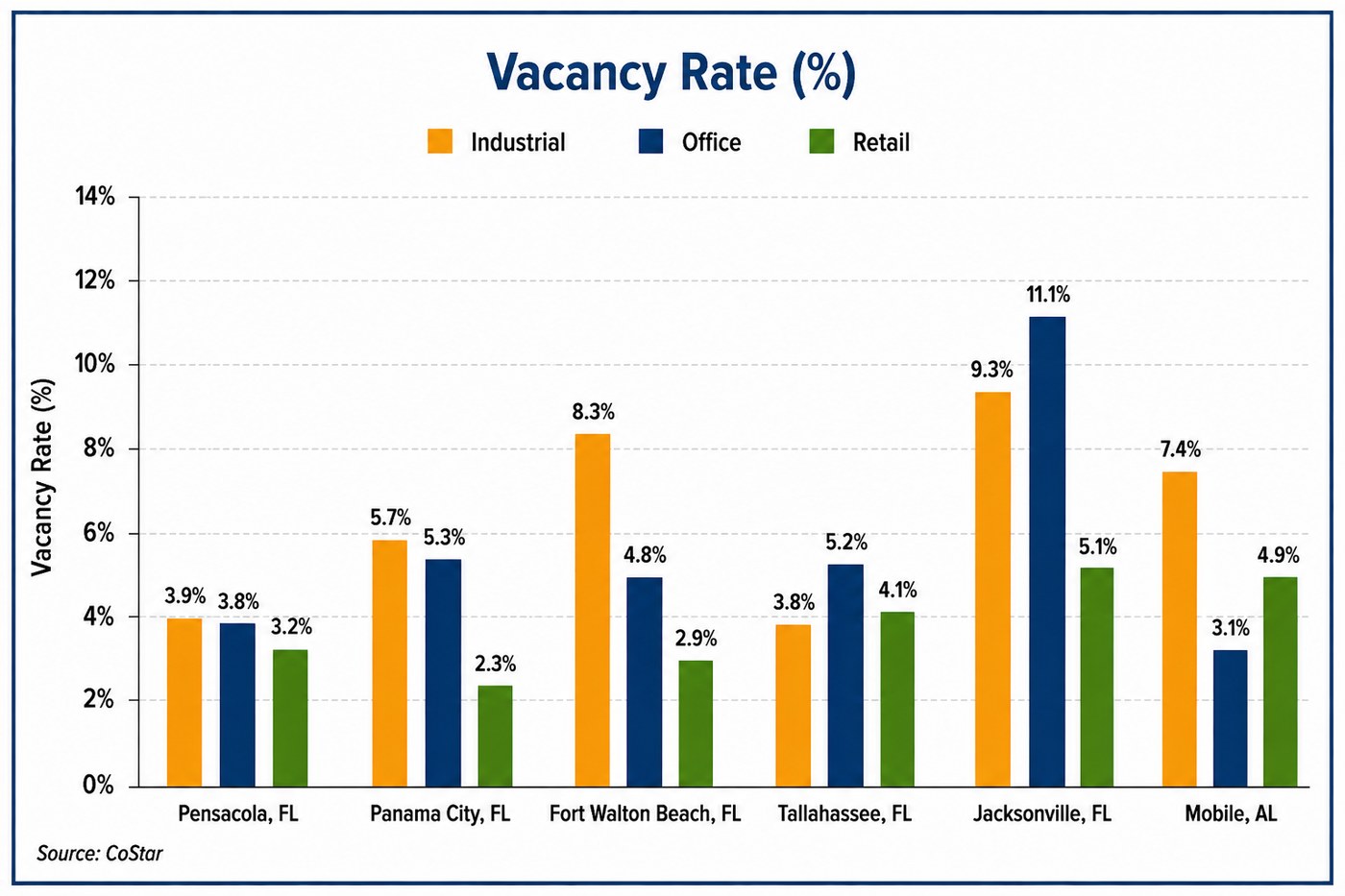
- Pensacola stands out as the region's most balanced CRE market. With vacancy below 4% across industrial, office, and retail, the market reflects healthy tenant demand and constrained supply. While tighter fundamentals may compress cap rates, they also support stronger rent growth and long-term income stability.
- Retail continues to offer the strongest risk-adjusted fundamentals. Every market shown reports retail vacancy below 5.1%, reinforcing the sector's resilience. For investors, necessity-based and neighborhood retail centers remain well-positioned to benefit from limited new supply and sustained consumer demand.
- Office performance is increasingly market-specific, not sector-wide. Jacksonville's 11.1% vacancy highlights the ongoing challenges facing larger urban office markets, while Pensacola and Mobile remain comparatively tight. Investors should prioritize markets with stable employment growth and limited speculative office development rather than making broad assumptions about the office sector.
- Market selection is becoming just as important as asset selection. The nearly threefold difference in industrial vacancy between Pensacola (3.9%) and Jacksonville (9.3%) illustrates how local supply pipelines and tenant demand can materially impact leasing risk, rent growth, and investment returns.
Market Asking Rent
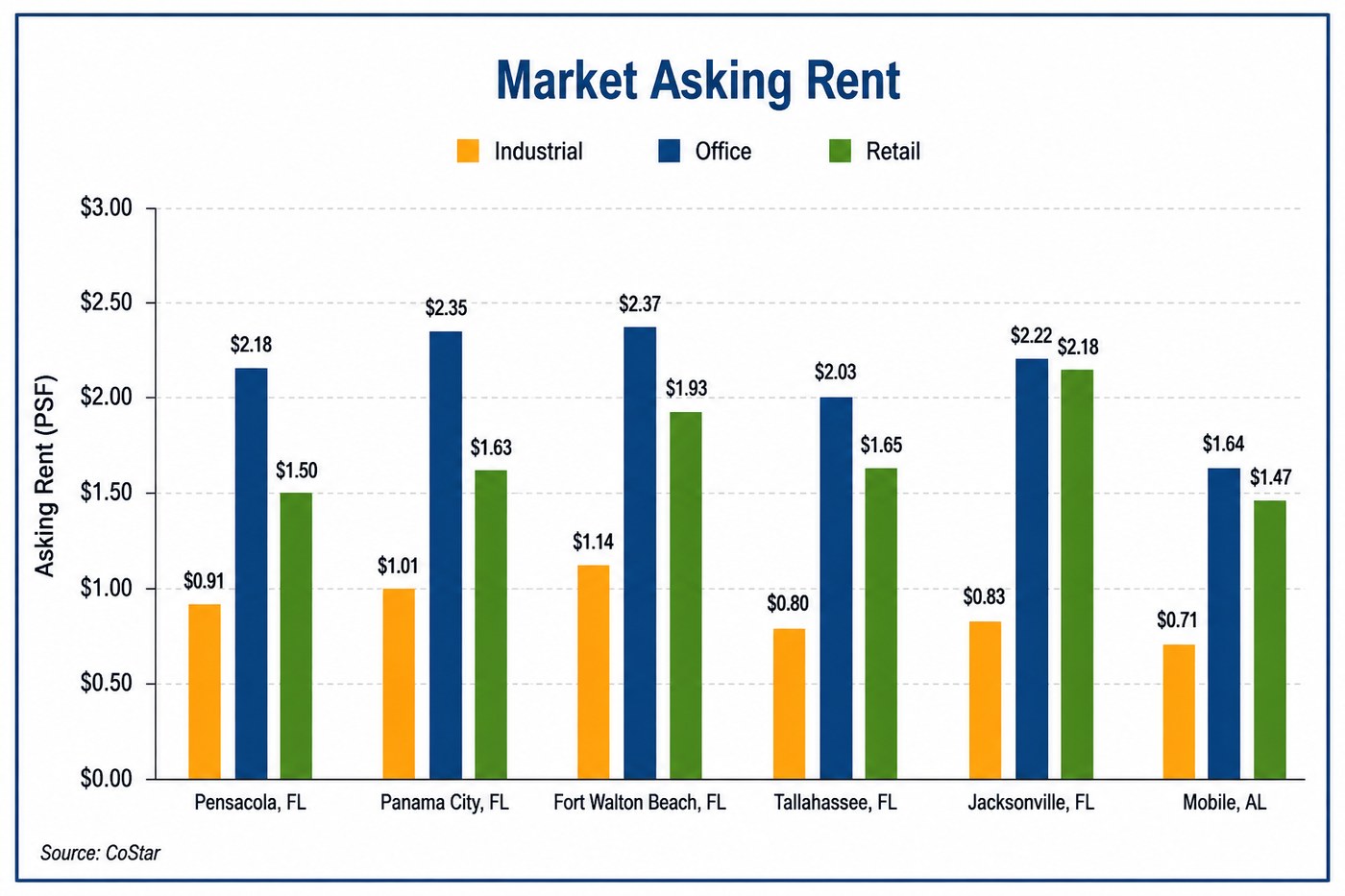
- Fort Walton Beach commands the region's highest asking rents, reflecting strong demand and limited availability across industrial, office, and retail properties.
- Pensacola continues to stand out for its pricing power. While asking rents remain below some neighboring markets, exceptionally low vacancy suggests additional room for rent growth.
- Jacksonville demonstrates that premium rents don't always translate into stronger fundamentals. Higher asking rents are accompanied by elevated vacancy, increasing leasing risk and competitive pressure.
- Retail pricing remains resilient across every market, reinforcing investor demand for necessity-based centers supported by limited new supply and steady consumer spending.
- For investors, the best opportunities may lie where strong occupancy supports future rent growth—not simply where today's asking rents are highest. Markets with balanced supply and demand often deliver more durable long-term performance.
Availability Rate
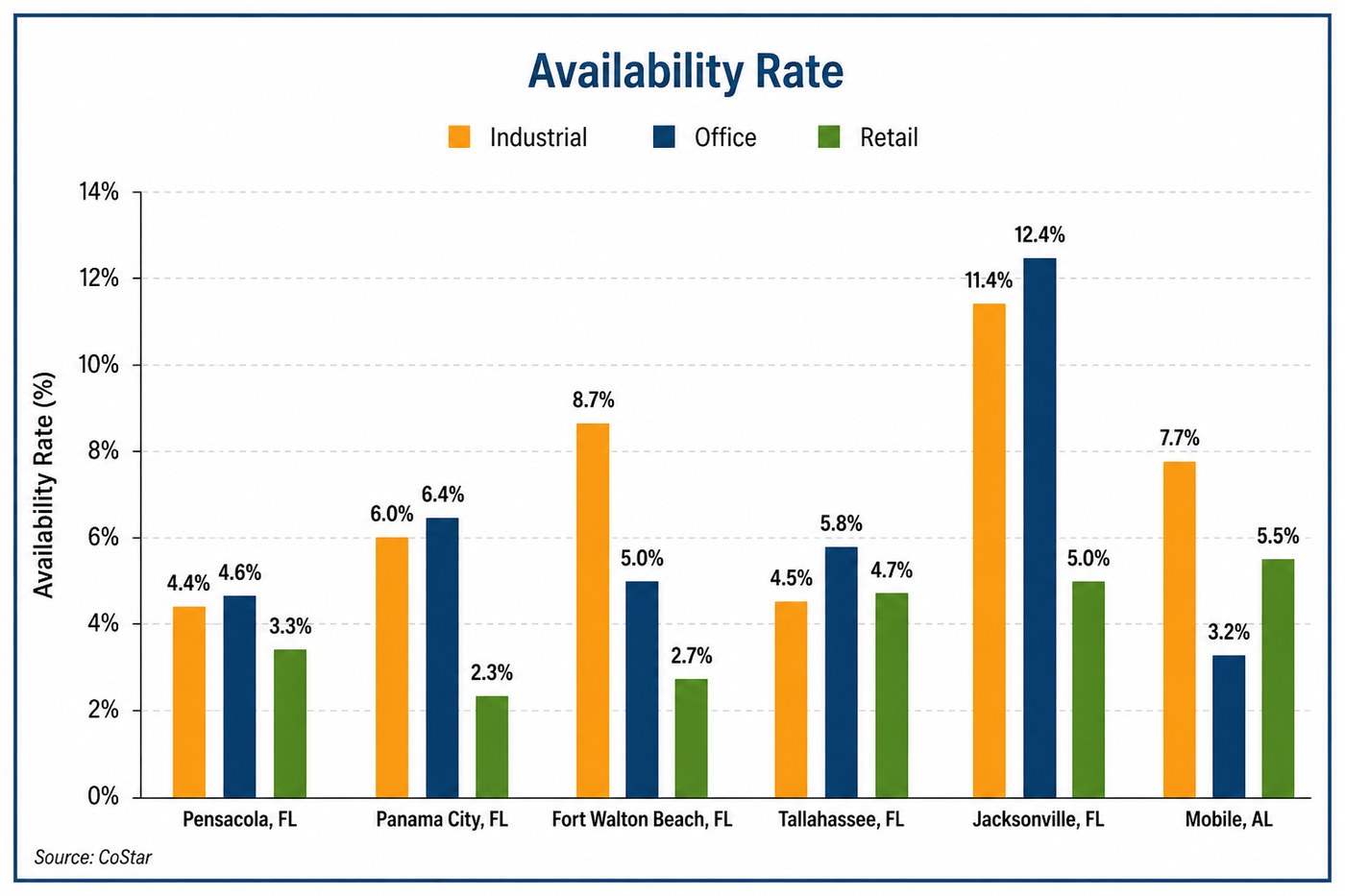
- Pensacola continues to demonstrate the region's healthiest market fundamentals, with the lowest availability across all three property types, indicating limited supply and continued landlord pricing power.
- Jacksonville's double-digit industrial (11.4%) and office (12.4%) availability signals a more competitive leasing environment. Elevated available space may increase concessions and slow rent growth until demand catches up.
- Retail availability remains remarkably tight across the region, with every market below 5.5%, reinforcing the sector's resilience and supporting long-term occupancy and rental stability.
- Fort Walton Beach presents an interesting contrast. While industrial asking rents lead the region, availability remains relatively elevated (8.7%), suggesting recently delivered space still needs to be absorbed before landlords regain stronger leverage.
- For investors, availability rates often provide an early signal of market direction. Markets with low availability are generally better positioned for future rent growth, while elevated availability may indicate slower lease-up periods and greater near-term income risk.
Net Absorption (SF)
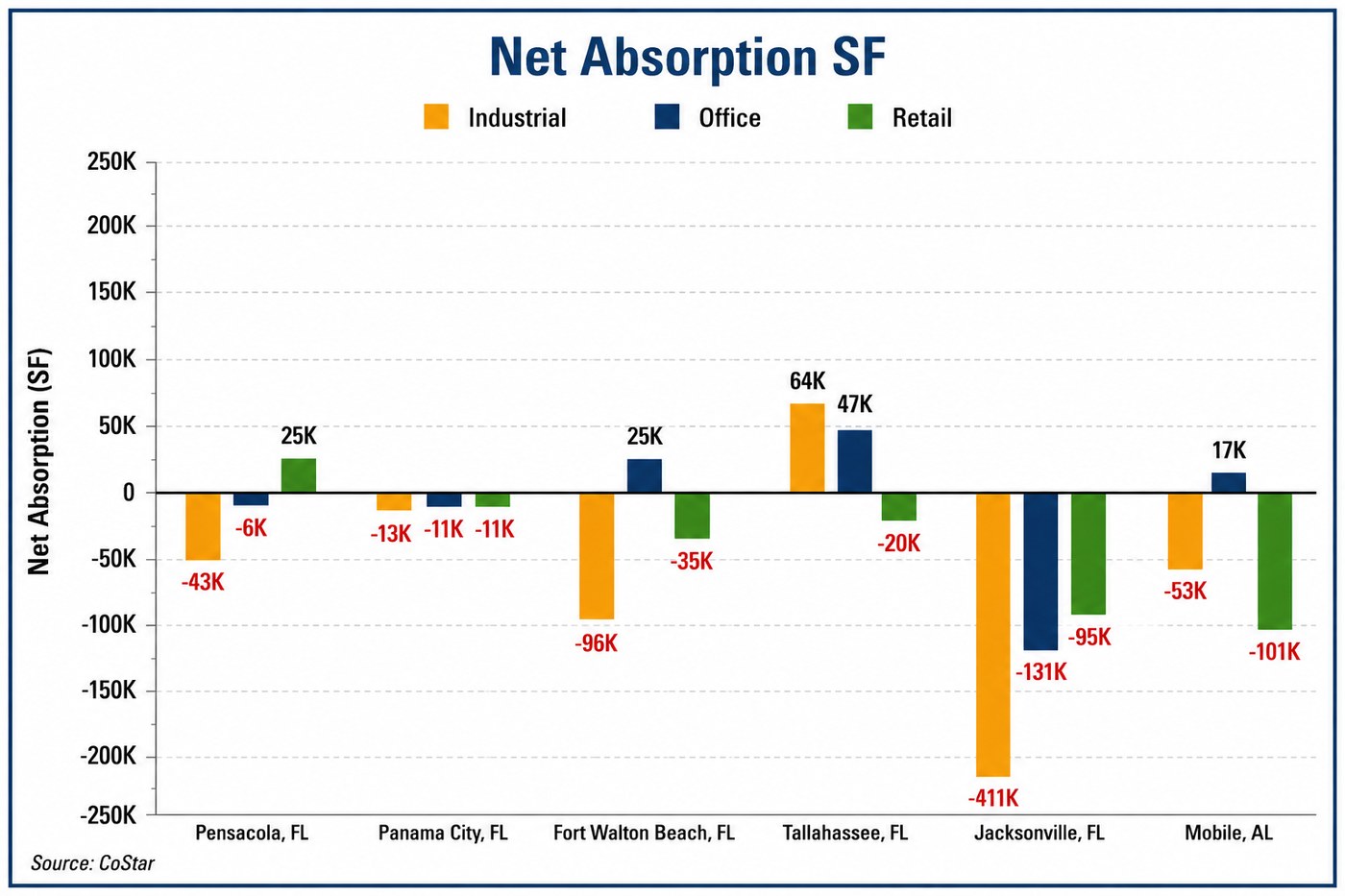
- Tallahassee was the only market to post positive industrial and office absorption, signaling healthy tenant expansion and continued demand for well-located commercial space.
- Jacksonville experienced the weakest performance, with significant negative absorption across all three sectors, suggesting supply is outpacing demand and leasing conditions remain challenging.
- Pensacola and Panama City posted modest absorption overall, indicating relatively stable market conditions despite limited near-term tenant expansion.
- Office demand remains highly market-specific. Positive absorption in Tallahassee and Mobile contrasts with continued softness elsewhere, reinforcing the importance of local market dynamics over national office trends.
- For investors, sustained positive absorption often precedes stronger rent growth and tighter vacancies.
Under Construction (SF)
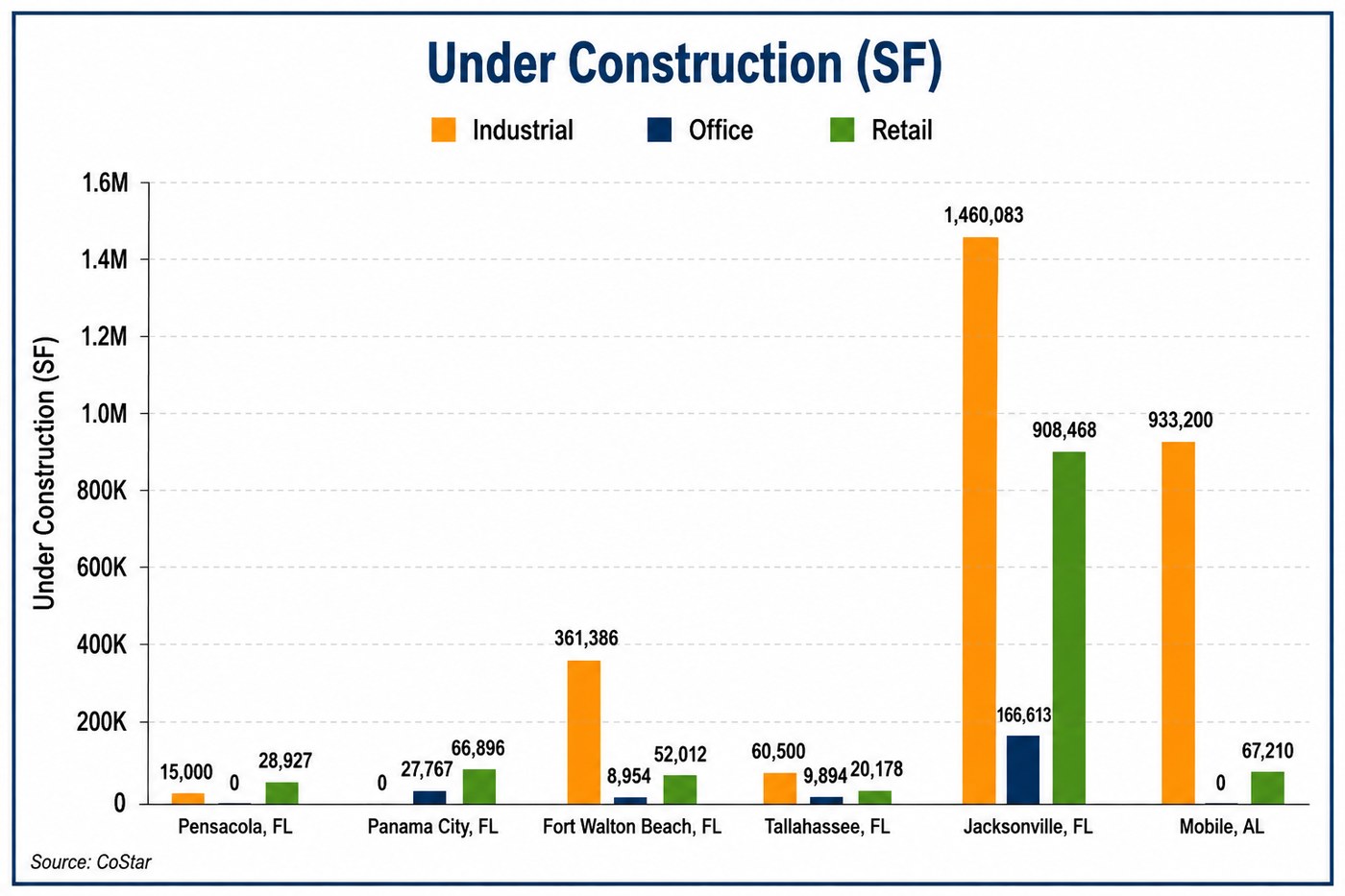
- Jacksonville has the region's largest development pipeline by a wide margin, particularly in industrial (1.46M SF) and retail (908K SF). While this reflects strong long-term confidence, it also increases the risk of near-term lease-up pressure and slower rent growth.
- Pensacola's limited construction pipeline supports its strong fundamentals. With minimal new development across all property types, existing assets may benefit from continued supply constraints and greater pricing power.
- Fort Walton Beach remains one of the Panhandle's most active growth markets. A meaningful industrial pipeline reflects continued demand, but new deliveries will need to be absorbed to sustain current rental momentum.
- Mobile's industrial pipeline stands out despite softer recent absorption. Investors should monitor leasing activity closely, as the success of new projects will depend on continued tenant demand.
- New supply remains highly concentrated in a few markets. Markets with disciplined development pipelines may offer more durable occupancy, rent growth, and long-term cash flow.
12-Month Vacancy Change (YOY)
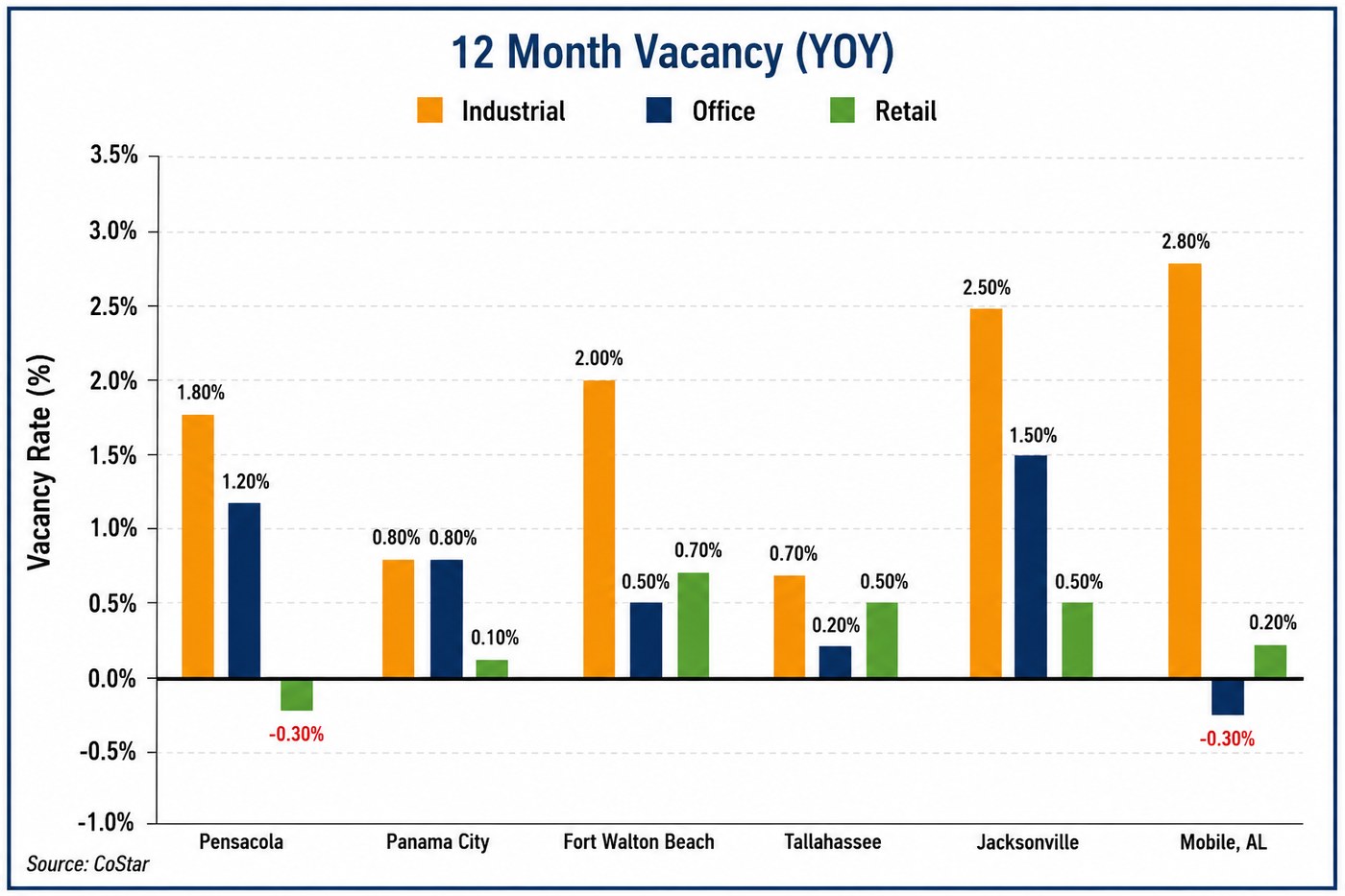
- Industrial vacancy increased across every market, with the largest year-over-year increases in Mobile (+2.8%) and Jacksonville (+2.5%), reflecting recent supply additions that will require continued leasing to stabilize.
- Retail fundamentals remain the most resilient. Retail vacancy was essentially flat across most markets, while Pensacola (-0.3%) posted the region's only year-over-year decline.
- Office trends remain highly localized. Jacksonville (+1.5%) and Pensacola (+1.2%) experienced the largest increases in office vacancy, while Mobile (-0.3%) was the only market to record an improvement.
- Panhandle markets continue to demonstrate relative stability. Panama City, Fort Walton Beach, and Tallahassee all posted modest year-over-year changes across most property types.
- For investors, rising vacancy isn't necessarily a warning sign—it should be viewed alongside new construction and absorption.
12-Month Net Absorption (SF)
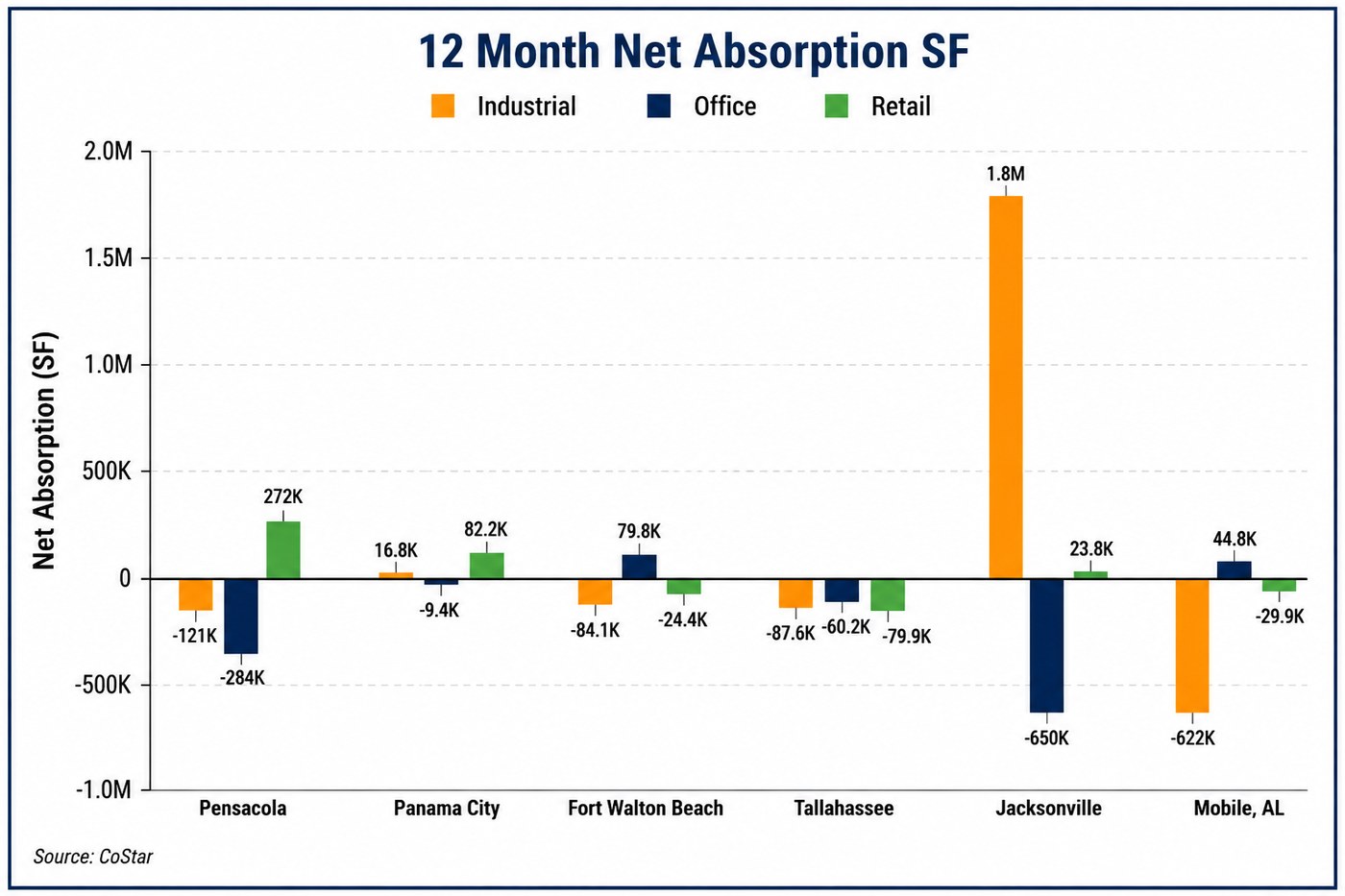
- Jacksonville remains the region's industrial powerhouse, generating 1.8 million SF of annual industrial absorption, despite recent increases in vacancy.
- Pensacola and Panama City stand out for retail demand, posting the strongest annual retail absorption in the region.
- Office demand remains uneven across markets. Fort Walton Beach and Mobile posted positive annual office absorption, while Jacksonville and Pensacola continue to work through elevated office availability.
- Tallahassee and Fort Walton Beach recorded negative absorption across multiple sectors, highlighting the importance of local economic drivers when evaluating investment opportunities.
- Markets consistently adding occupied space are generally better positioned to support occupancy, rent growth, and long-term asset appreciation.
12-Month Deliveries (SF)
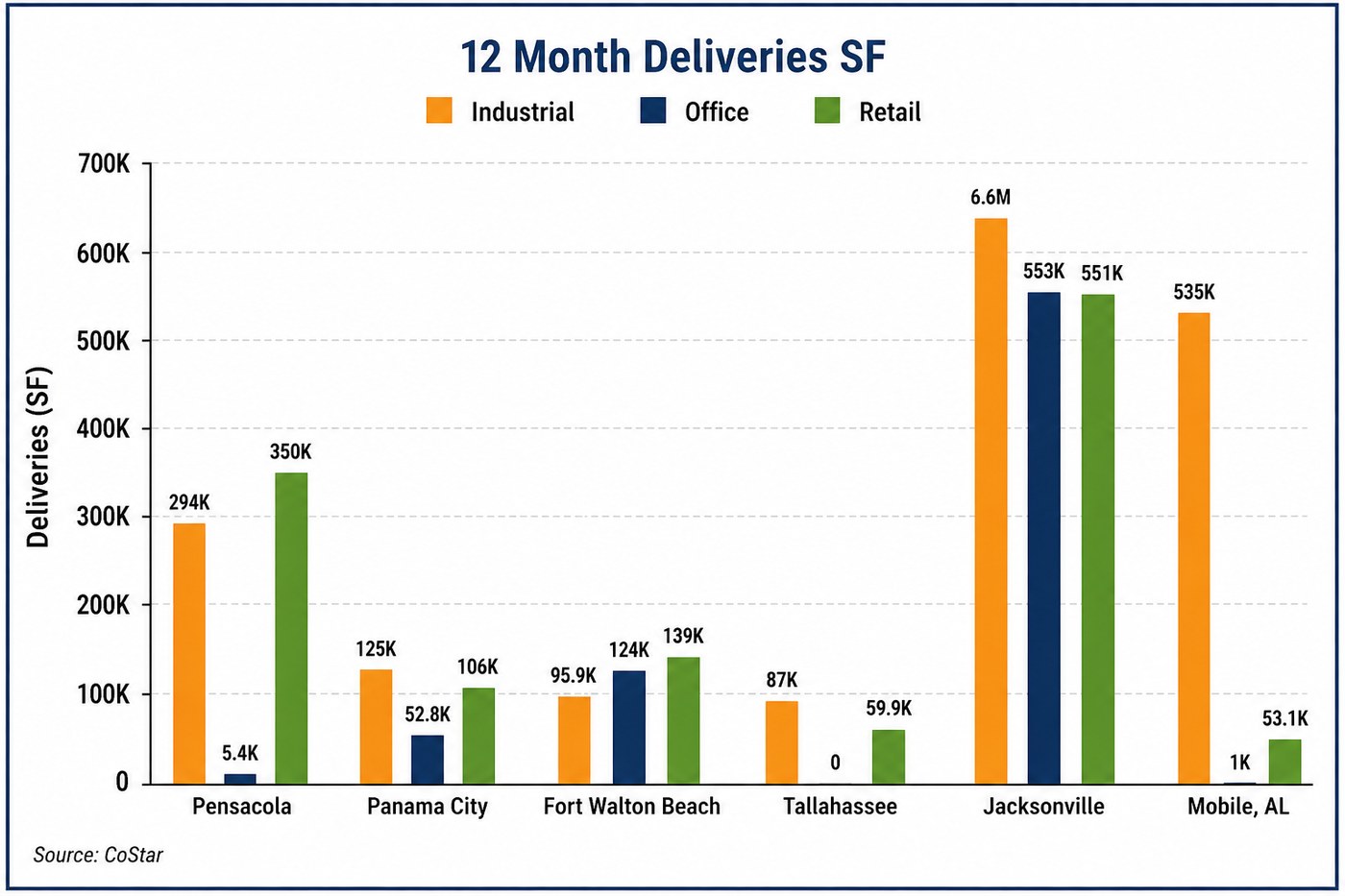
- Jacksonville led the region in new deliveries across all property types, reinforcing its role as a major growth market. The challenge now will be absorbing this new inventory without creating prolonged vacancy pressure.
- Pensacola's measured development pipeline supports long-term market stability, helping limit oversupply risk while preserving future rent growth potential.
- Fort Walton Beach and Panama City continue to add inventory at a disciplined pace, allowing new supply to better align with tenant demand.
- Mobile's industrial market remains expansion-focused, with more than 500,000 SF delivered over the past year.
- New deliveries should be viewed alongside absorption and vacancy trends when underwriting future performance.
12-Month Market Asking Rent Growth
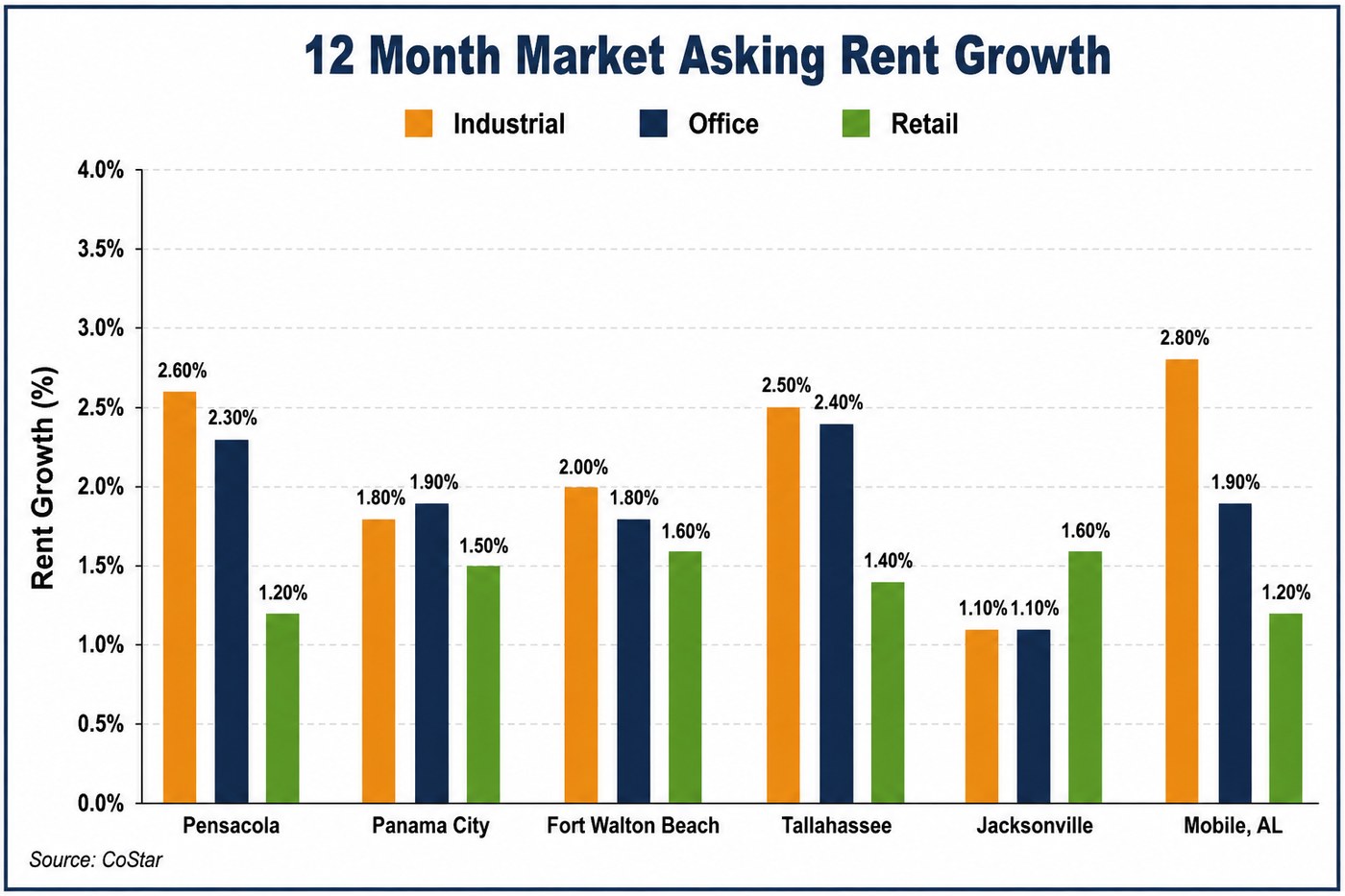
- Industrial continues to lead rent growth across the region, with Mobile (2.8%), Pensacola (2.6%), and Tallahassee (2.5%) posting the strongest gains.
- Pensacola demonstrates one of the healthiest combinations of fundamentals, pairing above-average rent growth with low vacancy and limited new supply.
- Office rent growth remains positive across every market, suggesting well-located, high-quality office assets continue to command pricing power.
- Retail rent growth remains steady and consistent, reinforcing the sector's resilience.
- Sustained rent growth is a key driver of NOI and asset appreciation.
12-Month Sales Volume
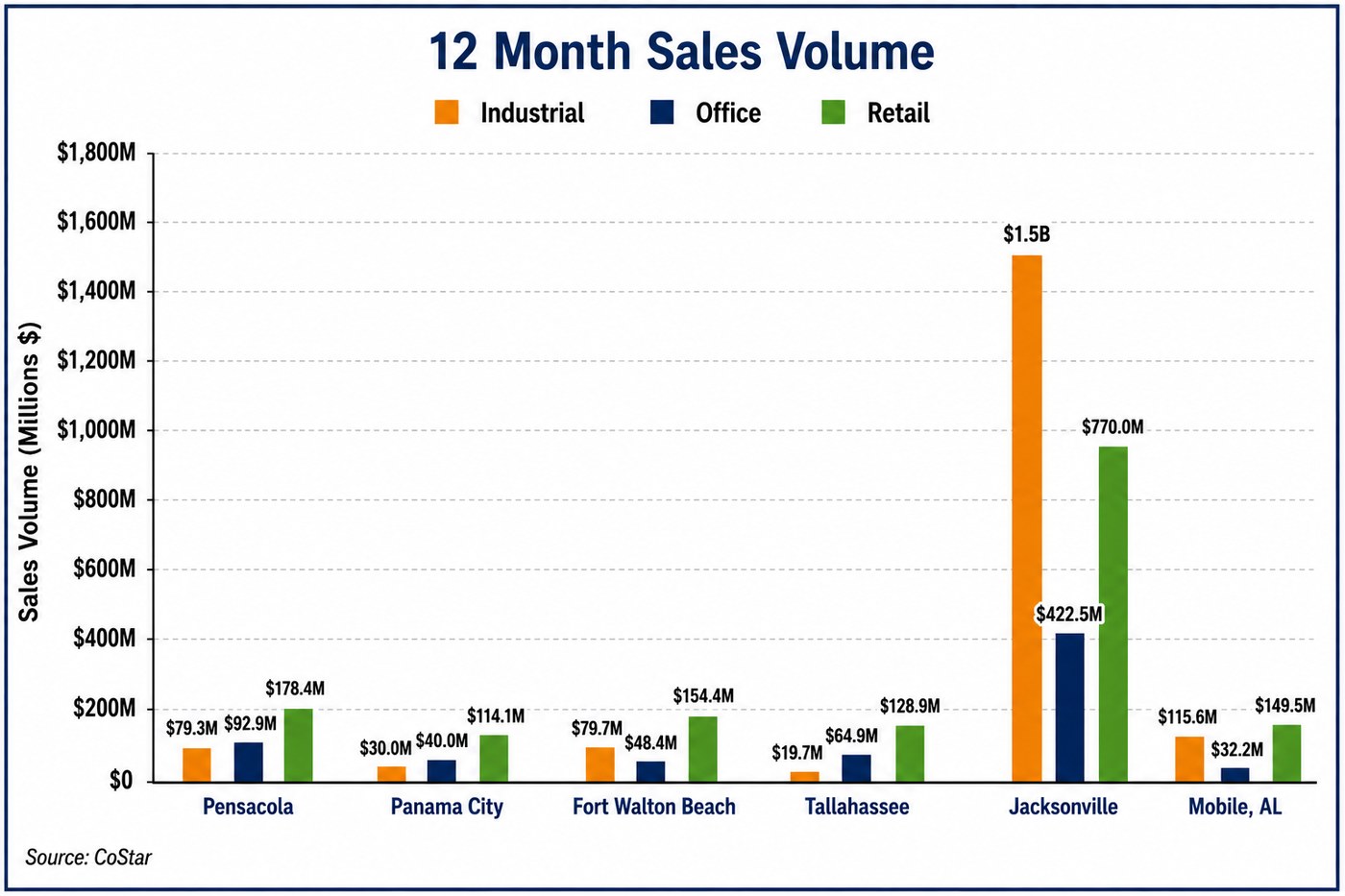
- Jacksonville continues to dominate regional investment activity, attracting the highest sales volume across industrial, office, and retail.
- Retail remains a favored asset class, generating strong transaction volume across nearly every market.
- Pensacola and Fort Walton Beach are attracting balanced investment across multiple property sectors, signaling broad investor confidence.
- Lower transaction volume in markets like Tallahassee and Panama City may reflect limited inventory rather than weak demand, creating opportunities for investors seeking less competitive acquisitions.
- Sales volume is a key indicator of market liquidity and exit flexibility.
Estimated Market Cap Rate
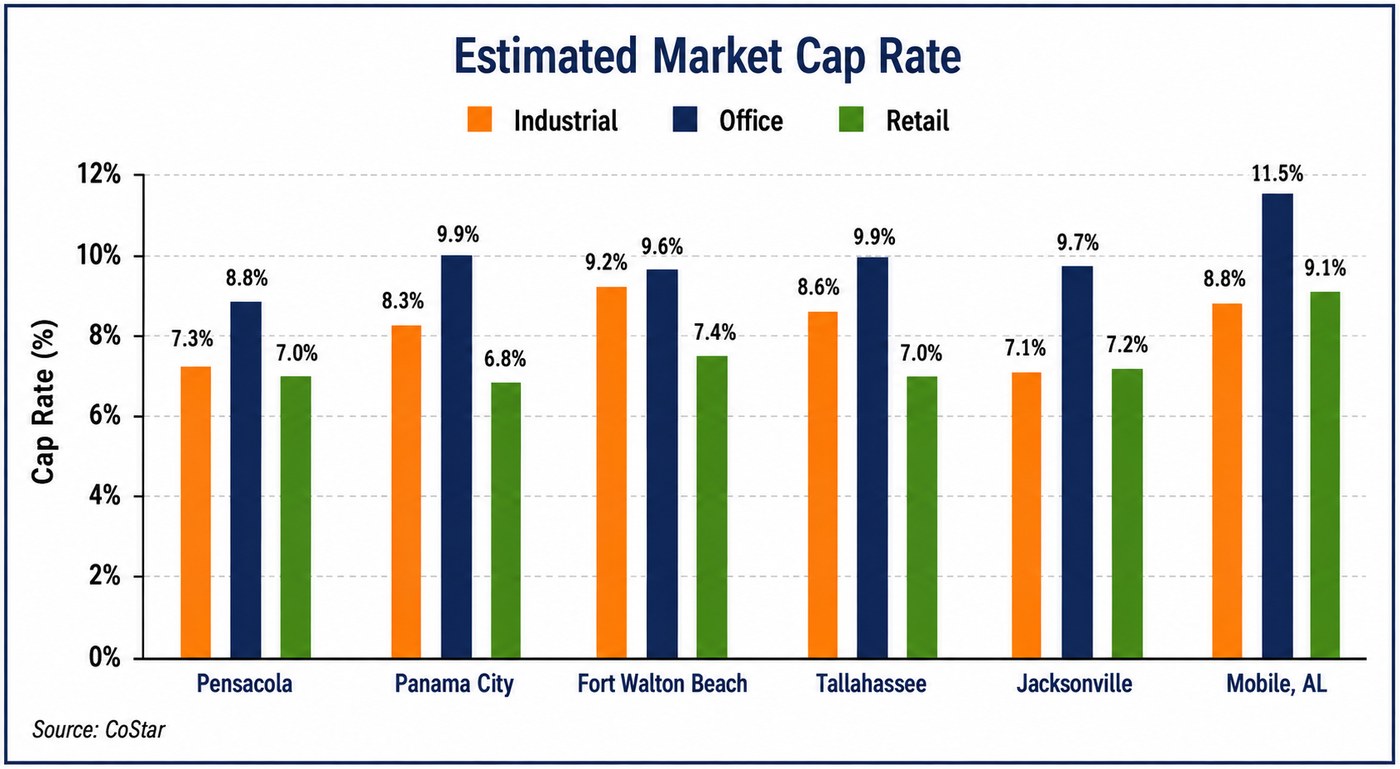
- Pensacola continues to command the lowest cap rates in the region, reflecting strong investor demand, stable fundamentals, and lower perceived investment risk.
- Mobile and Fort Walton Beach offer some of the highest cap rates, providing potentially higher yield opportunities for investors willing to underwrite additional leasing or market risk.
- Office cap rates remain elevated across every market, highlighting continued investor caution toward the sector.
- Retail cap rates remain relatively compressed, reflecting sustained demand for necessity-based retail assets.
- Cap rates should always be evaluated alongside market fundamentals.
Multifamily Update
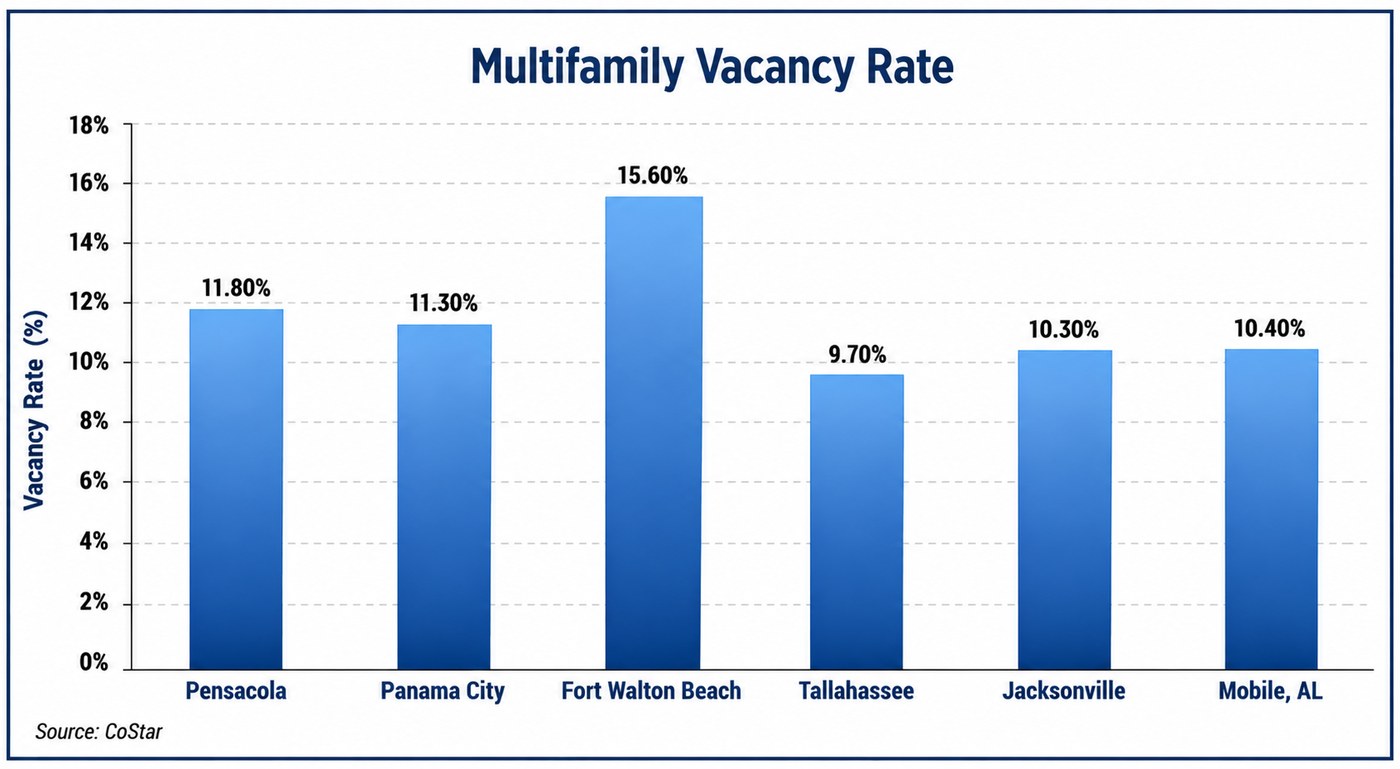
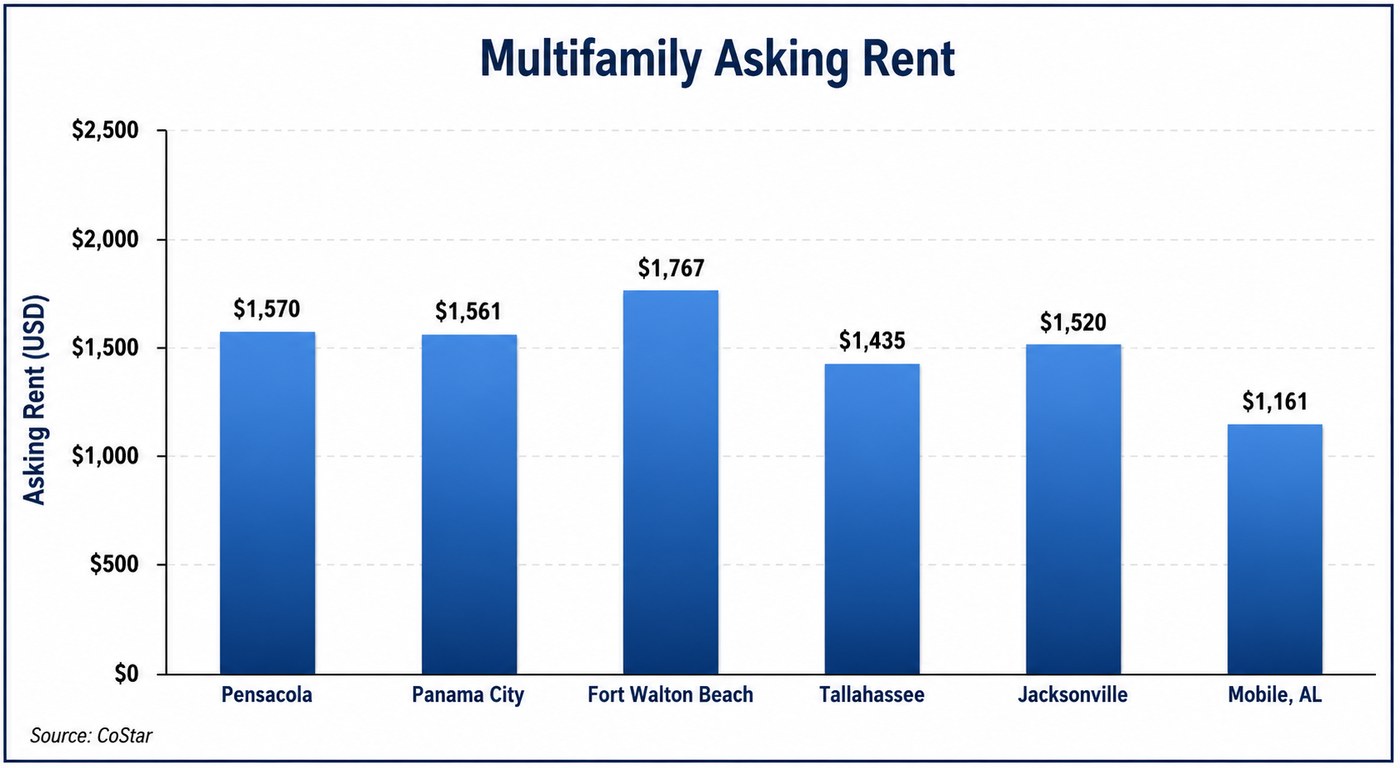
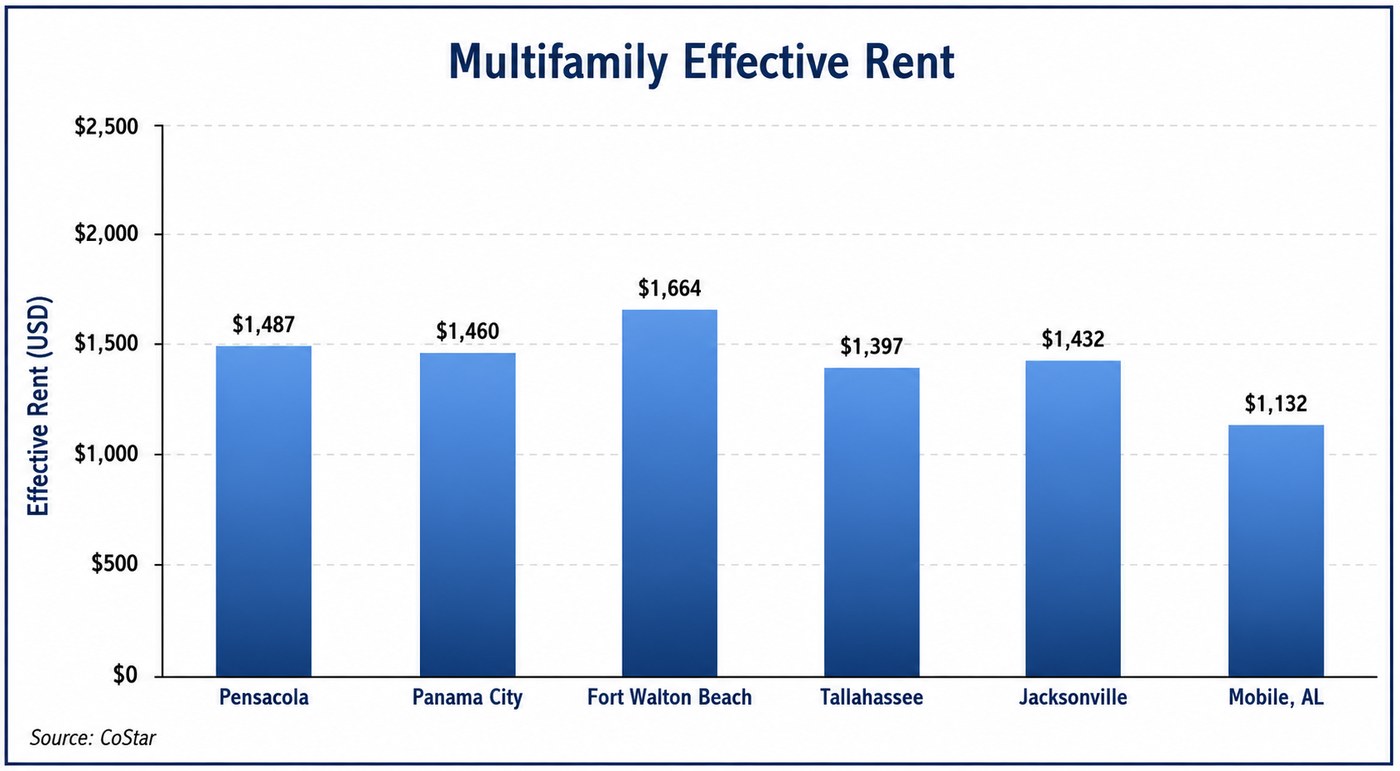
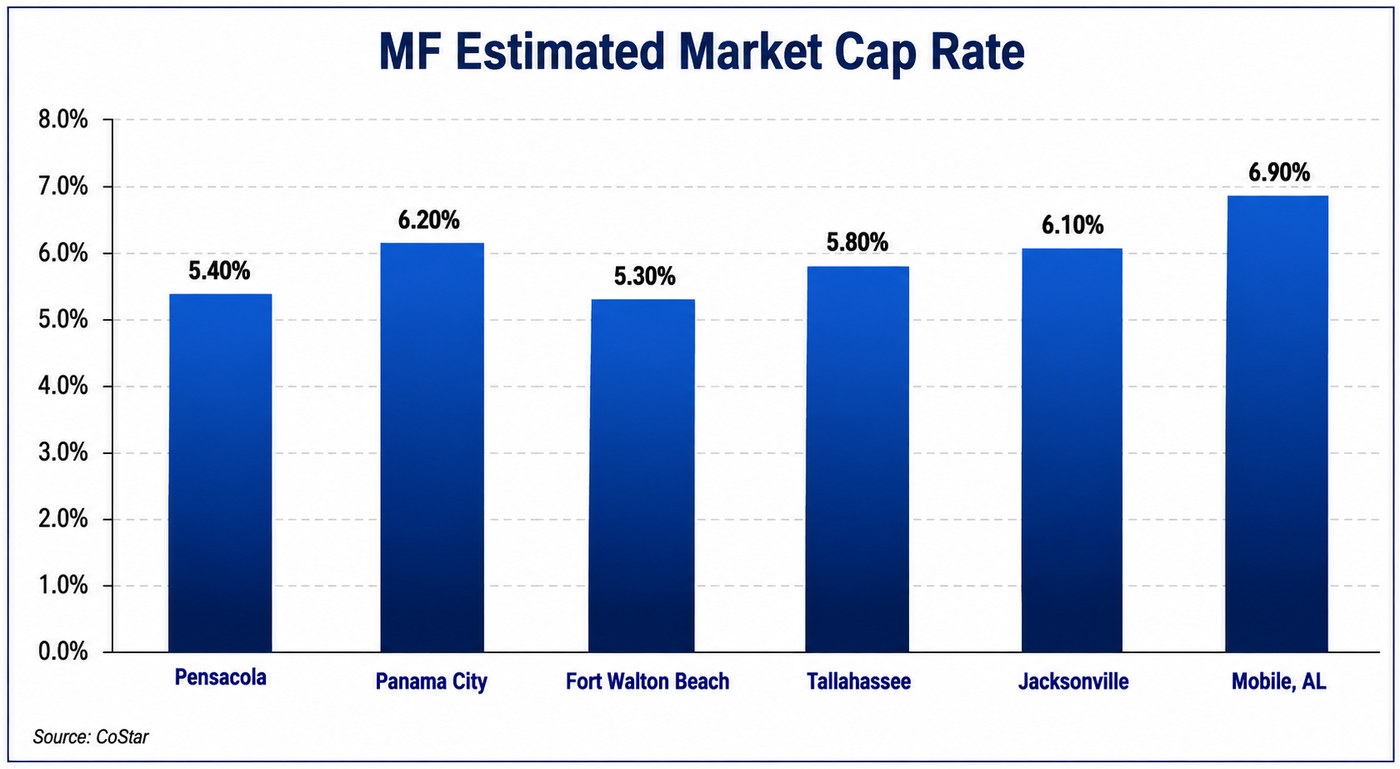
Vacancy, asking rent, effective rent, and estimated cap rates across the region's multifamily markets:
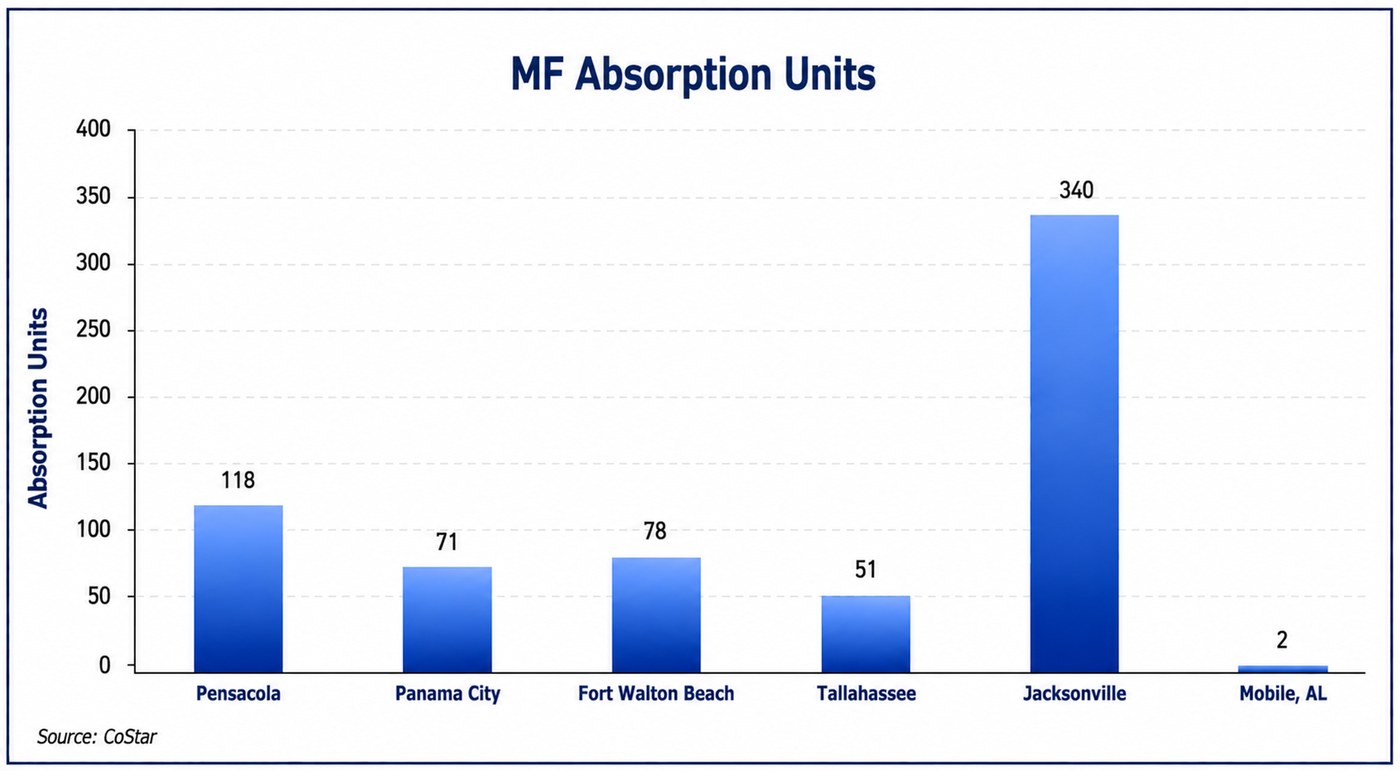
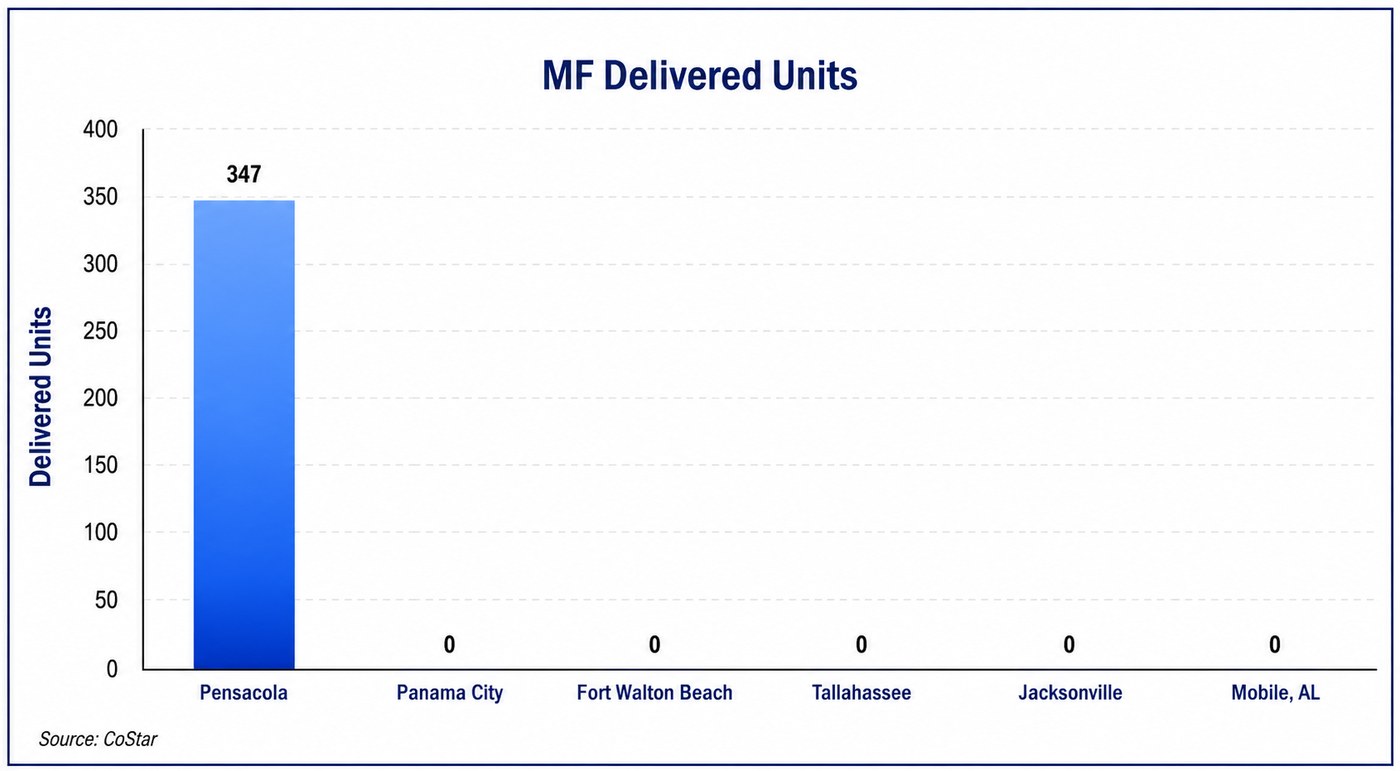
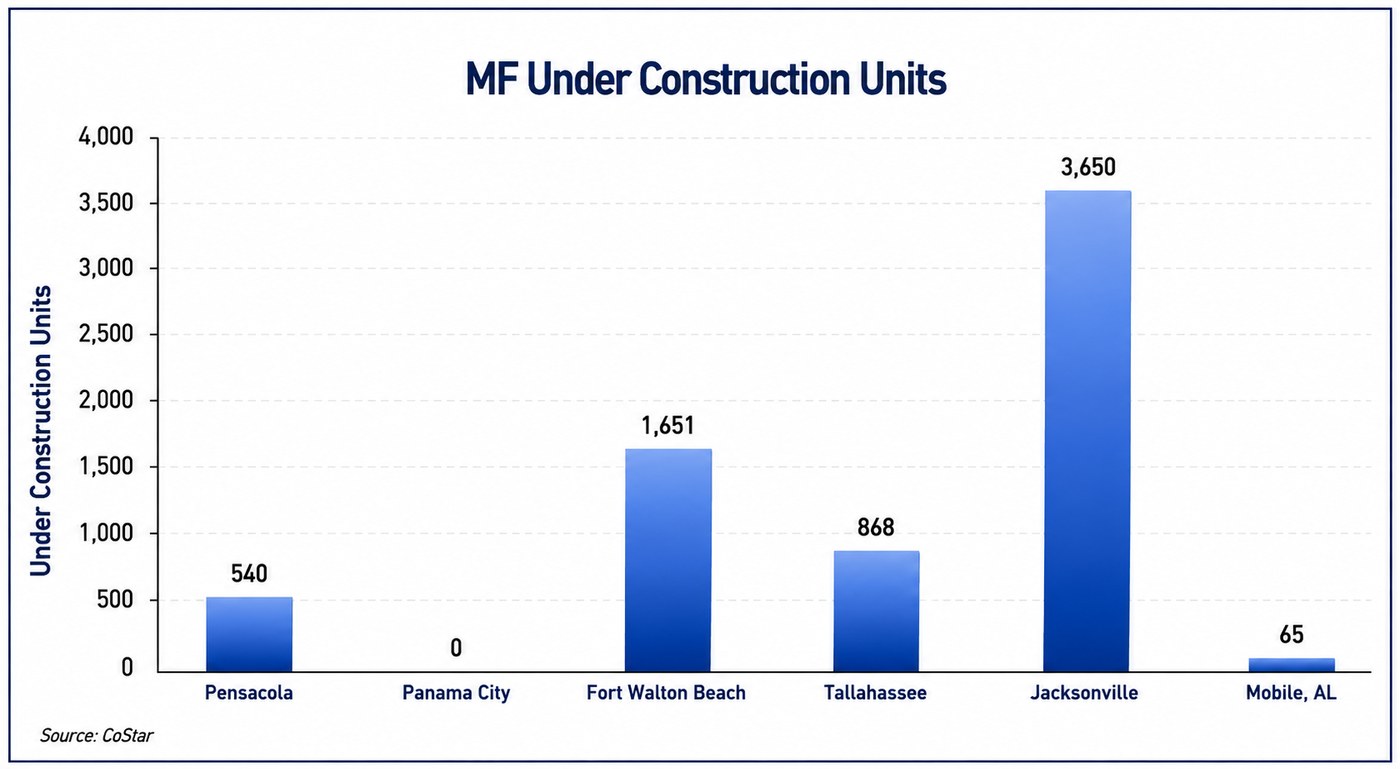
Multifamily Supply and Demand
Multifamily 12-Month Trends
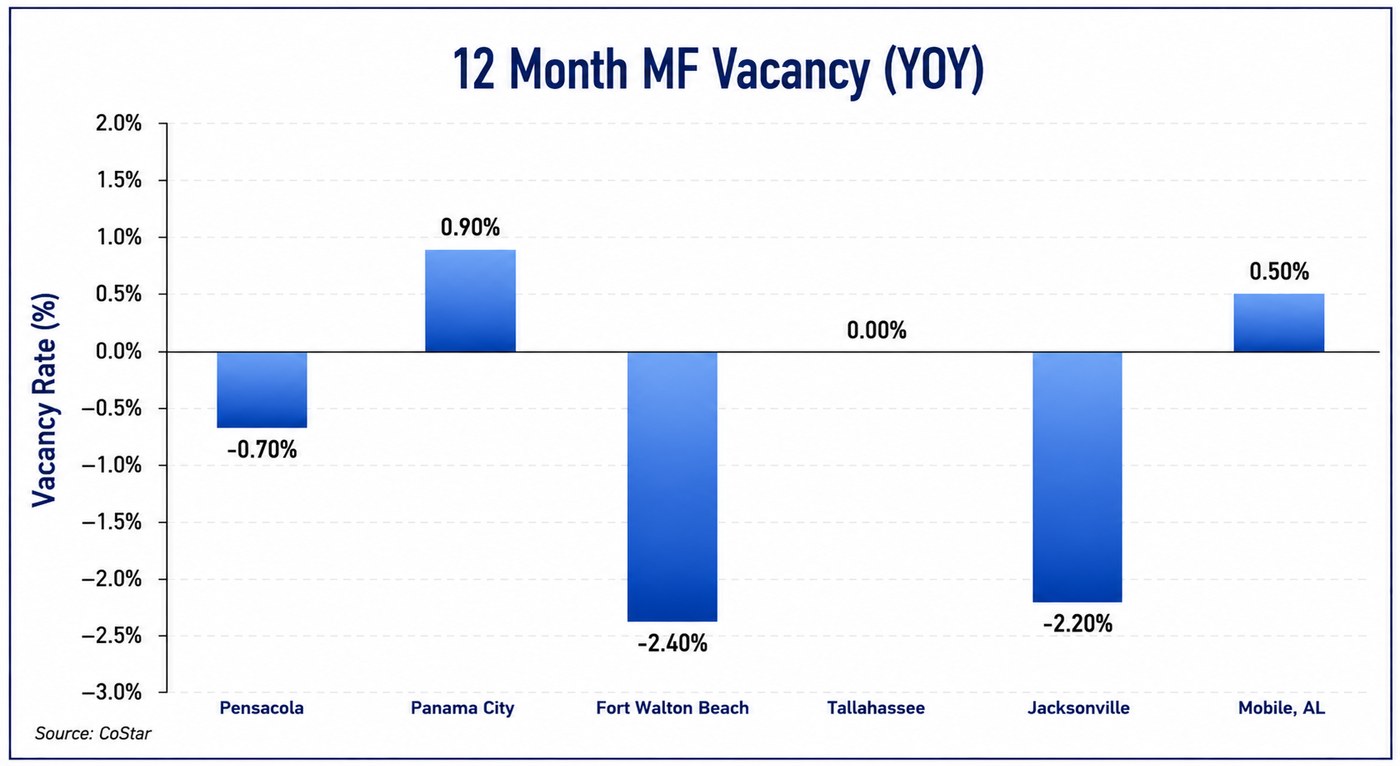
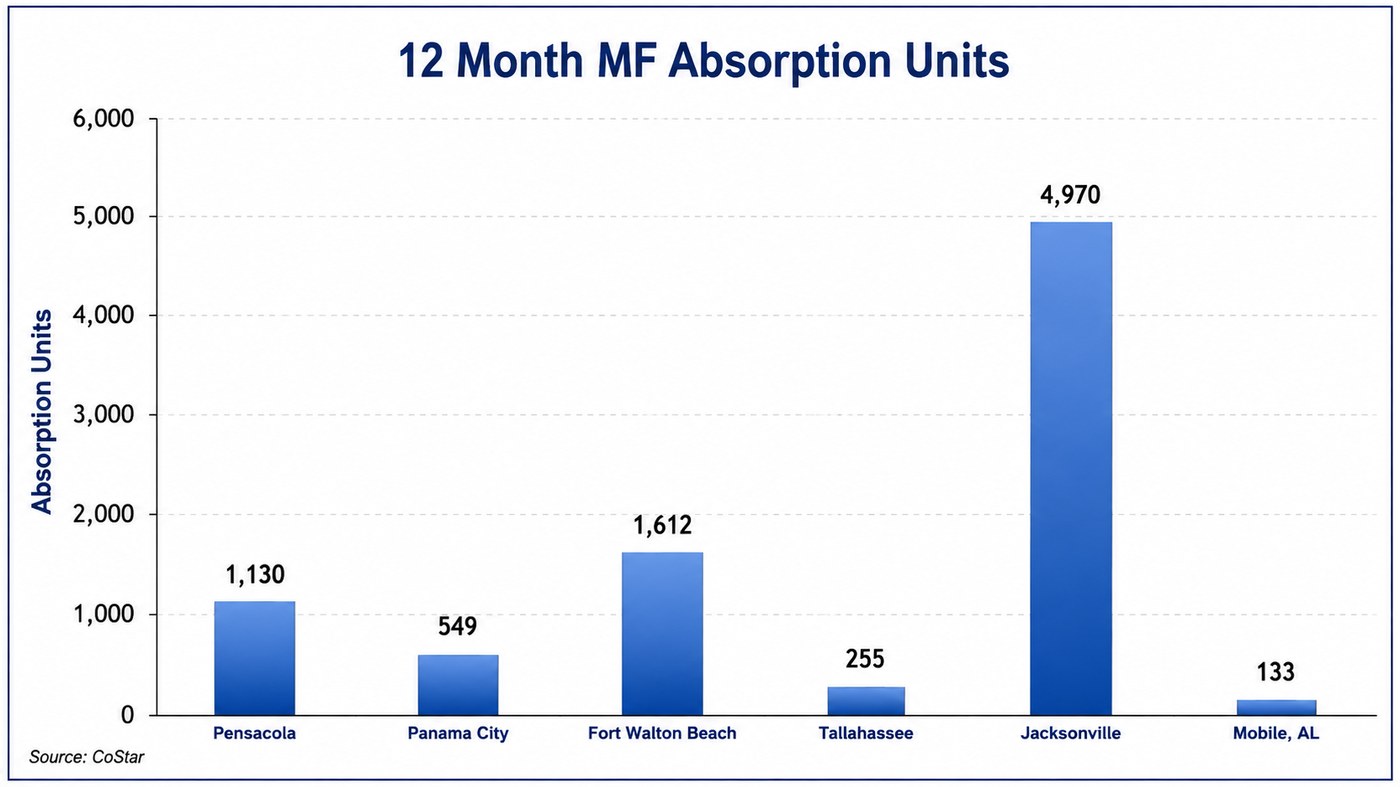
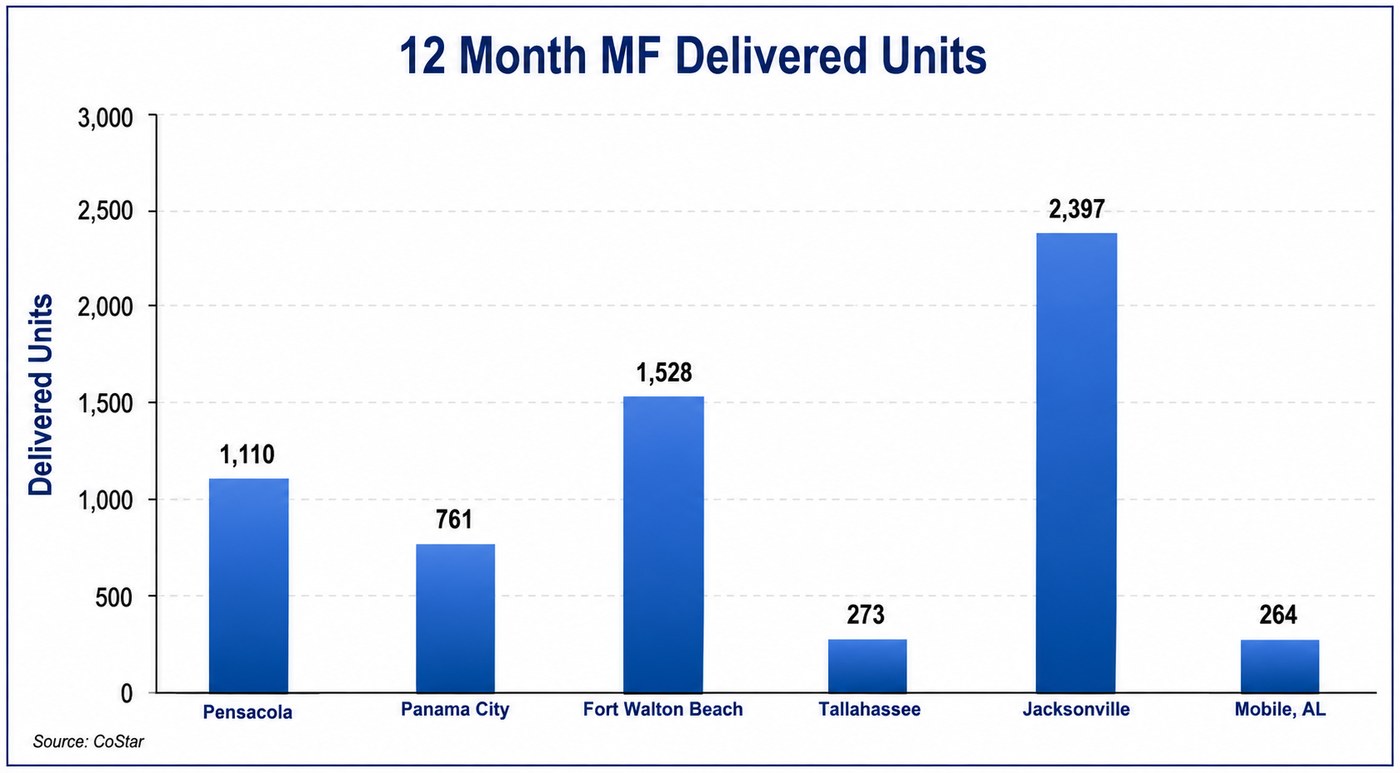
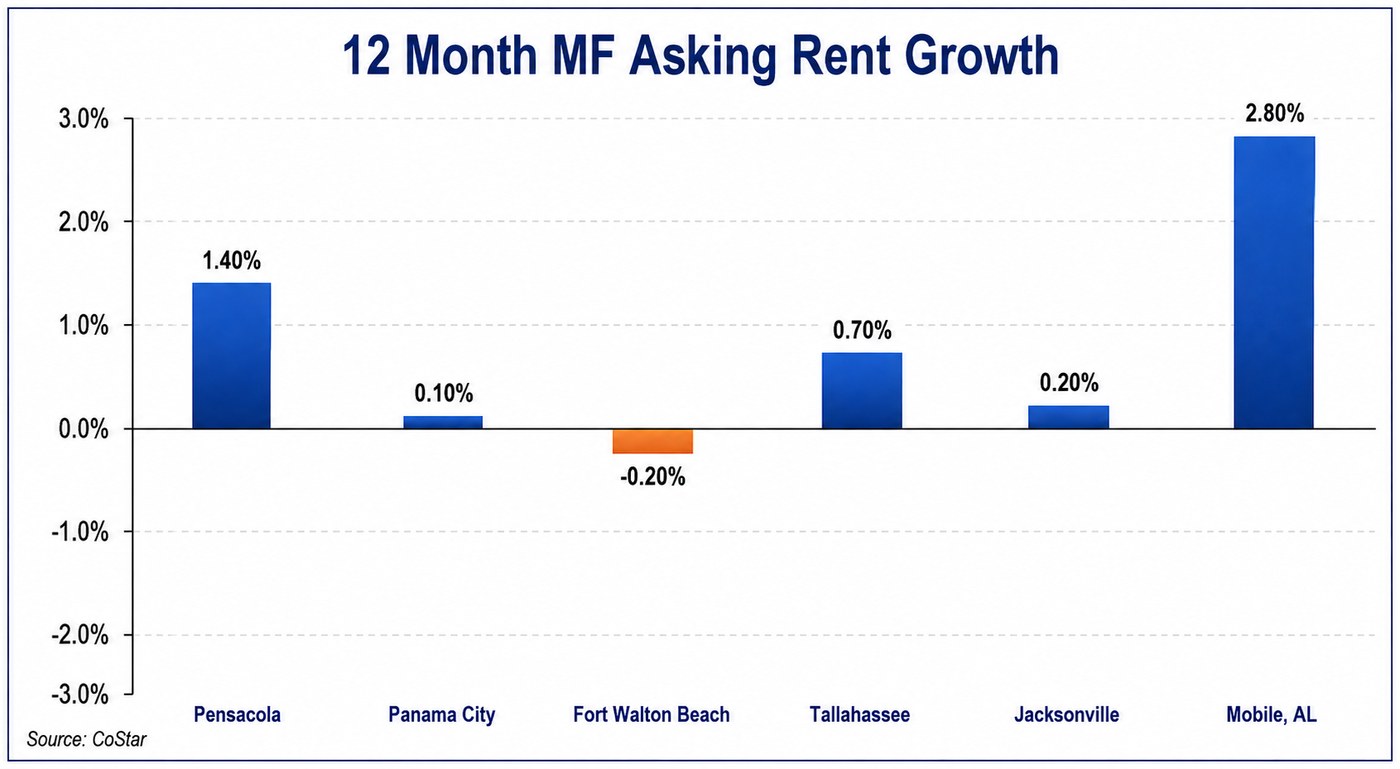
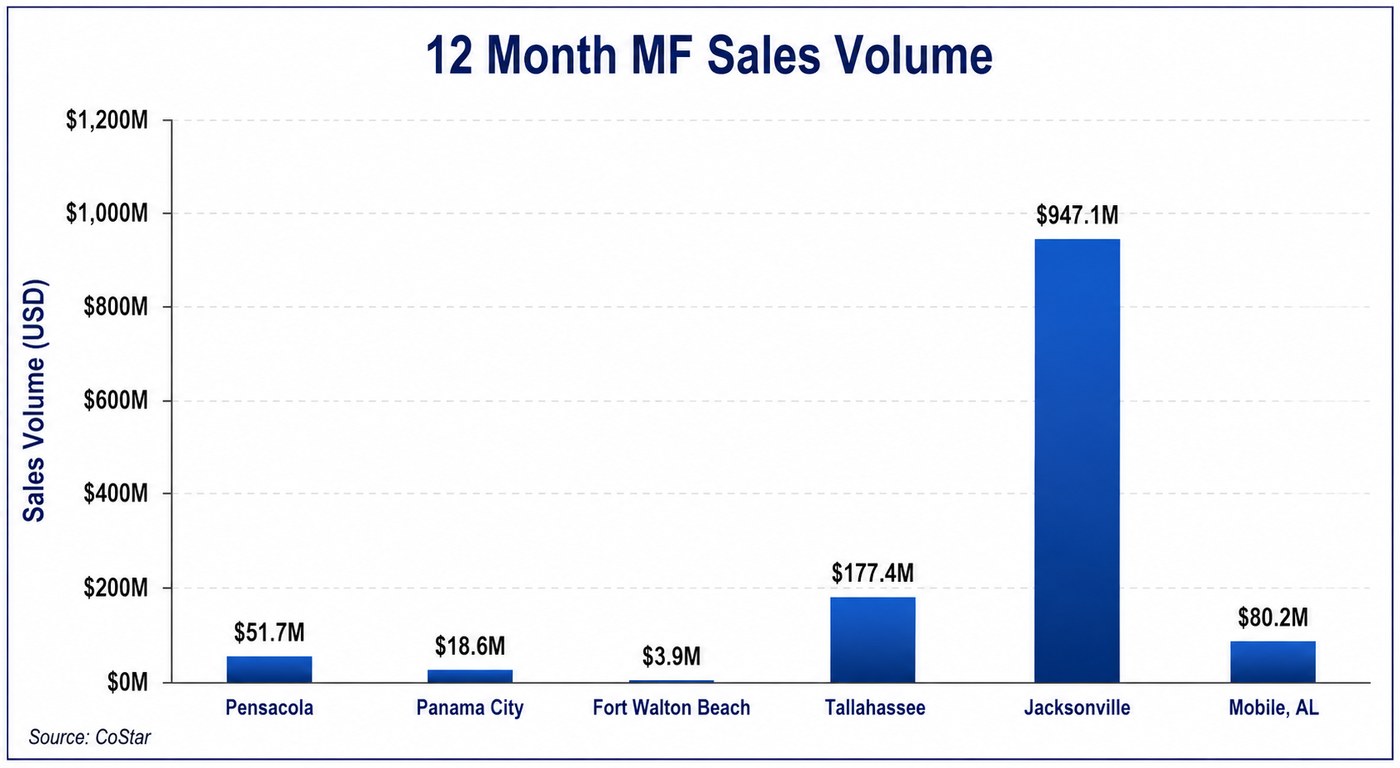
- Pensacola continues to demonstrate one of the region's strongest multifamily fundamentals, pairing the lowest cap rates with positive absorption, declining vacancy, and steady rent growth—reflecting sustained investor demand.
- Fort Walton Beach leads the region in asking and effective rents, but elevated vacancy and declining rent growth suggest new supply is temporarily outpacing demand.
- Jacksonville remains the state's most active multifamily market, with the highest sales volume, construction pipeline, and absorption, though recent vacancy declines indicate demand is keeping pace with new deliveries.
- Panama City and Tallahassee remain relatively balanced markets, supported by moderate vacancy, limited new development, and stable cap rates.
- Mobile offers the highest multifamily cap rates but the weakest pricing fundamentals, suggesting investors can achieve higher yields in exchange for slower rent growth and lower transaction activity.
Overall Takeaway
Market conditions continue to favor owners of well-located, high-quality assets. Limited new supply and resilient demand are supporting occupancy and rent growth across much of Northwest Florida, while larger markets work through greater development activity. Property owners who prioritize leasing, asset improvements, and proactive management should be well-positioned to preserve value and capitalize on future growth opportunities.
The best investment opportunities often emerge before they reach the broader market. Join our investor network to receive exclusive access to off-market listings, market intelligence, and acquisition opportunities throughout Northwest Florida.
Join our investor network and stay ahead of the market: Investment Partnerships.