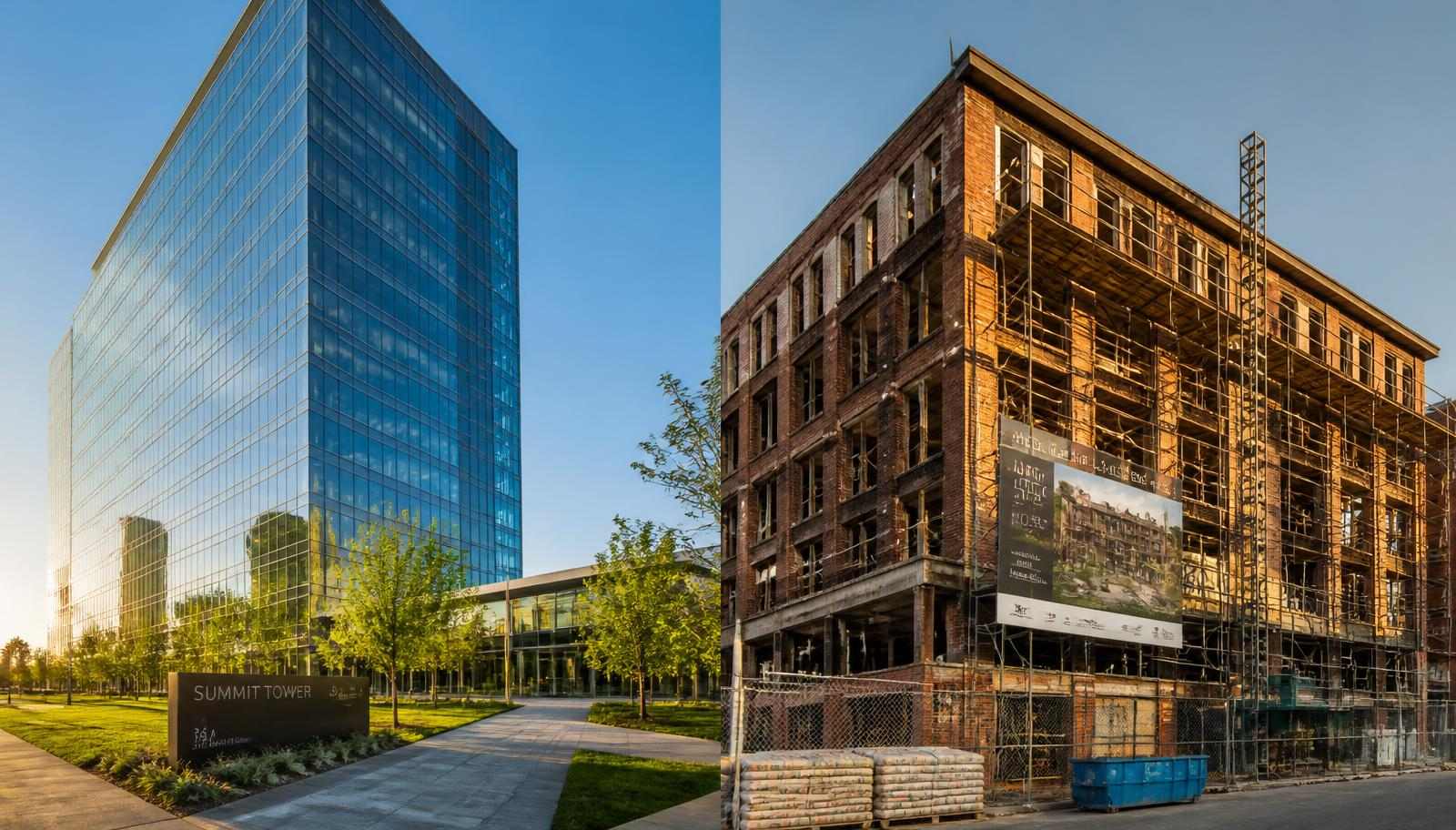
What Makes a Commercial Property Truly Value-Add?
A commercial property is truly value-add when it has a specific, underwritten path to higher net operating income (NOI)—not merely a dated lobby, a vacant suite, or a seller’s optimistic story. A value add property opportunity can combine a fixable income gap, a realistic improvement budget, and a clear plan to stabilize the asset at a higher value.
In other words, value add commercial real estate is not about buying “a project.” It is about buying an underperforming asset where the cost to improve it is meaningfully lower than the income and valuation it can create. CBRE Investment Management describes value-add investing as active management that grows NOI through renovation, repositioning, leasing vacant space, and operational improvements.
What a value add property really means
A value-add property usually has existing income, but it is not performing at its full potential. The gap may come from below-market rents, vacancy, weak management, deferred maintenance, outdated space, or a tenant mix that no longer fits the market.
The essential test is simple:
Value created = stabilized value − purchase price − improvement costs − carry costs
If that spread is large enough to compensate for construction risk, leasing risk, and time, the deal may be genuinely value-add. If the rent increase is speculative or the renovation budget is unsupported by market evidence, it is more likely a hope than a business plan.
NOI Is the Engine of Value
Commercial property valuation is largely driven by NOI. A simplified income-approach formula is:
Property value = net operating income (NOI) ÷ cap rate
NOI increases when a property earns more revenue or spends less to operate. Because value is capitalized from NOI, even modest income improvements can create outsized valuation gains.
A higher NOI can support a higher income-based valuation if the cap rate stays unchanged. That assumption needs testing: financing conditions, tenant risk, and market pricing can change the cap rate and offset part of the projected gain.
Signs of a True Value-Add Opportunity
Not every older or partially vacant building is a value-add deal. Potential CRE investment opportunities show a clear gap between current performance and achievable performance.
Look for properties with:
- Below-market rents: Existing leases are materially under current market comparables and can be reset at renewal or expiration.
- Vacancy or lease-up upside: The property has demand-supported space that can be leased at realistic rents.
- Deferred maintenance: Roof, HVAC, parking, lighting, façade, or systems issues are identifiable and cost-effective to correct.
- Operational inefficiency: Vendor contracts, utilities, staffing, or management practices can be improved without harming tenant experience.
- Weak tenant mix: The property can be re-tenanted to stronger credits, complementary uses, or higher-demand industries.
- Mispositioned space: The building can be reconfigured, subdivided, or repositioned to meet current tenant demand.
- A realistic basis: The purchase price leaves room for capital costs, downtime, leasing commissions, and contingencies.
A property with strong fundamentals but poor execution is often more attractive than a property in a weak location with a beautiful renovation plan. Location, demand, visibility, access, and submarket fundamentals still matter.
Commercial Property Repositioning
Commercial property repositioning is the active process of changing a property’s physical condition, tenant mix, market perception, or use to capture income it is not currently achieving. It is the execution layer behind many value-add strategies.
Repositioning can be light or heavy:
- Light repositioning: Signage, façade refresh, landscaping, lighting, parking improvements, lobby upgrades, and better property management.
- Moderate repositioning: Renovating suites, improving common areas, upgrading HVAC or electrical systems, and attracting a stronger tenant profile.
- Heavy repositioning: Major renovation, re-tenanting, subdivision of large spaces, or conversion to a different use.
CBRE identifies a spectrum from operational improvements to renovation, major repositioning, and change-of-use strategies. As the scope becomes more aggressive, risk generally rises as well.
Commercial Property Improvements That Create Value
Useful commercial property improvements do more than make a building look better. They either increase revenue, reduce expenses, improve tenant retention, or make the asset easier to lease.
High-impact improvements may include:
- Renovating lobbies, restrooms, corridors, and common areas
- Upgrading façades, signage, lighting, and curb appeal
- Improving HVAC, roofing, electrical capacity, and building systems
- Adding spec suites, flexible floor plates, or divisible space
- Enhancing parking, loading, truck access, or site circulation
- Installing energy-efficient lighting, controls, and HVAC equipment
- Creating ancillary income through storage, parking, signage, or service space
- Re-tenanting with complementary businesses that improve traffic and lease economics
The key question is always: Will this improvement produce rent, occupancy, expense savings, or tenant retention that exceeds its cost? If not, it may be maintenance or preference spending—not value creation.
The Role of Commercial Asset Management
Commercial asset management turns a value-add thesis into results. A strong asset manager reviews the rent roll, lease terms, operating expenses, capital needs, leasing strategy, and market positioning, then adjusts the plan as performance evolves. See educational resources from the CCIM Institute for commercial investment analysis.
Effective commercial asset management focuses on:
- Marking rents to market as leases roll
- Reducing vacancy and shortening downtime
- Improving collections and reducing credit loss
- Negotiating vendor and service contracts
- Auditing CAM recoveries and expense pass-throughs
- Prioritizing capital improvements with measurable ROI
- Tracking occupancy, rents, expenses, and leasing velocity
- Preparing the asset for refinancing or sale once stabilized
This is why value-add investing is more active than core investing. The investor is not simply collecting rent; they are managing a business plan designed to force appreciation through improved NOI.
Value-Add vs. Opportunistic
Value-add sits between core and opportunistic investing. Core assets are typically stabilized, well-leased, and lower risk. Opportunistic deals often involve ground-up development, severe distress, major entitlement risk, or a complete change of use.
A true value-add property generally has:
- Existing income or a clear path to income
- An existing permitted use and building infrastructure
- Identifiable physical or operational deficiencies
- A market-supported plan to increase NOI
- Moderate leverage and a defined exit strategy
If the property has no current income, requires entitlement, needs a complete redevelopment, or depends on a major use change, it may be better classified as opportunistic rather than value-add.
How to Underwrite a Value-Add Deal
Before pursuing a value-add acquisition, underwrite the downside as carefully as the upside. A credible plan should include verified rents, supported market comparables, contractor pricing, lease-up timelines, carry costs, and contingency reserves.
A disciplined underwriting checklist should include:
- Current rent roll, leases, and expiration schedule
- Market rent comparables and absorption data
- Property condition assessment and capital needs budget
- Renovation scope, hard costs, soft costs, and contingency
- Lease-up assumptions, downtime, tenant improvements, and commissions
- Operating expense audit and stabilization assumptions
- Debt structure, interest reserve, and refinancing risk
- Exit scenarios at conservative, base-case, and downside cap rates
Common value-add mistakes include underestimating construction costs, assuming rapid lease-up, ignoring carry costs, and paying too high a basis at acquisition. Set contingency reserves using the property condition assessment and contractor estimates rather than a generic allowance.
The Bottom Line
A commercial property is truly value-add when it has a curable income problem, a market-supported business plan, and enough spread between total cost and stabilized value. Cosmetic upgrades alone do not create value; NOI growth does.
Disciplined value-add investors identify the gap, price the solution, execute efficiently, and manage the asset until the income supports a higher valuation. If you are evaluating CRE investment opportunities in Northwest Florida, focus less on what a property looks like today and more on what its income can become with the right plan.
Talk to a broker or Request a valuation to discuss your property and the assumptions behind its value-add plan.